
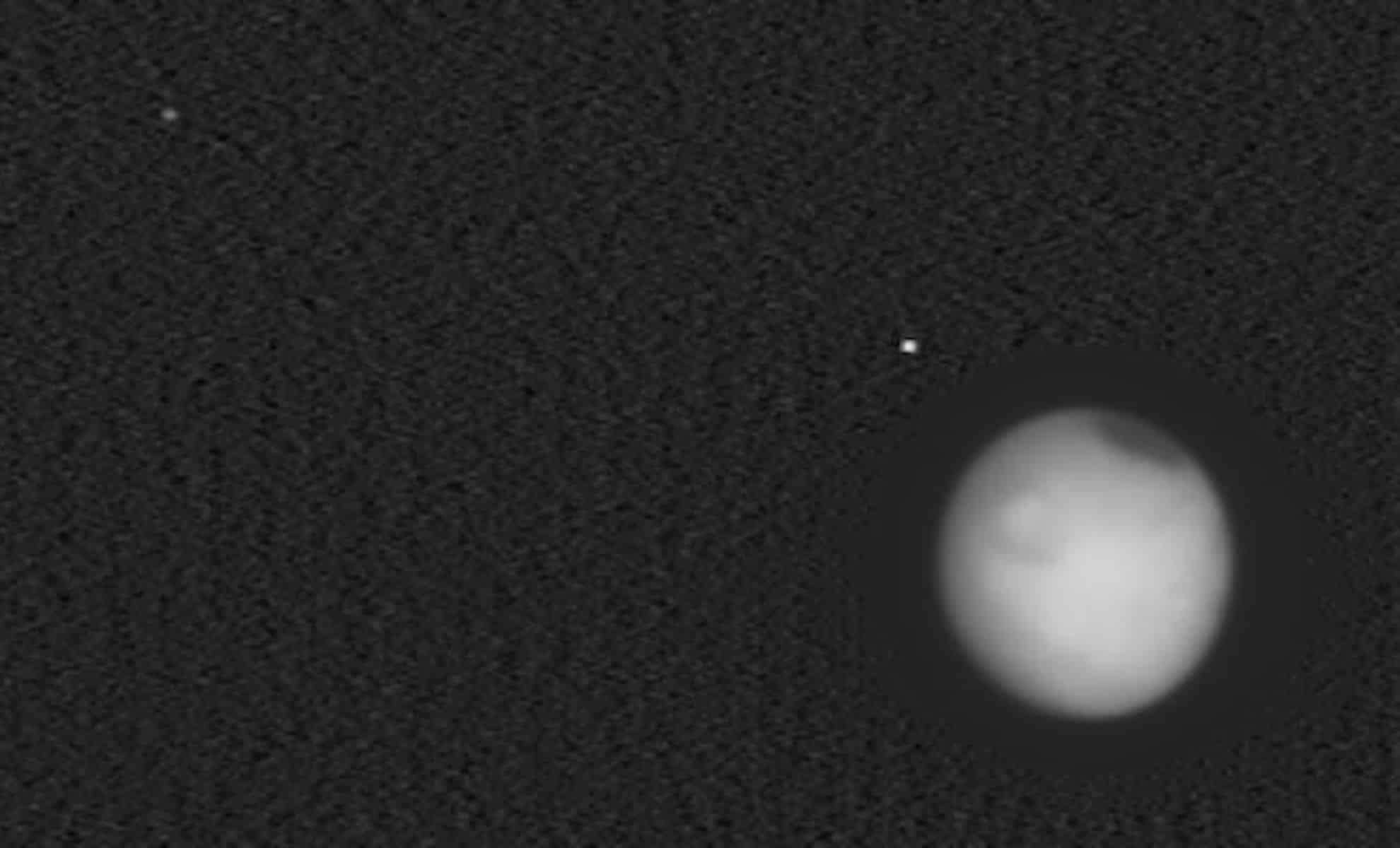
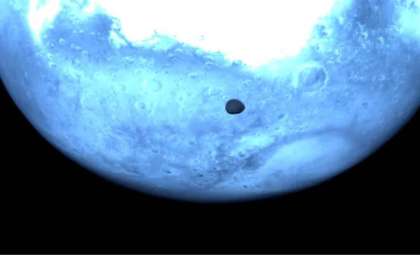
During its expedition toward Jupiter, NASA’s Europa Clipper spacecraft captured an extraordinary infrared image showcasing Mars alongside its two natural satellites, Phobos and Deimos, all visible within a single frame. This uncommon alignment delivers a vivid portrayal of these Martian moons, enhancing our understanding of these lesser-known celestial bodies through thermal imaging. The Europa Clipper, originally tasked with studying Europa, Jupiter’s ice-covered moon, utilized its thermal cameras to conduct an early experiment en route. Captured from a distance exceeding 560,000 miles, this image marks a notable milestone, providing fresh insight into Mars and its moons and underscoring the spacecraft’s advanced technological capabilities.
Viewing Mars and Its Moons: A Journey Into the Solar System’s Depths
While primarily designed to analyze Europa’s icy crust and subsurface ocean, the Europa Clipper deviated slightly to observe Mars. On February 28, its infrared sensor, the Europa Thermal Emission Imaging System (E-Themis), captured 200 frames over 20 minutes, which were subsequently combined to create a seamless image of Mars and its moons illuminated in infrared light.
This compelling infrared snapshot centers on Mars, accompanied by its moons—Phobos, the larger and closer moon, and Deimos, smaller and farther away. The image highlights the heat emitted by all three bodies, with Mars shining the brightest. The moons appear dimmer, with Deimos visible as a tiny spot toward the upper left and Phobos positioned near Mars, offering a clear thermal contrast.

The photograph not only captures a rare celestial event but also serves as crucial data to assess the spacecraft’s thermal imaging system, essential for studying Europa. As it moves closer to Jupiter, the Europa Clipper’s sophisticated instruments will help NASA examine the moon’s icy shell and the potential for habitability beneath its surface.
Infrared Vision: Unveiling the Thermal Signatures of Martian Neighbors
A standout feature of this capture is the deployment of infrared detection, which allows observation of heat instead of visible light. The E-Themis camera was instrumental in detecting thermal emissions from Mars and its two moons. These infrared images provide scientists with a novel way to analyze characteristics hidden from traditional optical telescopes.
Securing this image presented many challenges, due to the vast distance of over 560,000 miles between the Europa Clipper and Mars. To highlight the faint thermal glow of the moons, which are roughly 250 times dimmer than Mars’s heat signature, image brightness was enhanced during processing. This approach grants a distinctive opportunity to observe Mars’s moons with clarity not attainable by conventional viewing methods.
Beyond the visual appeal, this infrared data enriches scientific understanding of the thermal behavior of Mars, Phobos, and Deimos, contributing valuable knowledge about their physical properties and shaping future exploration efforts.
Unraveling Mysteries of Mars’ Small Moons: Phobos and Deimos
Phobos and Deimos remain among the solar system’s most enigmatic satellites despite their close proximity to Mars. Phobos measures approximately 14 miles across and completes three orbits around Mars daily, whereas Deimos is smaller—about 7 to 8 miles wide—and takes roughly 30 hours to orbit the planet. Their irregular shapes and diminutive sizes have fueled various theories about their origin.
Scientists debate whether these moons are captured asteroids or debris remnants from a massive impact on Mars that occurred billions of years ago. Despite extensive observations, their histories have yet to be conclusively determined.
The image from the Europa Clipper offers a unique chance to view both moons simultaneously alongside Mars. The last comparable image was taken by the 2009 Mars Express mission, making this latest infrared capture a fresh look from a new vantage point.
Enhancing Space Missions Through Gravity Slingshots
A notable aspect of the Europa Clipper’s trajectory involves the use of gravity assists, a maneuver that leverages a planet’s gravitational force to boost velocity and redirect the spacecraft. In March, Mars provided such a slingshot, altering the spacecraft’s course toward the farther reaches of the solar system. This approach conserves fuel and enables the craft to gather valuable scientific data during planetary flybys.
This Mars encounter also offered an opportunity to test the spacecraft’s instruments. By imaging the Mars-Phobos-Deimos system, the Europa Clipper confirmed the functionality of its thermal cameras, which will be critical when it arrives at Jupiter in 2030. At that time, it will perform multiple flybys of Europa to probe its surface and interior, aiming to assess its habitability potential.
- Categories:
- News





0 comments
Sign in to Comment