
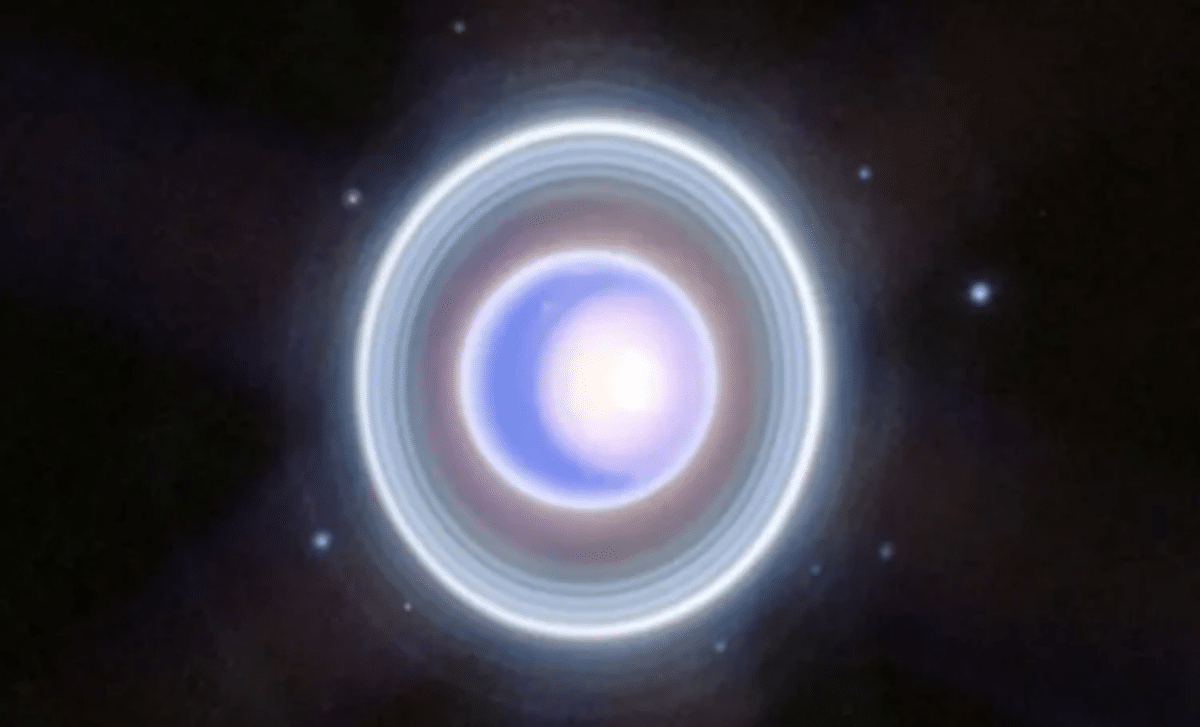
A novel mission proposal unveiled at the 57th Lunar and Planetary Science Conference aims to deepen our understanding of Uranus’ icy secrets. The CASMIUS (Coupled AtmosphereS and Magnetosphere Interactions of the Uranus System) mission concept is poised to provide crucial insights into this distant world, which has remained largely mysterious since Voyager 2’s flyby in 1986. As space exploration advances, CASMIUS stands out as a possible flagship endeavor that could transform our knowledge of Uranus and the wider solar system.
CASMIUS Mission: Charting New Frontiers in Uranus Exploration
CASMIUS is a mission concept designed by Dr. Hadi Madanian, a Research Scientist and founder of Earth and Planetary Exploration Sciences LLC (Epex Scientific), sparking renewed enthusiasm in the scientific community. Uranus, often neglected due to its remote location and great distance from the Sun, harbors many scientific puzzles. Its unique sideways spin, distinctive magnetic field, complex ring system, and intriguing moons make it an exceptionally fascinating, yet understudied, member of the solar system.
During the 57th Lunar and Planetary Science Conference, Dr. Madanian introduced a plan involving two spacecraft that would operate in coordination to gather comprehensive data on Uranus’ atmosphere, magnetic environment, rings, and satellites. Unlike earlier missions, this concept stresses how CASMIUS could provide an exhaustive study of Uranus’ intricate system, addressing many open questions left since Voyager 2’s brief visit. While the mission’s specific mode—orbiter or flyby—is yet to be determined, the approach promises a major leap in planetary science.

Uranus: An Ice Giant Still Wrapped in Mysteries
Though one of the solar system’s largest planets, Uranus remains largely unexplored due to its vast distance from Earth. The only close encounter to date was Voyager 2’s 1986 flyby. As highlighted by Universe Today, Voyager 2’s discoveries included identifying 10 previously unknown moons, two additional rings, and the planet’s unusual magnetic orientation. Despite these milestones, the mission’s swift passage left many fundamental questions unanswered.
Scientists remain captivated by Uranus’ rings and moons due to their remarkable characteristics. The planet’s tilted rotational axis causes its moons to orbit at extreme angles, challenging existing models of planetary behavior and offering potential insights into ice giant formation and evolution. CASMIUS, with its twin-spacecraft strategy, is uniquely positioned to investigate the connections between Uranus’ magnetic field and its complex system of rings and moons.
CASMIUS’ Promise: Revealing the Mysteries of Uranus’ Magnetic Field
A central focus of the CASMIUS mission is to decode the unusual magnetic field of Uranus. Unlike most planets, Uranus’ magnetic field is both tilted and offset from its center, indicating an uncommon internal structure that remains poorly understood. This research underscores the significance of probing such a complex magnetic environment since it may illuminate the fundamental processes behind planetary magnetic dynamos.
“The study notes, ‘Understanding the complexities of the Uranus system opens a new window to understanding the solar system formation, planetary dynamo, and exoplanet research,'” said Dr. Madanian.
Investigating Uranus’ magnetic interactions could extend scientists’ understanding not only of the ice giant itself but also of the underlying mechanisms that shape magnetic fields across the solar system and beyond. This knowledge could even shed light on Earth’s geomagnetism, enhancing comprehension of the planet’s core dynamics and how they influence climate and atmospheric conditions.
- Categories:
- Nasa





0 comments
Sign in to Comment