
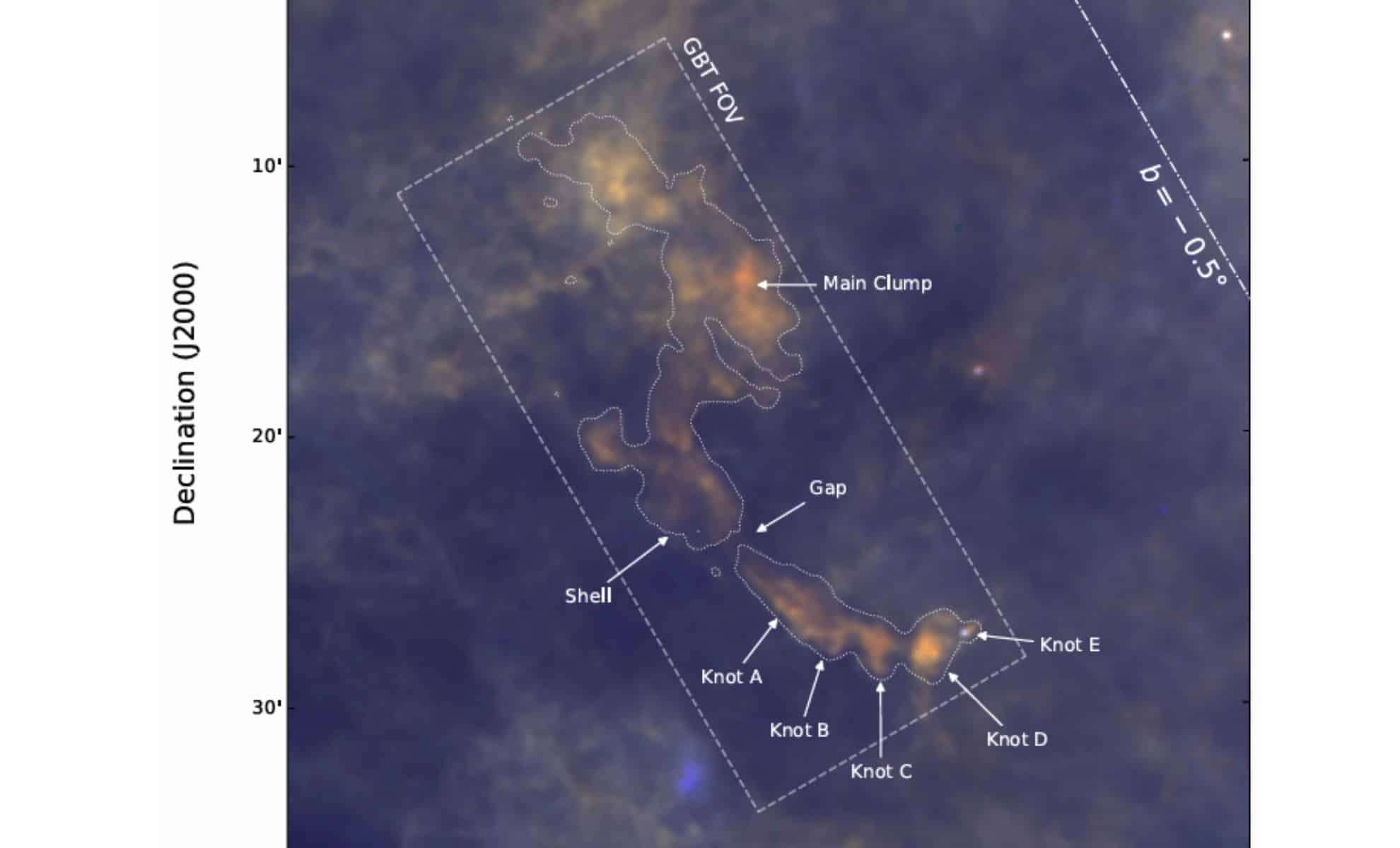
Astronomers have unveiled a previously unknown giant molecular cloud (GMC) within our Milky Way, shedding fresh light on the galaxy’s intricate structure and star-forming activity. Known as M4.7-0.8, this cloud was observed through the capabilities of the Green Bank Telescope (GBT). It is situated roughly 23,000 light years from Earth, positioned centrally along a dusty lane within the Milky Way’s bar.
Stretching approximately 195 light years in length with a vertical span of about 65 light years, M4.7-0.8 ranks among the largest molecular clouds discovered to date. Holding an estimated mass near 160,000 times that of our Sun, it mainly consists of cold molecular hydrogen gas, with dust temperatures around 20 Kelvin. This finding was detailed in a study released on March 18, 2025, on the arXiv preprint server.
Molecular clouds like this serve as stellar nurseries, containing cold gas and dust where new stars are born. In particular, giant molecular clouds are essential to our comprehension of star creation and the broader processes governing galaxy evolution.

Distinctive Attributes of M4.7-0.8
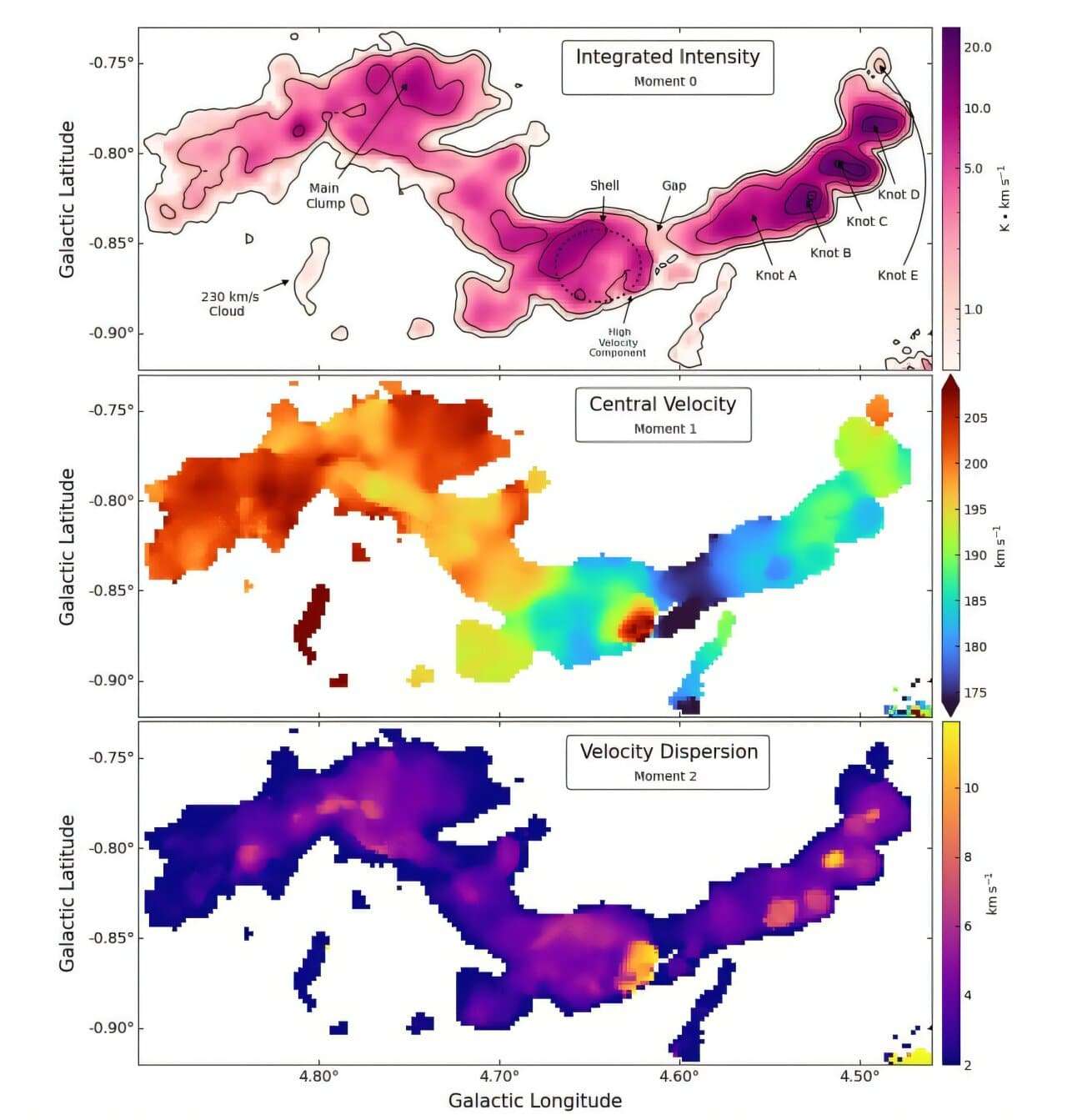
The researchers identified two prominent structures within the M4.7-0.8 cloud: the "Nexus" and the "Filament." The Nexus corresponds to the cloud's most luminous carbon monoxide (CO) emissions and marks the densest central region. Extending from this is the Filament, a slender, thread-like formation commonly seen in areas undergoing star formation, as described in similar star-forming environments.
Additionally, specific regions within the cloud called Knot B and Knot E have been identified as promising sites for potential star birth. Notably, Knot E exhibits a comet-shaped appearance and might represent a freely drifting evaporating gas globule, a phenomenon warranting deeper future analysis.
Furthermore, the cloud displays a shell-like formation highlighted by a bright rim observed in ammonia emissions, featuring a hollow center. This kind of structure is of great interest as it may be linked to active star formation or other astrophysical processes occurring within the cloud.
Implications of the Finding
Uncovering M4.7-0.8 adds critical knowledge about the Milky Way’s central bar region dynamics. Dust lanes within this galactic bar are key channels funneling gas and dust inward toward the galactic core, leading to the buildup of dense rings that drive vigorous star formation.
By investigating clouds such as M4.7-0.8, astronomers gain a better grasp of star formation mechanisms and broader galactic evolution. These dense molecular regions are believed to be the origin points of stars including our own Sun. Therefore, such studies are vital to piecing together the complex history and development of galaxies.
This discovery also paves the way for enhancing our understanding of interstellar medium evolution, especially regarding how molecular clouds develop over time and act as cradles for emerging stellar systems.
- Categories:
- News




0 comments
Sign in to Comment