
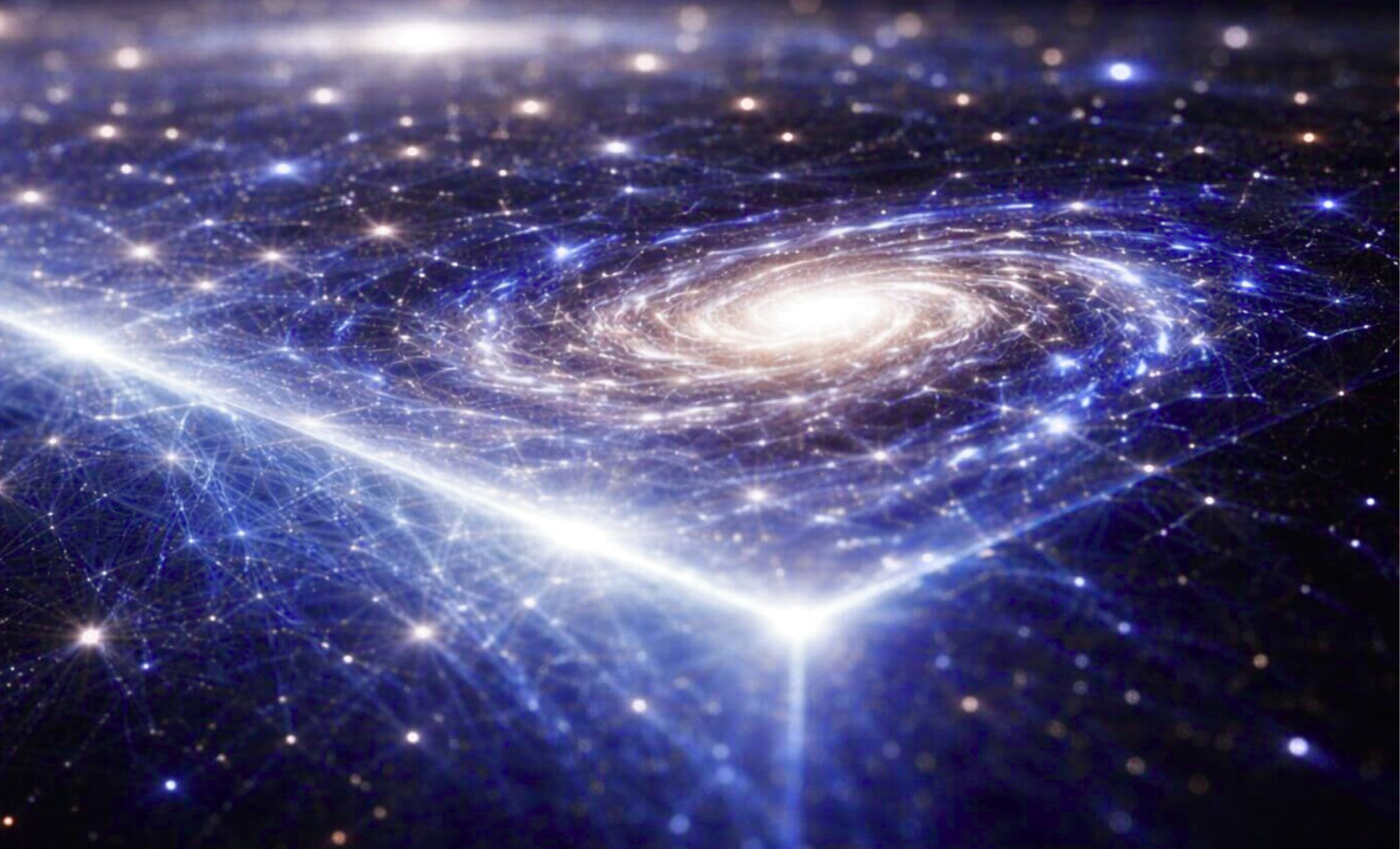
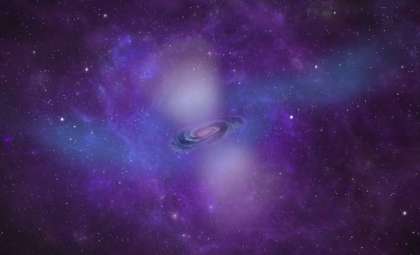
Advanced high-resolution simulations have provided a novel perspective on the Milky Way’s cosmic environment. Instead of being surrounded by a uniform halo, our galaxy is positioned within a vast, planar formation dominated almost entirely by dark matter.
This discovery offers fresh insight into a long-standing puzzle: why do galaxies near the Milky Way move away more slowly than predicted based on the Local Group’s calculated mass? Previous spherical mass models failed to accurately explain this, leaving discrepancies between expected and observed galactic motions.
Scientists now propose that a colossal dark matter sheet stretching over tens of millions of light-years is responsible for these unusual dynamics. This flat structure corresponds well with the measured velocity field and matches large-scale galaxy arrangements surrounding our galaxy.

Published in Nature Astronomy in early 2026, the research combines observed data with cosmological modeling to challenge traditional views on the Milky Way’s mass distribution.
Revealing a Hidden Dark Matter Structure Around Our Galaxy
The investigation, spearheaded by Ewoud Wempe from the Kapteyn Astronomical Institute, employed the Bayesian Origin Reconstruction from Galaxies (BORG) approach to simulate conditions around the Milky Way. By generating 169 variations of a Local Group analog based on cosmic microwave background data and tracking 31 proximal galaxies, the team found compelling results.
A vast flat dark matter formation spanning over 10 megaparsecs (approximately 30 million light-years) was identified. This structure has a central plane with a density nearly twice that of the cosmic mean and sparse voids above and below. Its existence changes local gravitational forces in ways that accurately reproduce the unusual velocity patterns recorded near the Milky Way.
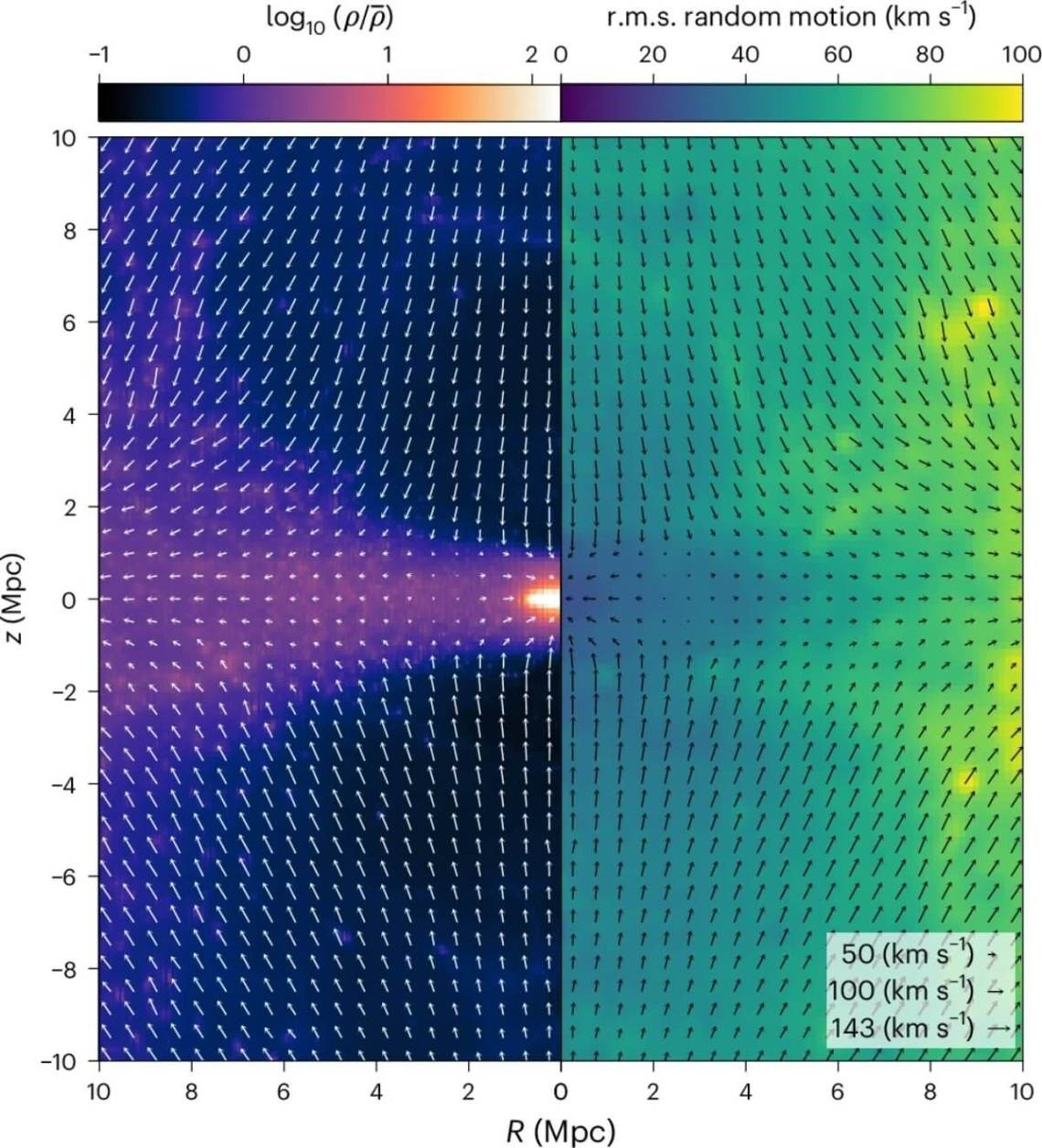
This configuration impacts gravitational pull distribution. Within this setup, more distant mass along the plane exerts forces that reduce inward velocities toward the Local Group’s core, explaining why nearby galaxies move more gradually than predicted by a spherical distribution model.
Simulated visualizations demonstrated the dark matter sheet closely follows the Supergalactic Plane, a known galactic structure defined by luminous galaxies. The overlap between inferred dark matter mass and visible galaxy positions strengthens the idea that ordinary matter roughly traces the dark matter framework.
Resolving Long-Standing Mass Discrepancies Through Dark Matter Distribution
For decades, astronomers have used the timing argument to gauge the Local Group’s mass, modeling the Milky Way and Andromeda (M31) as a binary system that formed after the Big Bang. Mass estimates from this approach, first introduced in 1959, consistently clashed with observed galaxy motions nearby.
Attempts to incorporate additional neighboring galaxies still assumed a spherical mass layout, usually estimating the Local Group’s mass between 1.3 and 2.3 trillion solar masses. However, these values failed to justify the particularly slow speeds at which galaxies just outside the group’s edges are retreating.
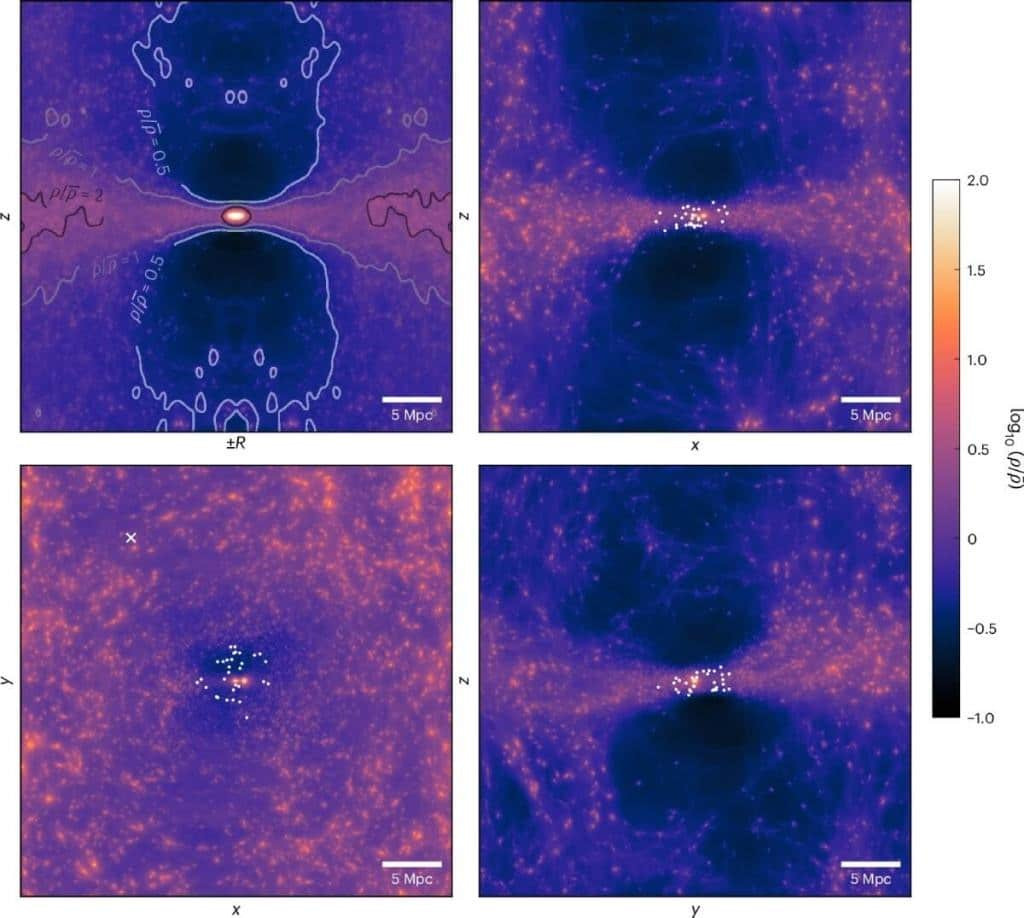
The new sheet model resolves these inconsistencies. The simulations suggest the Local Group’s combined mass is 3.3 ± 0.6 trillion solar masses, but this only accounts for part of the gravitational influence. The expansive dark matter sheet holds over four times this mass within a 4-megaparsec radius. While a spherical model with this much mass contradicts observed galaxy velocities, the sheet model successfully corresponds to observed motions and mass measurements.
Predicted velocity patterns within this dark matter plane also better fit real data, with speeds typically under 30 kilometers per second reflecting the “cold” local Hubble flow. Above and below the sheet, velocities rise as galaxies move toward the denser midplane, creating an anisotropic velocity field.
Dark Matter Sheets Reflected in Early Cosmic Structures
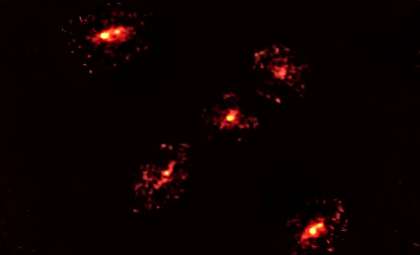
Dark matter planes are not exclusive to the Local Group. Using the Atacama Large Millimeter/submillimeter Array (ALMA), astronomers discovered enormous galaxies forming within dark matter-concentrated zones in the early universe. In 2017, scientists identified SPT0311-58, a pair of galaxies observed when the cosmos was only 780 million years old.
These galaxies existed within a dark matter halo with a mass of several trillion suns. Their intense formation activity and dense settings imply that dark matter sheets could be common in shaping galaxies throughout the universe’s history.
These parallels back the concept that planar dark matter structures not only influence present-day galactic motions but also helped shape early cosmic formations. Studies of such primordial systems further validate the model suggested for our Local Group as a universal phenomenon.
More details about early cosmic modeling and star formation appear in Phys.org’s coverage, which highlights ALMA’s contributions to understanding dark matter’s cosmic role.
Testing the Dark Matter Sheet Through Further Observation
Despite the close alignment of simulations with observations, the model’s verification is limited by current data. Most of the 31 galaxies used as tracers lie near the Supergalactic coordinate system plane, restricting insight into vertical inflow dynamics from the adjacent voids.
Researchers predict strong incoming flows above and below the sheet, with peculiar velocities exceeding 100 kilometers per second. However, confirming this awaits new observational data from isolated dwarf galaxies at high supergalactic latitudes within 5 megaparsecs.
The simulations cover a 40-megaparsec box and apply periodic boundary conditions, which might affect the large-scale alignment of structures. The team notes this could influence the sheet’s directional orientation but does not change its fundamental geometry or the velocity-data correlation.
- Categories:
- Space




0 comments
Sign in to Comment