
For centuries, the mystery surrounding how life began from nonliving elements on Earth has captivated researchers. A remarkable study by Robert G. Endres, published in July 2025, introduces cutting-edge mathematical tools and information theory to question longstanding perspectives on life’s beginnings. Endres’ paper, titled The Unreasonable Likelihood of Being: Origin of Life, Terraforming, and AI (arXiv), reveals significant mathematical challenges that indicate the spontaneous formation of life may be much less probable than previously believed. His findings prompt a reconsideration of the pathways through which life could have emerged from primordial chemistry.
The Role of Probability in Understanding Life’s Start
The traditional idea about how life began has relied on the concept of spontaneous generation — that life could arise naturally from nonliving substances under the right conditions. Endres’ analysis, however, highlights how improbably such an event could transpire. Using probability theory, he describes life’s emergence as akin to randomly typing letters and hoping to form meaningful sentences: the more complex the outcome, like a living organism, the lower the likelihood of success.
Simply put, the spontaneous assembly of a living entity demands not only chance chemical interactions but a highly ordered configuration of molecules. Under the tumultuous prebiotic Earth, producing such molecular precision is exceedingly improbable. Endres emphasizes the necessity of a system capable of both creating and maintaining this sophisticated information—something incredibly rare in natural conditions.

Applying Information Theory and Algorithmic Complexity
Central to Endres’ inquiry are two key frameworks: information theory and algorithmic complexity. Information theory examines the quantification and transmission of information, while algorithmic complexity relates to how complicated a system is based on the minimum description length required. These concepts are applied to protocells — primitive structures proposed as precursors to living cells. These early entities could sustain and replicate themselves. Endres models their emergence and demonstrates that the immense information load necessary for such structures makes their natural occurrence highly unlikely.
Algorithmic complexity measures the fewest steps to describe a system or process. Systems with greater complexity, such as living organisms, need more descriptive steps. Applying this to protocell formation, Endres indicates that the informational demands surpass what early Earth’s environment likely supported, making chance emergence implausible.
Obstacles to Life Arising from Random Processes
A major insight from Endres’ study is the challenge posed by disorder. Natural tendencies push systems toward increasing entropy instead of order. Life’s development, however, requires a well-organized setup to function and replicate. Without mechanisms encouraging order, assembling life from random molecular mixtures is severely hindered. Chemical reactions on primordial Earth were more apt to create random molecules than the precise structures essential for life.
Additionally, the limited duration of Earth’s early environment compounds the difficulty. Considering chaotic surroundings and the vast complexity even primitive life demands, Endres argues that random chemistry alone is unlikely to account for life’s origin within that timeframe.
Considering Alternative Origins: Panspermia and Directed Seeding
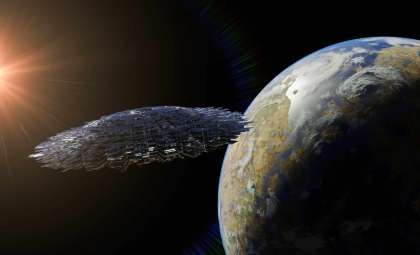
Although the research doesn’t entirely dismiss life’s natural emergence, it invites consideration of other explanations. One such idea is panspermia, which suggests life or its components may have arrived through comets or asteroids, originating elsewhere in the cosmos. Directed panspermia goes further, proposing that advanced extraterrestrials might have purposefully introduced life to Earth.
While these notions remain speculative, Endres finds them logically plausible, especially given the statistical obstacles highlighted in his study. Yet, he cautions that these hypotheses complicate Occam’s Razor, which favors simpler solutions. Hence, panspermia may not suffice as an explanation without stronger supporting evidence.
Charting New Terrain in the Quest for Life’s Beginnings
Endres’ work underscores a vital point: prevailing physical theories explaining life’s origins might be incomplete. The results imply that undiscovered principles or mechanisms could be involved in life’s emergence. This calls on scientists to broaden their perspectives beyond conventional models and explore innovative research directions. Whether that means investigating novel chemical pathways, probing quantum biology, or assessing external contributions like cosmic dust, Endres advocates for a more expansive and rigorous approach to understanding how life began.
- Categories:
- News



0 comments
Sign in to Comment