
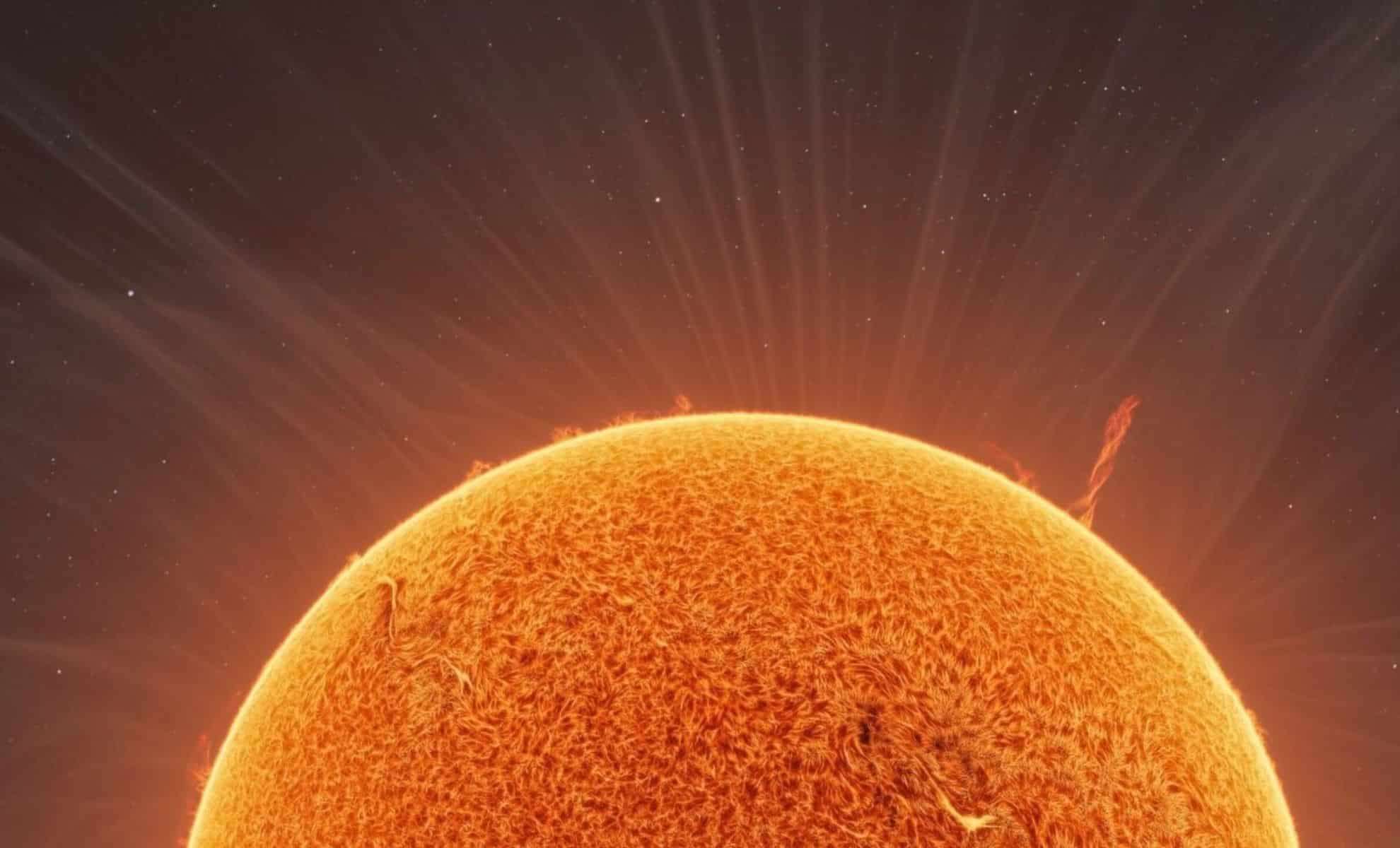
On Christmas Eve last year, NASA’s Parker Solar Probe achieved a groundbreaking feat by flying closer to the Sun than any previous spacecraft. At an astonishing distance of just 3.8 million miles (6.12 million kilometers) from the solar surface, the probe set a new proximity benchmark. Its Wide-Field Imager for Solar Probe (WISPR) captured extraordinary images revealing the intricate structure of the Sun’s corona, the outermost layer of its atmosphere, in unprecedented detail.
Exploring the Sun’s Energetic Outer Layer
Recently made public, these remarkable pictures expose the Sun’s corona as it endures relentless bombardment from powerful solar wind streams. They also document a captivating spectacle—several coronal mass ejections (CMEs) colliding at the edges of the Sun's magnetic environment. These vast expulsions of plasma and magnetic fields are vital to comprehending space weather, and observing their interactions offers fresh perspectives on CME dynamics.
“In these pictures, the CMEs are visibly layering upon each other,” explained Angelos Vourlidas, a WISPR engineer at Johns Hopkins Applied Physics Laboratory. Understanding how these solar eruptions combine is key for assessing space weather effects and safeguarding spaceborne and ground-based technology.

Enhanced Understanding of Space Weather Phenomena
During its close passage, the Parker Solar Probe collected high-definition data on solar wind behavior, critical for advancing space weather forecasting. This area of research is becoming increasingly important as solar winds and CMEs can interfere with Earth’s communication networks, satellite operations, and electrical grids.
Nicky Fox, associate administrator of NASA’s Science Mission Directorate, highlighted the mission’s importance: “Parker Solar Probe has once again brought us face-to-face with the vigorous environment of our nearest star.” Insights from these close-proximity images will sharpen our grasp of solar processes and enhance predictions of their potential impact on Earth.
Upcoming Close Approach to Yield More Discoveries
The exploration by Parker Solar Probe is ongoing. On September 15, 2025, the spacecraft is scheduled for another close solar encounter to collect even richer data. Joe Westlake, director of NASA’s Heliophysics Division, remarked, “The incoming data from this mission will offer novel insights into a region of space humanity has never directly explored.”
Each orbit brings Parker Solar Probe closer to unveiling the Sun’s complex nature, aiding both future deep space missions and the protection of vital technologies.
- Categories:
- News




0 comments
Sign in to Comment