

A newly uncovered fossil species from China provides an exceptional window into marine life shortly after Earth’s most devastating extinction event. This fossil exhibits extraordinary preservation, revealing strong jaws in a group typically known just from their shells.
Identified as Yunnanocyclus fortis, this species was discovered from three fossil specimens at the Guiyang biota, a fossil hotspot located in Guizhou province. Published in Papers in Palaeontology, these creatures lived during the Early Triassic period, about 251 million years ago, when ocean ecosystems were gradually recovering from the Permian-Triassic extinction.
Cyclidans, the group to which this species belongs, have remained largely mysterious due to a limited fossil record, often restricted to isolated carapaces. Xiaoyuan Sun and the research team emphasized that this scarcity of fossilized appendages has long concealed their complete anatomy, making each new find particularly valuable.

An Exceptionally Preserved Specimen
The crustacean fossils stand out because they preserve delicate body parts beyond the typical oval carapace, including sensitive structures like antennules, antennae, and seven pairs of thoracic segments.
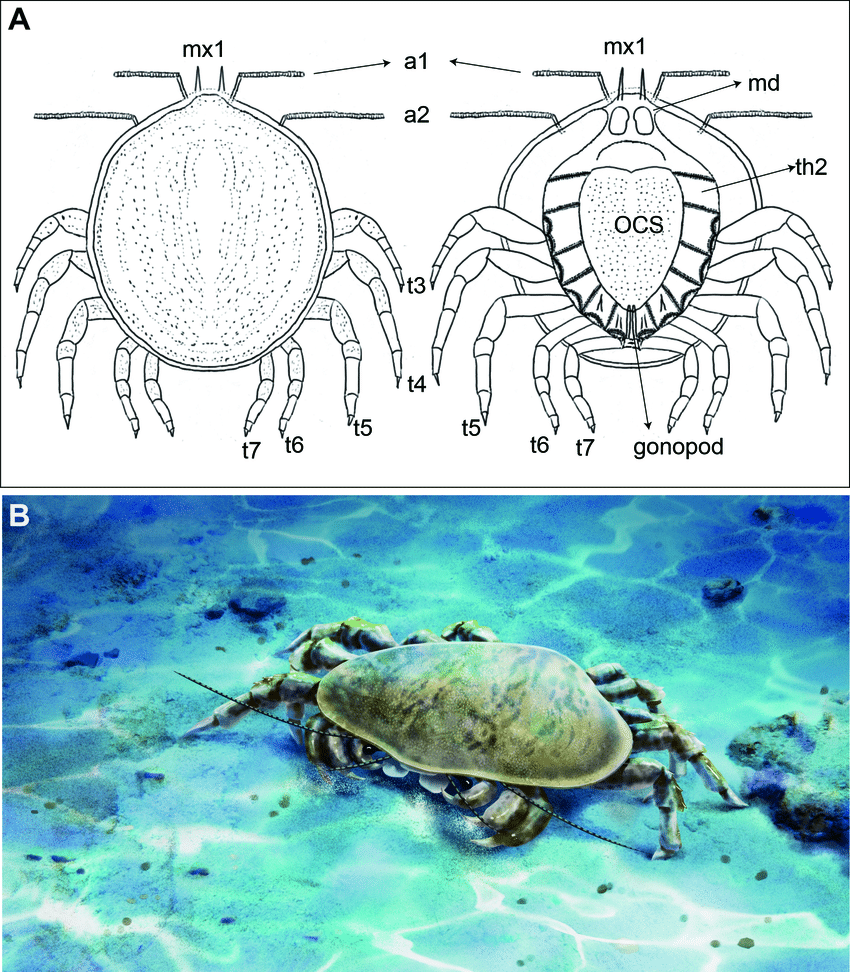
The researchers note that such remarkable preservation is rarely seen in cyclidans, where soft tissues generally do not fossilize. These observations cement their placement within Crustacea, supported by appendages such as mandibles and maxillipeds.
The holotype specimen measures approximately 19.8 mm long and 14.7 mm wide, providing an invaluable snapshot of the species’ physical traits.
Noteworthy Robust Mandibles
The most striking aspect of Yunnanocyclus fortis is its unusually strong pair of mandibles, a feature rarely preserved in this group. The jaws measure about 1.7 mm in length and 0.8 mm in width. Micro-X-ray fluorescence analysis revealed elevated levels of calcium and phosphorus in the mandibles and adjacent structures. According to the study, this suggests the jaws were heavily mineralized and robust.
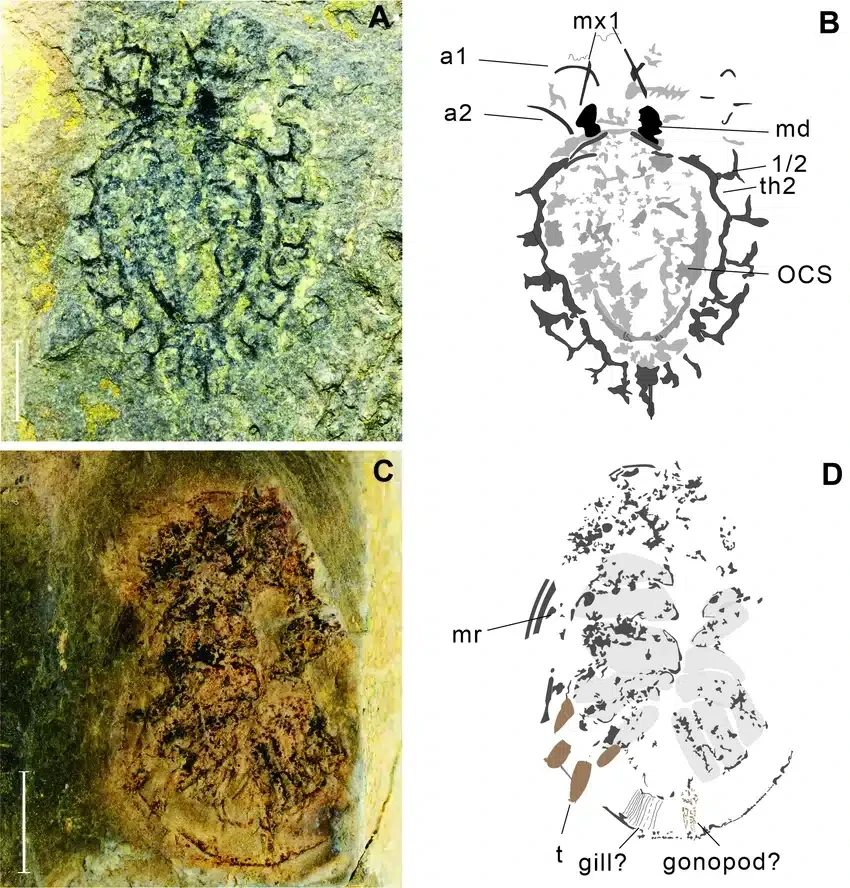
The team describes the mandibles as “strongly ovoid,” implying a role in processing tougher food materials, though no specific diet was determined.
“As an enigmatic and specialized group of crustaceans, they originated in the Mississippian (359 to 323 million years ago) and became extinct in the Late Cretaceous Maastrichtian (73 to 66 million years ago).” a team led by Dr. Xiaoyuan Sun of the China University of Geosciences, including researchers from China and the United States, reported.
Extending the Known Distribution of Cyclidans
Finding Yunnanocyclus fortis in China broadens the known geographic range for Early Triassic cyclidans, which were previously mainly recorded in Madagascar and parts of Europe. The new discovery marks the oldest record for this group in the eastern Tethys region.
“Our discovery of new species from China expands the known paleogeographic distribution of Early Triassic cyclidans,” the researchers, however, added that: “Early Triassic cyclidans are most widely distributed in Madagascar, Europe and China. By the Late Triassic, they were recorded only in Europe.”
Additionally, their analysis of morphological data allowed the team to reconstruct cyclidan diversity trends, revealing peak diversity during the Carboniferous followed by a decline. This supports the “early burst” evolutionary model.
Findings from the Guiyang biota further suggest that complex marine ecosystems reemerged sooner than expected, with cyclidans already spreading across diverse areas.
- Categories:
- Science






0 comments
Sign in to Comment