
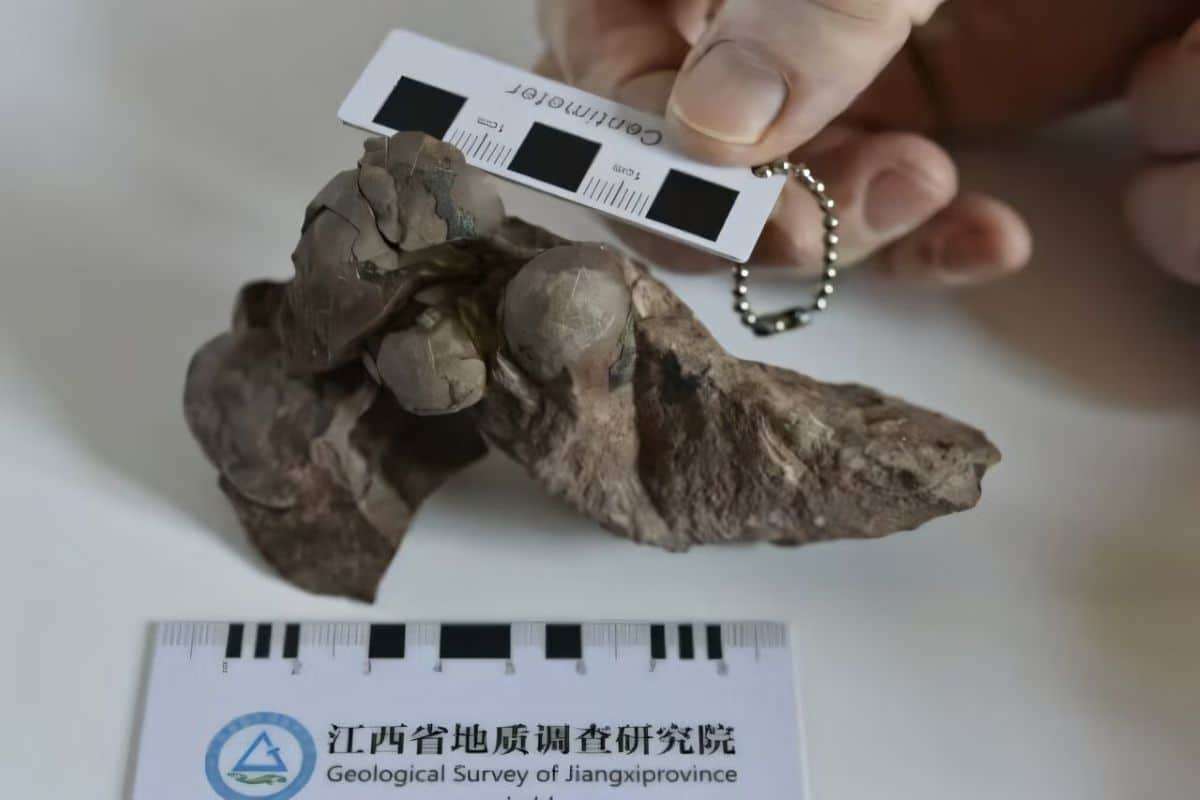
A remarkably small dinosaur egg fossil, measuring just 29 millimeters in length, was uncovered in Ganzhou, Jiangxi Province, China. This specimen is now recognized as the smallest fully intact dinosaur egg ever discovered.
Dubbed the Ganzhou Mini Egg, this fossil belongs to a never-before-identified species within the oval-shaped dinosaur egg group. This exceptional find provides fresh perspectives on dinosaur reproduction and evolutionary history.
An Unprecedented Paleontological Find
The Ganzhou Mini Egg is smaller than the previously smallest known dinosaur egg, the Jingguo Micro Ellipsoid Egg, found in Zhejiang Province, which measured approximately 45.5 mm × 40.4 mm × 34.4 mm. The fossil was excavated in 2021 at a construction site in Meilin, Ganxian District, by a research team led by Lou Fasheng, chief engineer at the Jiangxi Geological Survey and Exploration Institute.

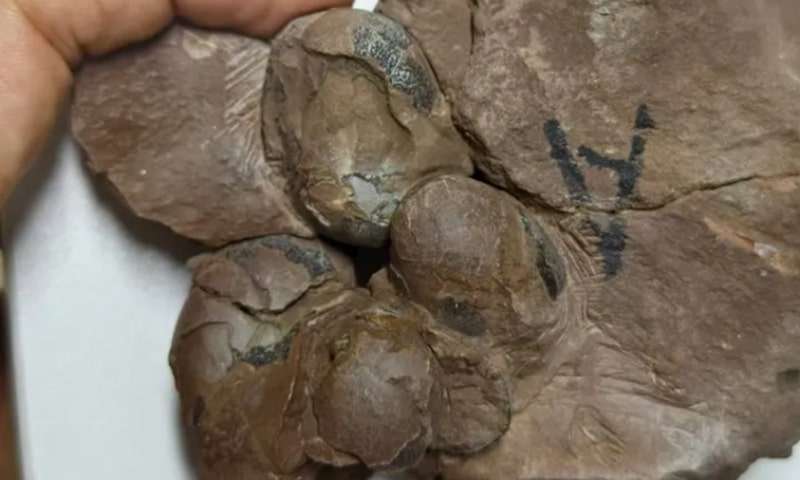
During the excavation, scientists discovered a nest containing nearly six well-preserved dinosaur eggs, dating back to the Late Cretaceous period, around 80 million years ago.
In a careful investigation spanning over three years, researchers from the China University of Geosciences (Wuhan) and the Institute of Vertebrate Paleontology and Paleoanthropology under the Chinese Academy of Sciences validated this discovery as a significant advancement in paleontology.
Detailed Examination Reveals Novel Dinosaur Egg Species
Advanced methods such as electron microscopy scanning and electron backscatter diffraction were employed to explore the eggshell’s microstructure. Based on features such as shape, shell texture, and structural characteristics, the fossil was assigned to the ellipsoidal category of dinosaur eggs.
The Ganzhou Mini Egg exhibited distinct traits unlike any previously documented eggs, including differences in dimensions, shell thickness, pore configuration, and microscopic structure.
These unique qualities prompted scientists to define a new genus and species, thereby expanding knowledge about dinosaur diversity.
Connection to Small Theropod Dinosaurs
Han Fenglu, an associate professor specializing in vertebrate paleontology at China University of Geosciences (Wuhan), suggests the eggs were likely laid by a small theropod dinosaur. Theropods—including famously carnivorous dinosaurs like the Tyrannosaurus rex and Velociraptors—displayed a wide array of reproductive strategies.
This discovery of an exceptionally small yet well-preserved egg fossil adds valuable insight into the diversity of theropod eggs during the Late Cretaceous. The distinctive features of the Ganzhou Mini Egg point towards varying reproductive behaviors potentially influenced by environmental factors such as climate, nesting habits, or evolutionary developments.
Exploring Dinosaur Reproductive Biology
The findings, published in Historical Biology , outline plans for further exploration. Researchers aim to employ micro-CT scanning technology to reconstruct the burial posture of the eggs, which may help identify the specific dinosaur species responsible for laying them.
This approach could enhance understanding of the reproductive behaviors of other dinosaurs from the same era.
By examining how these eggs were formed, scientists hope to learn more about embryonic development, nesting environments, and incubation practices. Such fossil studies are essential for revealing how dinosaurs adapted and evolved across millions of years.
- Categories:
- Science






0 comments
Sign in to Comment