
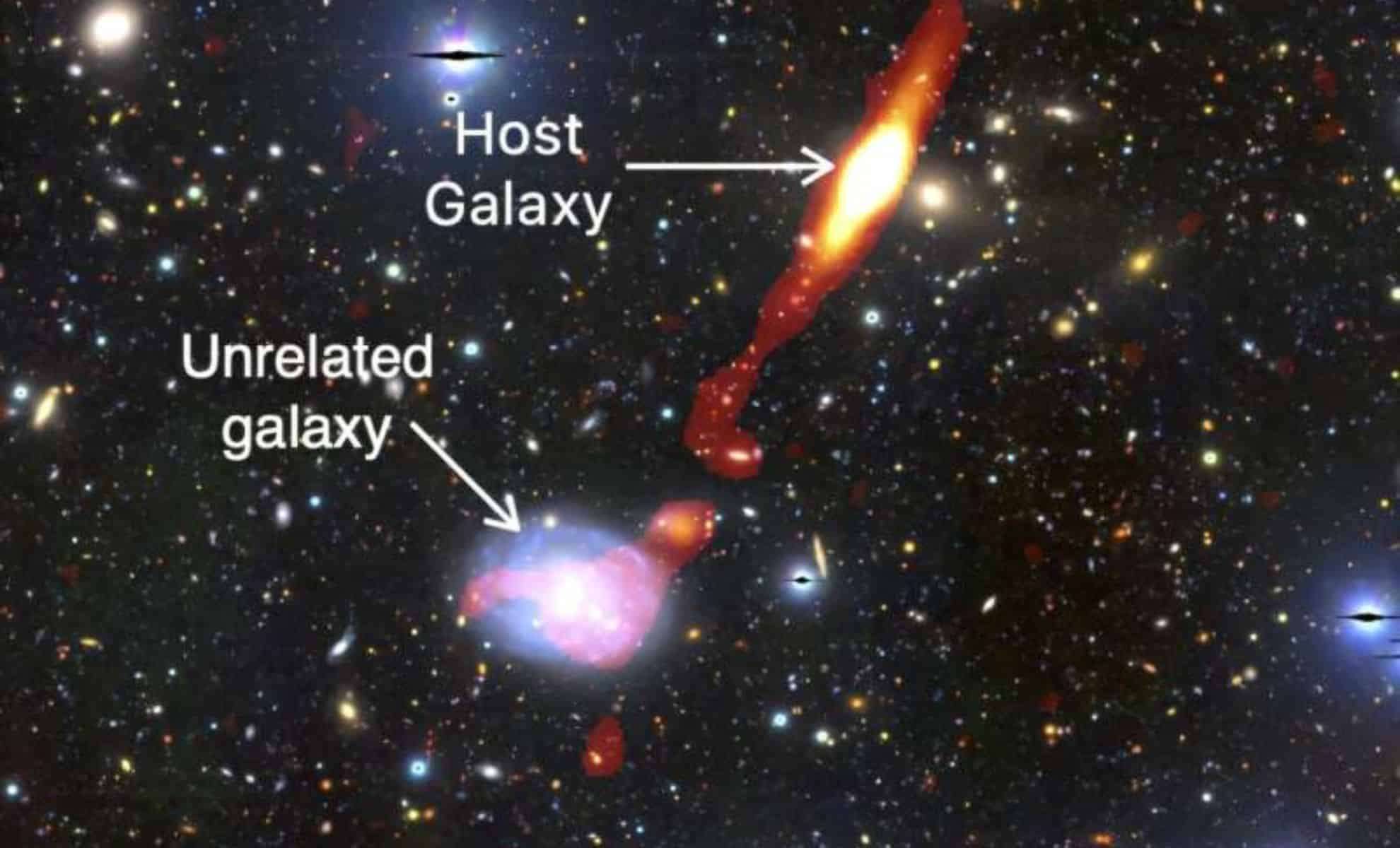
Astronomers have detected an immense giant radio galaxy (GRG) extending approximately 3.3 million light-years—a colossal scale nearly 32 times that of the Milky Way. This extraordinary GRG, dubbed Inkathazo, meaning “trouble” in isiZulu and isiXhosa, was observed using South Africa’s powerful MeerKAT telescope. Its plasma jets, driven by a supermassive black hole, pose intriguing puzzles due to their distinct bent formation and vast reach, which challenge typical expectations for radio galaxies situated in dense galaxy environments.
Published in the Monthly Notices of the Royal Astronomical Society, the discovery shakes up prevailing theories on how GRGs form and develop. Researchers are now delving deeper into Inkathazo’s complex plasma behaviors to gain new insights into these telling cosmic giants.
A Surge in Giant Radio Galaxy Discoveries
The last five years have witnessed a dramatic rise in GRG identifications, largely fueled by next-generation radio telescopes such as MeerKAT. These instruments offer exceptional sensitivity and clarity, allowing astronomers to detect subtle radio emissions from distant GRGs with greater accuracy. “The number of GRG detections has skyrocketed recently, thanks to advanced telescopes like MeerKAT,” said Kathleen Charlton, a Master’s student at the University of Cape Town and lead author of the study.

This rapid discovery pace has turned GRG research into an exhilarating, fast-evolving field. “GRG studies are progressing so quickly that it’s a challenge to keep up, which is incredibly exciting,” Charlton added. Inkathazo’s discovery highlights the power of cutting-edge technology to reveal previously unseen cosmic giants.
Inkathazo: The ‘Troublesome’ Giant
The name Inkathazo aptly captures the difficulties astronomers face in explaining this galaxy’s features. “We chose the name ‘Inkathazo,’ meaning ‘trouble’ in isiZulu and isiXhosa, because unraveling the physics driving this object has proven quite challenging,” Charlton explained.
One puzzling characteristic of Inkathazo is its plasma jets, which deviate from the patterns typical of other GRGs. “Unlike many giant radio galaxies, one of its jets is distinctly bent rather than extending straight across the galaxy,” Charlton noted.
What’s more, Inkathazo’s placement within a dense galaxy cluster defies common expectations. Most GRGs are found in isolated regions where their plasma jets can extend unimpeded, but Inkathazo’s environment should restrict such growth due to interactions with hot intracluster gas. “Locating a GRG inside a cluster prompts fresh questions about how environments influence the formation and evolution of these giant galaxies,” remarked Dr. Kshitij Thorat, co-author and researcher at the University of Pretoria.
Investigating the Physics of Giant Radio Galaxies
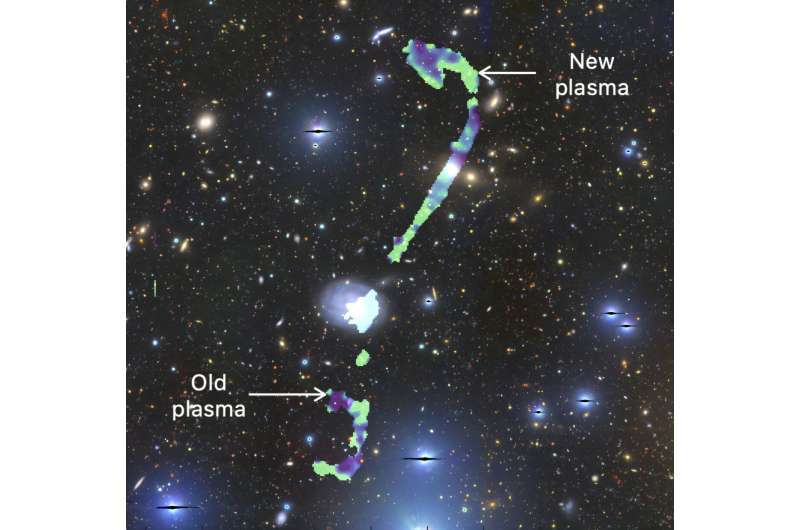
Utilizing MeerKAT’s superior resolution, scientists constructed detailed spectral age maps of Inkathazo to study the distribution and maturity of its plasma. These maps provide vital clues to the galaxy’s developmental history.
“This find offers an unparalleled chance to dissect the physical mechanisms within giant radio galaxies,” Thorat stated. The spectral data revealed areas where plasma electrons receive unexpected energy boosts, likely caused by interactions with hot gas in the surrounding intergalactic medium.
“These observations challenge our current models and imply we have much to learn about the complex plasma dynamics in such extreme environments,” Thorat added. Inkathazo’s jets serve as a natural laboratory to examine the interplay between massive galaxies and their surroundings, pushing astrophysics forward.
The Southern Sky as a Rich GRG Hunting Ground
Inkathazo’s discovery is part of ongoing investigations into the relatively unexplored southern sky, a region promising a wealth of GRG detections. It is one of three GRGs uncovered within the COSMOS area, a sky patch roughly equal in size to five full moons.
“Finding three GRGs by focusing MeerKAT on just this small swathe of sky suggests a vast reservoir of hidden GRGs lies waiting to be discovered in the southern hemisphere,” said Dr. Jacinta Delhaize from the University of Cape Town, who led prior research identifying the other two COSMOS GRGs in 2021.
MeerKAT’s unique vantage point and robust capabilities make it ideal for uncovering these elusive giants. “Its location and sensitivity make MeerKAT a key instrument for studying and expanding GRG catalogs,” Delhaize emphasized.
A Promising Horizon for GRG Exploration
The identification of Inkathazo marks a pivotal achievement in radio astronomy but also signals the beginning of deeper inquiries. Acting as a precursor to the forthcoming Square Kilometer Array (SKA), MeerKAT prepares the groundwork for even more groundbreaking revelations.
“We are entering a new golden age of radio astronomy,” said Delhaize. “MeerKAT has pushed our limits impressively, and the SKA will further extend these frontiers, helping to unravel the enigmas of giant radio galaxies.”
Planned SKA research will concentrate on:
- Comprehensive Southern Sky Surveys: To identify more giant radio galaxies in unexplored regions.
- Enhanced Plasma Modeling: To better understand energy flows within GRG jets.
- Environmental Impact Studies: Investigating how dense clusters affect the growth and morphology of GRGs.
The insights from Inkathazo and similar objects promise to deepen our grasp of cosmic evolution and illuminate the processes sculpting the universe’s largest galactic entities.
- Categories:
- News









0 comments
Sign in to Comment