
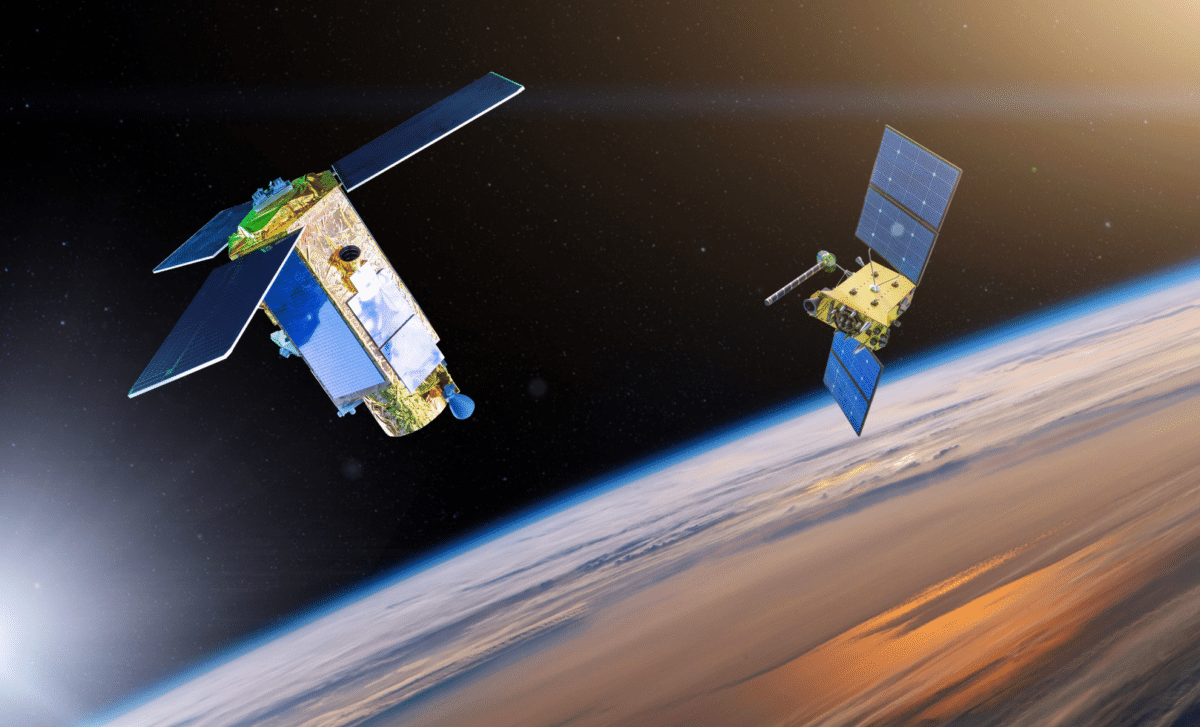
In a stunning display of orbital precision, two Russian satellites, COSMOS 2581 and COSMOS 2583, successfully executed a maneuver that brought them to within just 10 feet of each other while circling Earth at low orbit. This extraordinary event, carefully monitored and studied by COMSPOC—a leader in space situational awareness—indicates advanced Russian capabilities in satellite navigation and possibly signals new space operation technologies under testing.
Exceptional Accuracy in Russian Satellite Maneuvers
On April 28, 2026, the Russian satellites COSMOS 2581 and COSMOS 2583 performed a calculated close approach in low Earth orbit. Alongside them were COSMOS 2582 and an additional subsatellite, Object F, involved in a coordinated orbital ballet. COMSPOC confirmed that this was a deliberate act rather than an accidental pass.
“This wasn’t a coincidental pass, COSMOS 2583 performed several fine maneuvers to maintain this tight configuration,” the company wrote in a May 1 post on X, illustrating the highly controlled operation through an animation.
Add Cosmo Herald as a Preferred Source

Achieving this level of coordination required meticulous adjustments, with COSMOS 2583 actively steering its path to stay in close formation with COSMOS 2581. These maneuvers display a refined capacity for orbital control, hinting at applications far beyond routine satellite communications or scientific missions.
Tri-Satellite Formation and Its Strategic Meaning
Launched in February 2025 via a Soyuz rocket, the COSMOS satellites—2581, 2582, and 2583—entered low Earth orbit as a cluster. While 2581 and 2583 carried out the intricate proximity operation, COSMOS 2582 followed behind at a distance of less than 100 kilometers. COMSPOC noted, “COSMOS 2582 trailed the formation at sub-100 km range, while Object F passed within 15 km of 2582 and within 10 km of 2581 — neither maneuvered.” Such deliberate arrangements likely reflect experiments into new satellite deployment tactics with considerable strategic or defense potential.
As Space.com explains, rendezvous and proximity operations (RPO) like these can serve many functions including inspection, surveillance, or even disruption of rival space assets. The extended observation of these activities underscores Russia’s expanding ambitions in outer space.
A Pattern of Advanced Orbital Operations
Russia’s recent orbital achievements are part of a larger, ongoing effort. COMSPOC highlighted that, “for context: in late 2025 to now, we tracked these same COSMOS satellites performing 3-object RPO.” This continuous series of maneuvers points to a strategic period of testing sophisticated space capabilities. The mastery of multi-satellite precision control showcases Russia’s progress toward potentially military-grade space operations surpassing peaceful exploration or research.
While experts continue to analyze the ramifications, these developments clearly suggest a focus on technologies capable of strategic use in orbit. COMSPOC summarized this well: “Whatever Russia is testing, it’s sophisticated.” The ability to conduct complex maneuvers involving several satellites simultaneously highlights a significant technological breakthrough.
The Importance of Advanced Space Monitoring
Detailed tracking of these satellites is only possible thanks to advances in space situational awareness. Organizations like COMSPOC and LeoLabs provide vital monitoring services that track orbital objects and reveal crucial insights into their actions. The precise radar data enabled COMSPOC to verify the satellites’ close proximity and understand the nature of their synchronized maneuvers.
As nations ramp up their space capabilities, the role of companies specializing in space monitoring becomes increasingly vital. Real-time tracking of satellites will be essential to interpreting the evolving dynamics of space and to prevent potential orbital conflicts.
- Categories:
- Space






0 comments
Sign in to Comment