
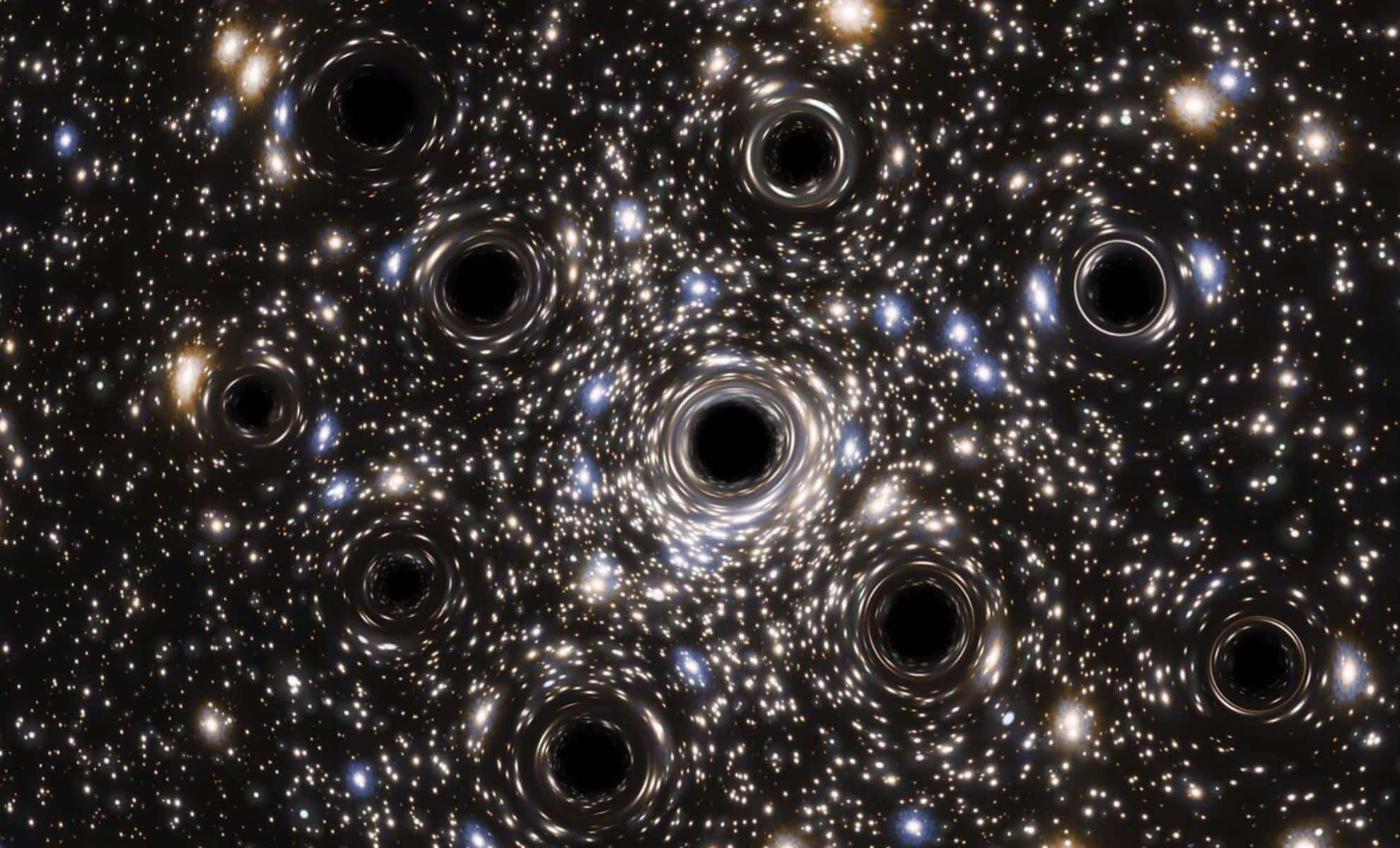
Black holes have long been divided into two well-known categories: stellar-mass black holes, weighing between 5 and 50 times the mass of our Sun, and supermassive black holes (SMBHs), which can reach millions or even billions of solar masses. However, the intermediate group—known as intermediate-mass black holes (IMBHs)—has remained largely hidden, with few confirmed detections. Unlike their smaller and larger counterparts, direct evidence of IMBHs has been extremely scarce—until recent discoveries.
A global collaboration of astronomers, spearheaded by Vanderbilt University’s Lunar Labs Initiative (LLI), has recently identified potential signals of these mysterious cosmic entities. Their work, featured in The Astrophysical Journal Letters, provides new evidence indicating that intermediate-mass black holes may not only be real, but also integral to understanding black hole lifecycle and growth.
Gravitational Wave Data Sheds Light on Missing Black Holes
The research team revisited data gathered by the Laser Interferometer Gravitational-Wave Observatory (LIGO) along with the Virgo Collaboration. These facilities capture gravitational waves—ripples in spacetime created when black holes collide and merge. Through detailed analysis, the researchers identified merger events involving black holes with masses between 100 and 300 times that of the Sun, consistent with the theorized range for IMBHs.

These observations mark the largest black hole collisions detected so far and strongly suggest the presence of the elusive intermediate-mass category. The team believes these signals could fill the long-standing gap between known stellar-mass and supermassive black holes, representing a missing evolutionary stage.
Pursuing Deeper Understanding of IMBHs
Confirming and studying these findings further remains a key goal. The forthcoming Laser Interferometer Space Antenna (LISA) mission, slated for launch in the late 2030s, promises to enhance these efforts. Unlike ground-based observatories like LIGO and Virgo, which capture the final moments of black hole mergers, LISA will track these systems over several years before their collision, offering unprecedented insight into IMBH formation and dynamics.
LISA’s prolonged observation window is eagerly anticipated by astronomers seeking to unpack the complex behaviors of intermediate-mass black holes. Lead investigator Krystal Ruiz-Rocha remarked, “We hope this research strengthens the case for intermediate-mass black holes as the most exciting source across the network of gravitational-wave detectors from Earth to space.” The mission’s extended timeline will enable scientists to explore the lifecycle of these black holes more comprehensively.
The Moon as a New Observatory for Gravitational Waves
Beyond recent gravitational wave breakthroughs, the study also explores innovative methods to detect IMBHs, including establishing a gravitational wave observatory on the Moon. NASA’s Artemis program is investigating this prospect, aiming to build upon the foundation laid by the Apollo 17 astronauts with their Lunar Surface Gravimeter experiment, ushering in a new era of space-based astrophysical observation.
The Moon provides a uniquely advantageous environment compared to Earth-bound detectors. Free from atmospheric interference, a lunar observatory could deliver clearer gravitational wave signals and deepen studies of cosmic phenomena like black holes. The research team is enthusiastic about leveraging lunar missions to advance our understanding of the universe’s mysteries.
As senior author and astronomer Karan Jani expressed, “This is an exciting moment in history – not just to study black holes, but to bring scientific frontiers together with the new era of space and lunar exploration.”
- Categories:
- News








0 comments
Sign in to Comment