
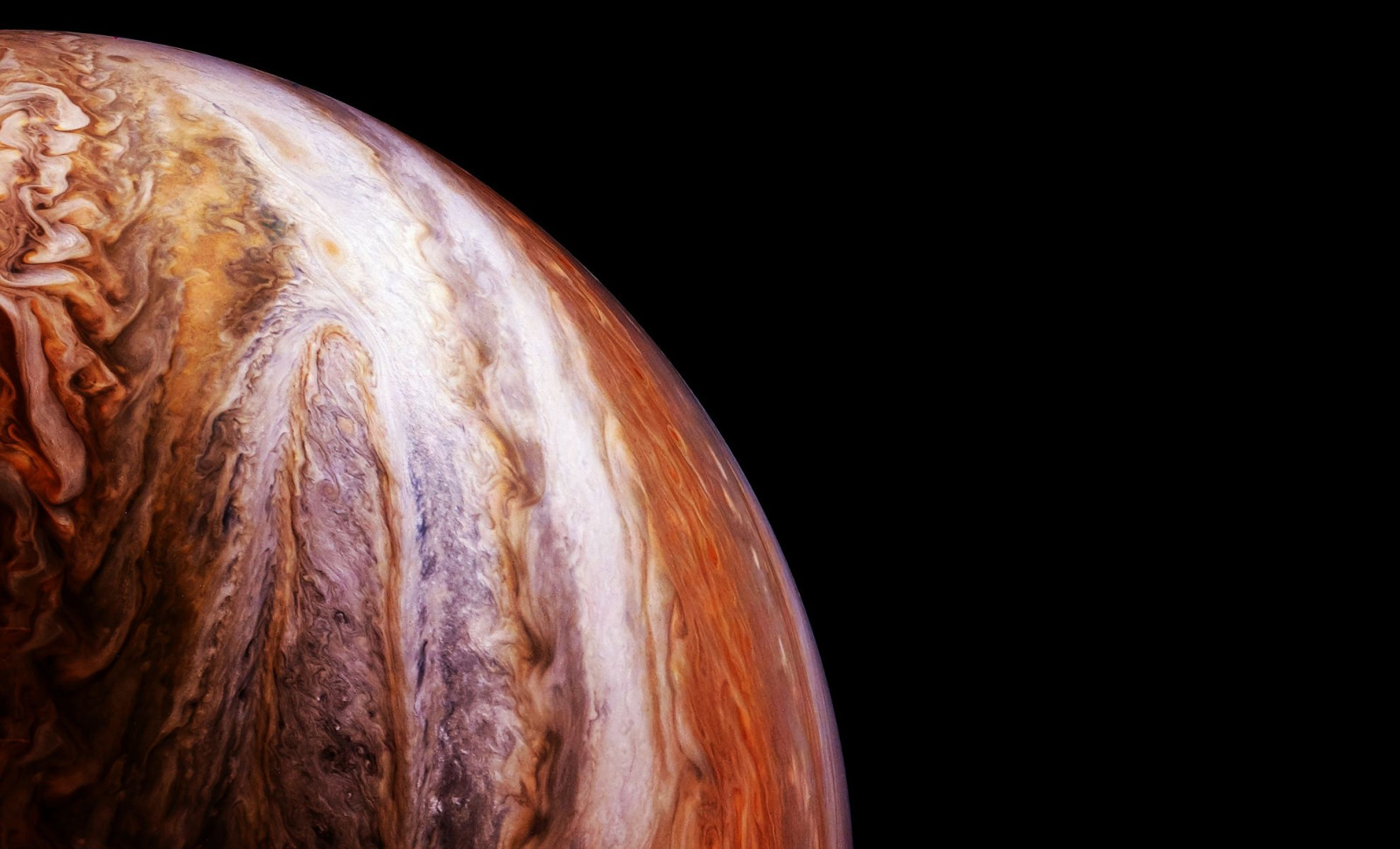
Jupiter, the Solar System's largest planet, has been found to be marginally smaller based on fresh observations. Recent analysis shows that the giant planet's equator is a bit less wide and its polar regions more flattened than earlier thought.
Historically, our understanding of Jupiter's size came from data gathered by NASA’s Voyager and Pioneer spacecraft. These estimates were derived using radio occultation (RO) methods, which monitor how radio waves bend as they pass through Jupiter’s atmosphere.
Although these pioneering measurements were significant for their time, advancements in technology combined with data from NASA’s Juno spacecraft have now provided a clearer and more precise picture of Jupiter’s true dimensions.

Revised Measurements Highlight Subtle Differences
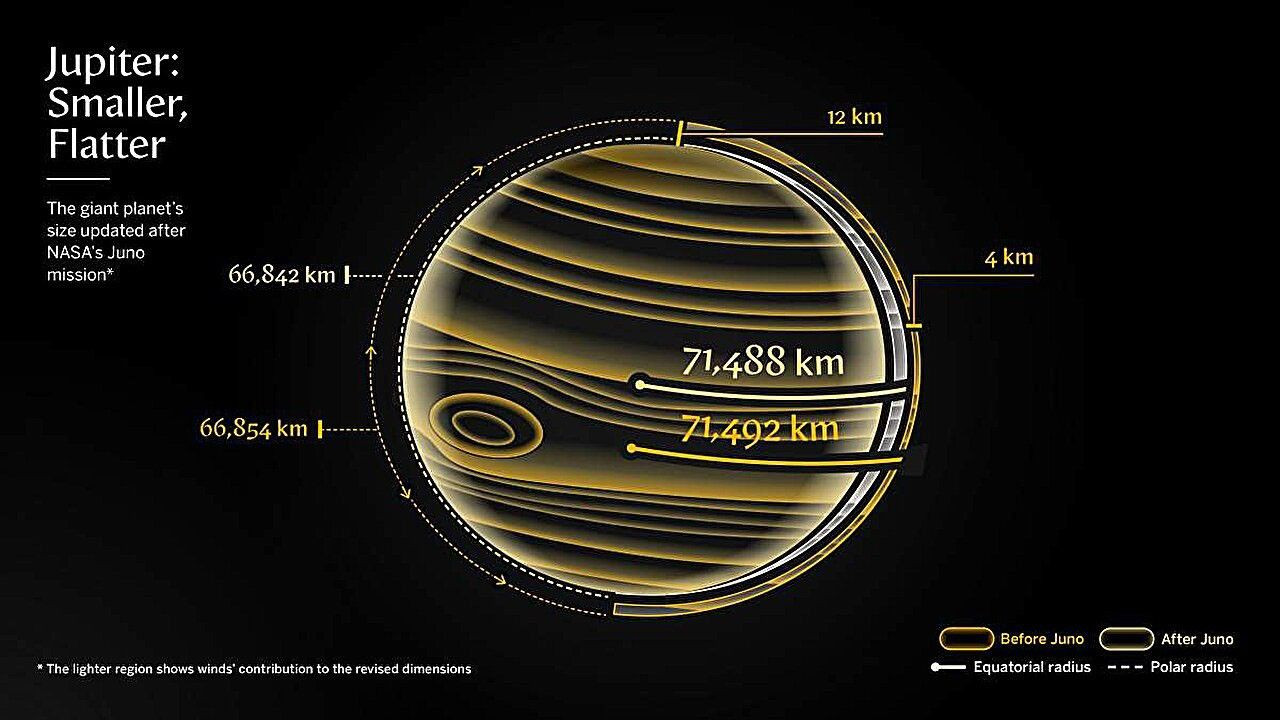
New data indicates that Jupiter’s equatorial radius is about 71,488 kilometers (44,421 miles), while its radius at the north pole is approximately 66,842 kilometers. According to a NASA report, these figures reveal the planet is 8 kilometers slimmer across its equator and 24 kilometers more flattened at its poles compared to earlier data.
“Even small changes in radius have meaningful implications,” explained Eli Galanti, a planetary scientist at the Weizmann Institute of Science. He stressed that minor adjustments help improve models of Jupiter’s interior by better matching gravity measurements with atmospheric properties.
Key Insights from the Juno Spacecraft
A study in Nature Astronomy credits NASA’s Juno mission, which has orbited Jupiter since 2016, as the source of this improved accuracy. Juno’s orbital shift in 2021 allowed it to observe the planet from behind relative to Earth, facilitating a wealth of new radio occultation data and finer size measurements.
“We tracked how the radio signals bend as they pass through Jupiter’s atmosphere, which allowed us to translate this information into detailed maps of Jupiter’s temperature and density,” explained Maria Smirnova, a planetary scientist at the Weizmann Institute.
This approach delivered the most precise depiction of Jupiter's overall shape and size to date.
Influence of Jupiter’s Intense Winds
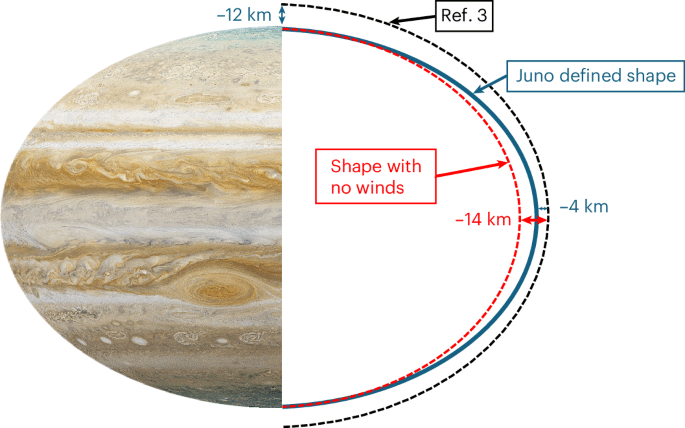
Beyond redefining Jupiter’s dimensions, the recent analysis also incorporated the impact of the planet’s strong wind systems. Earlier models largely omitted these high-speed atmospheric flows when determining size.
Thanks to updated understandings of Jupiter’s meteorology, researchers included wind effects in their assessments. This adjustment allowed for a more precise depiction of the planet’s form, addressing how these fierce winds reshape its structure. The team highlighted that integrating wind data notably enhanced measurement accuracy.
- Categories:
- Astronomy








0 comments
Sign in to Comment