
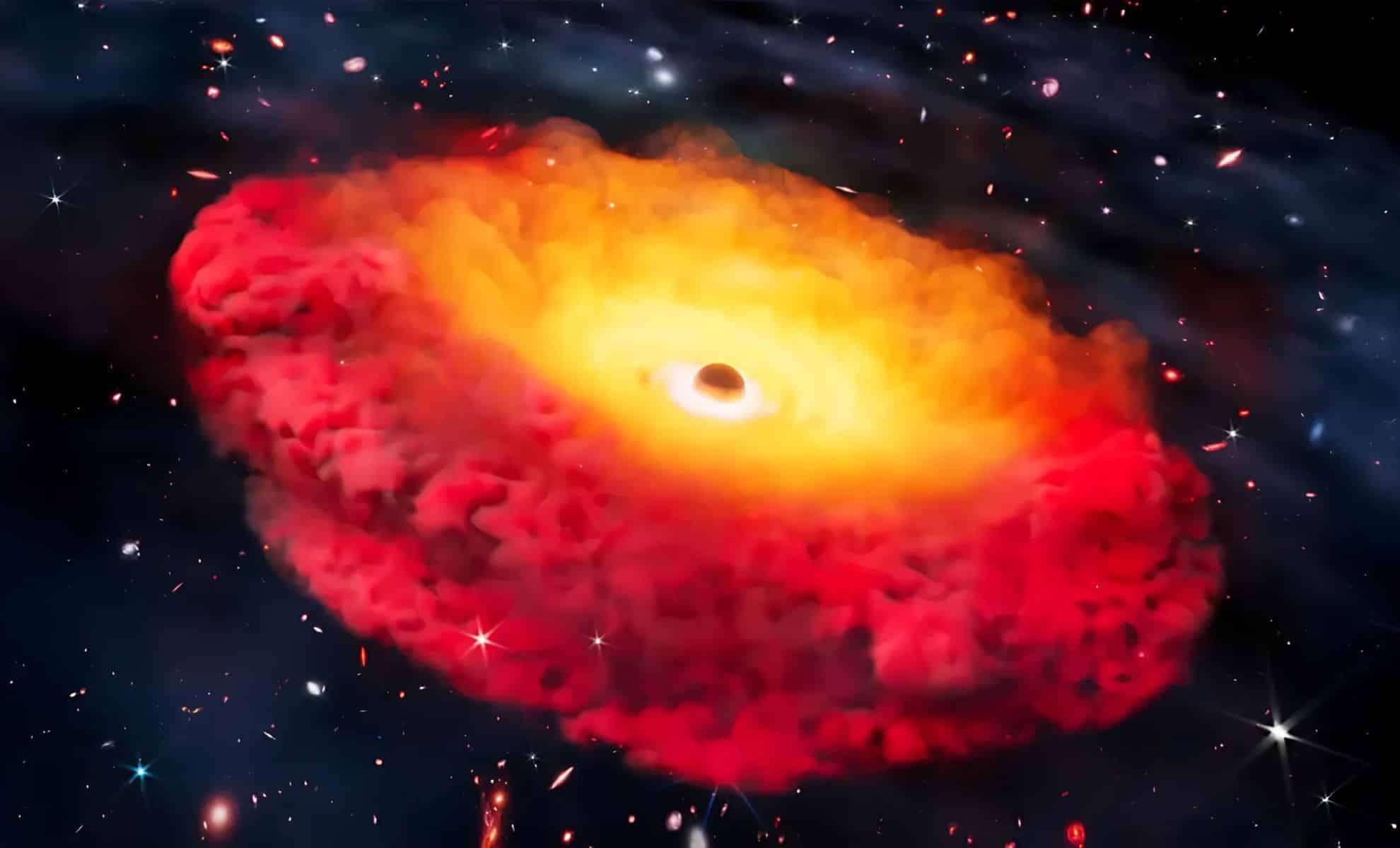
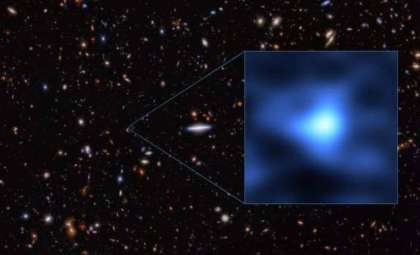
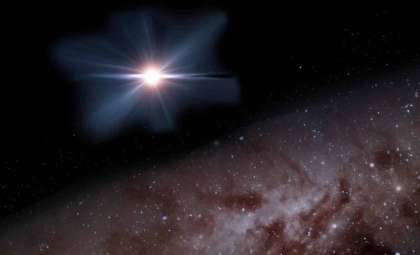
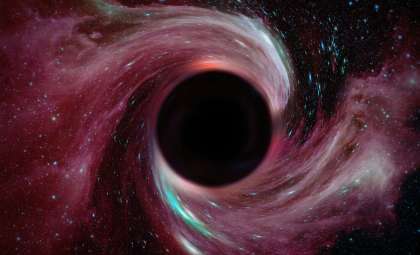
A team of astronomers has identified the most ancient black hole confirmed to date, revealing insights into the universe's infancy when it was merely 3% of its current age. Utilizing observations from the James Webb Space Telescope (JWST), this black hole sits at the core of the galaxy CAPERS-LRD-z9, an incredible 13.3 billion light-years distant. The groundbreaking research was published on August 6 in The Astrophysical Journal Letters, challenging previous conceptions about early black hole growth.
Gazing into the Universe’s Formative Epoch
Measured to have a mass around 300 million times that of our Sun, this massive black hole is remarkably large given its youthful cosmic age. Led by researchers at The University of Texas at Austin’s Cosmic Frontier Center, the team estimates this entity emerged just half a billion years after the Big Bang. “This marks nearly the furthest back in time we can effectively examine black holes,” explained Anthony Taylor, a postdoc and lead author of the study.
The discovery leveraged JWST’s CAPERS (CANDELS-Area Prism Epoch of Reionization Survey), a program dedicated to studying the earliest galaxies. The galaxy CAPERS-LRD-z9 was initially detected as a bright, compact anomaly before spectral analyses uncovered that its energy source is a rapidly accreting black hole rather than intense stellar activity.

The Enigma of the "Little Red Dots"
This galaxy is part of a mysterious group termed “Little Red Dots”, characterized by their compact size, brightness, deep red hue, and presence within the first 1.5 billion years after the Big Bang. Detected during JWST’s initial surveys, these galaxies have confounded astronomers due to their unexpectedly high luminosities, which traditional models struggle to explain since they imply star formation rates too rapid for such small early galaxies.
Emerging evidence suggests that these intense light emissions are largely generated by supermassive black holes, which shine brilliantly as they engulf surrounding material. “This supports a new perspective that black holes in the early universe grew at rates previously thought improbable,” noted co-author Steven Finkelstein.
Decoding the Hidden Power Source
Definitive evidence for the black hole’s presence was obtained through spectroscopic techniques, which dissect incoming light to reveal detailed information about celestial objects’ composition and motion. Gas accreting onto a black hole travels at extraordinary speeds, producing a telltale light pattern with both redshifted and blueshifted wavelengths, indicative of complex motions relative to the observer.
“Few phenomena produce this spectral signature,” Taylor explained. “Its presence in this galaxy confirms active black hole accretion.” This distinctive signal demonstrates how the black hole dominates the galaxy’s energy output by pulling in matter and illuminating its surroundings.
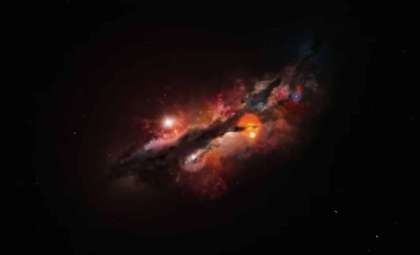
Another hint came from the galaxy’s deep red coloration, which scientists suspect arises from dense gas clouds enveloping the black hole that absorb and scatter light, shifting wavelengths towards the red before JWST detects them. Comparable effects have been recorded in other galaxies and align closely with observations of CAPERS-LRD-z9.
Revising Theories on Black Hole Origins
Given its enormous mass—roughly 300 million solar masses—this black hole is a rare giant for such an early era, accounting for nearly half the total stellar mass in its galaxy. This discovery points to two potential conclusions: either black holes in the primordial universe expanded at unprecedented speeds, or they formed with significantly higher initial masses. The galaxy CAPERS-LRD-z9 now stands as a key subject in unraveling the early growth and evolution of massive black holes.
Additional insights were gained from the Dark Energy Spectroscopic Instrument (DESI) at Kitt Peak National Observatory, which supplemented the JWST data. “Only recently have we begun to probe how black holes evolved in the universe's formative years,” said Taylor. “This extraordinary object offers a unique opportunity to deepen our understanding.”
- Categories:
- News




0 comments
Sign in to Comment