
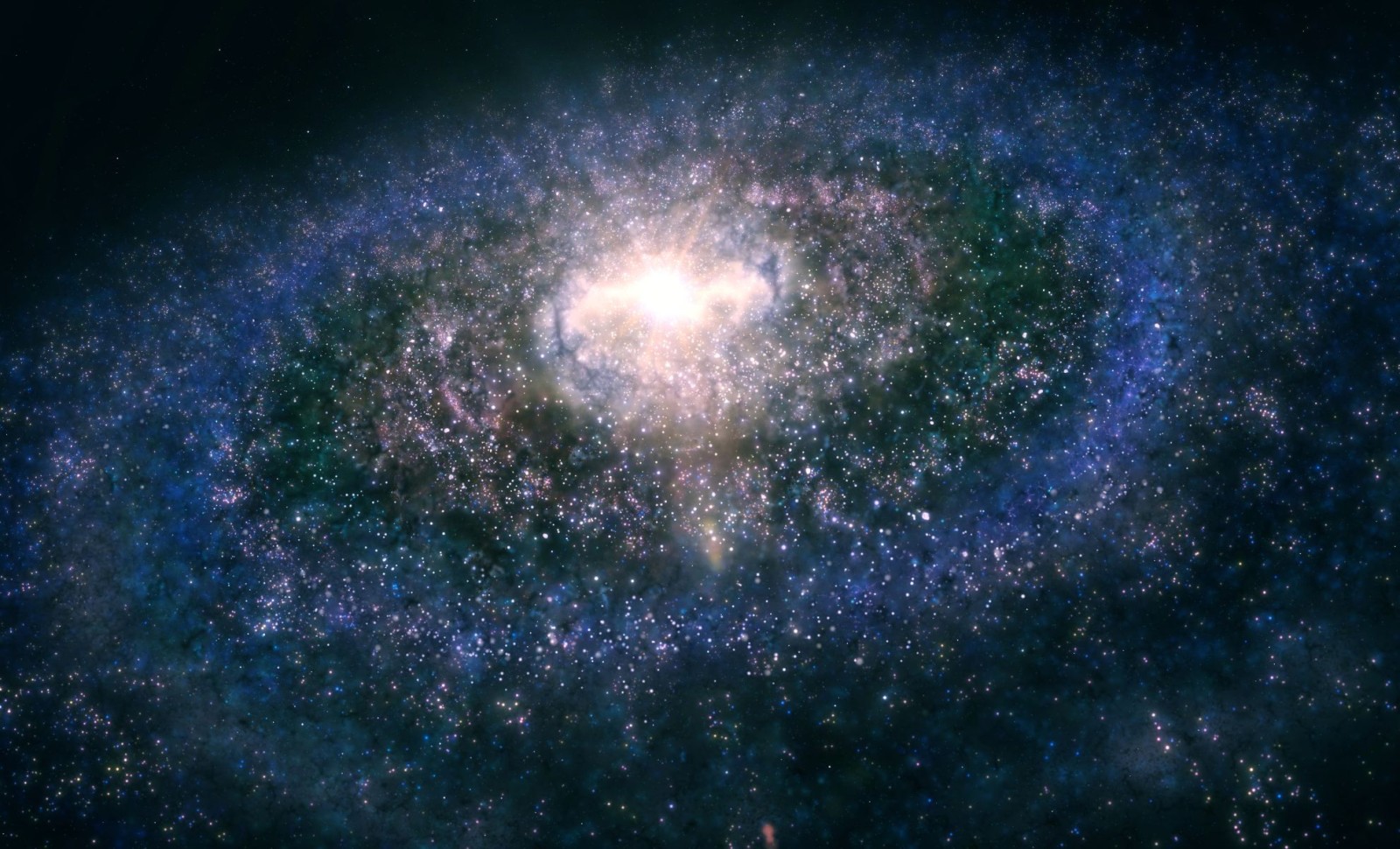
Researchers have identified an enormous spinning filament in space, stretching an incredible 50 million light-years and containing over 280 galaxies. This enormous structure rotates at speeds approaching 250,000 miles per hour, a revelation made possible by observations using South Africa’s MeerKAT radio telescope.
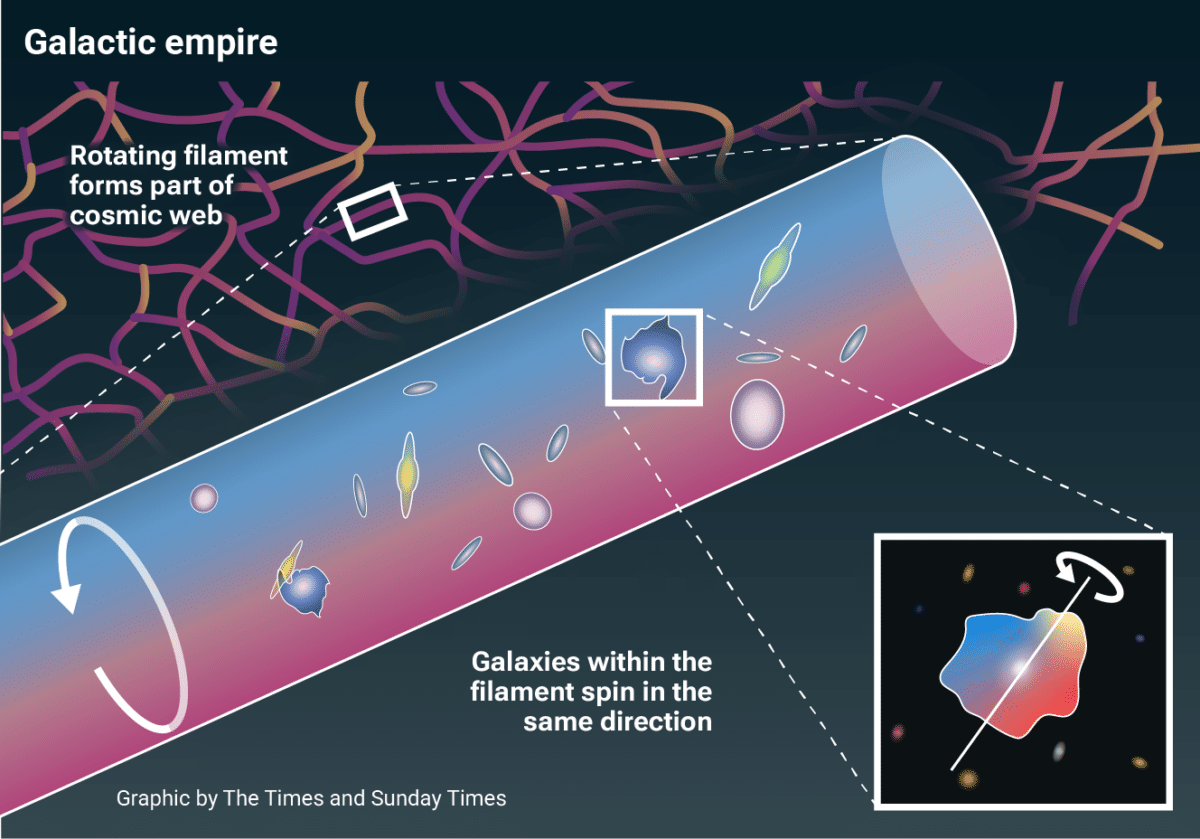
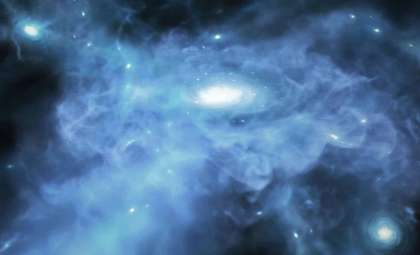
This filament is a component of the vast cosmic web — a network where immense strands of galaxies and dark matter interweave across the universe. These structures serve as vital channels directing matter towards galaxies, playing an essential role in their evolution and development.
Understanding the Immense Scale of Cosmic Filaments
Cosmic filaments rank among the universe’s largest known formations, extending over mind-boggling distances. The recently identified filament, detailed in a Monthly Notices publication, spans 50 million light-years — a distance so vast it challenges comprehension. To put it in perspective, one light-year covers approximately 5.8 trillion miles, making this filament around 100 billion times the gap between the Sun and Neptune.

Dr. Lyla Jung, a co-author from the University of Oxford, notes that this find is exceptional due to its combined enormity and the dynamism it exhibits. These filaments, composed of galaxies intertwined with dark matter, are fundamental to the framework of the cosmos. Dr. Jung emphasizes,
“What makes this structure exceptional is not just its size but the combination of spin alignment and rotational motion.”
The Intricate Motion of Galaxies and Filaments
The fascinating aspect of this cosmic filament lies in its simultaneous dual movement. The filament itself undergoes rotation, and the galaxies embedded within it also exhibit their own spins.
“You can liken it to a ‘teacups’ ride at a theme park. Each galaxy is like a spinning teacup, but the whole platform — the cosmic filament — is rotating too. This dual motion gives us rare insight into how galaxies acquire their spin from the larger structures they inhabit,” said the co-lead author of the study.
Scientists propose that the filament’s rotation could directly impact the spinning behaviour of its constituent galaxies, influencing their internal makeup and dynamics. Additionally, this motion may aid in funneling gas into nascent galaxies, promoting their early growth phases.
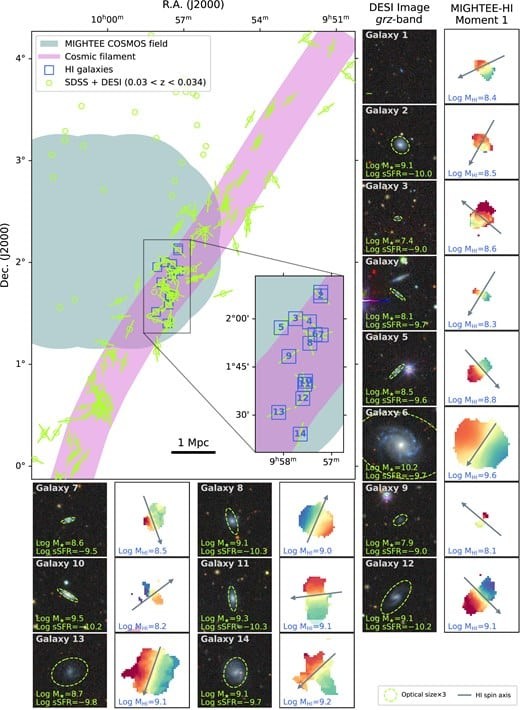
This inflowing gas, predominantly atomic hydrogen, is a vital ingredient in star creation and galaxy evolution. Researchers believe the filament’s spinning motion guides this gas into emerging galaxies, thereby affecting their growth rates, rotation speeds, and star formation activities.
A State-of-the-Art Telescope Unlocking New Cosmic Secrets
The groundbreaking discovery was enabled by the advanced MeerKAT radio telescope, featuring an array of 64 linked antenna dishes. Its remarkable sensitivity has allowed astronomers to capture faint radio signals from distant cosmic gases, revealing the precise structure and rotational dynamics of filaments like this.
“This filament is a fossil record of cosmic flows. It helps us piece together how galaxies acquire their spin and grow over time,” explained Madalina Tudorache, a Postdoctoral Research Assistant at Oxford University.
Thanks to its ability to detect subtle radio emissions, MeerKAT has unveiled the intricate dance of hydrogen gas within the filament, offering unparalleled insights into the forces shaping large-scale cosmic structures.
- Categories:
- Space






0 comments
Sign in to Comment