

Mercury, often dubbed the “hardest planet to see,” is challenging to observe because it remains close to the Sun’s glare. Yet, December 2025 offers a unique chance for enthusiasts to catch a glimpse of this swift planet in the predawn sky. Here’s a guide to timing and spotting Mercury in the early morning hours.
Why Mercury Is So Difficult to Observe
Mercury orbits the Sun swiftly, completing its circuit in just 88 Earth days. Consequently, it stays near the Sun’s bright glow, limiting viewing opportunities. Unlike the outer planets such as Jupiter or Mars, Mercury’s position changes quickly, often appearing briefly just before sunrise or right after sunset. This brief window makes it tricky to observe without optical aids like binoculars or telescopes.
Being an “inferior planet”—one that orbits closer to the Sun than Earth—Mercury is usually lost in solar brightness. It never ventures far from the Sun’s vicinity, rising and setting almost alongside it, making clear views rare. However, this December provides an exceptional opportunity to spot Mercury clearly.

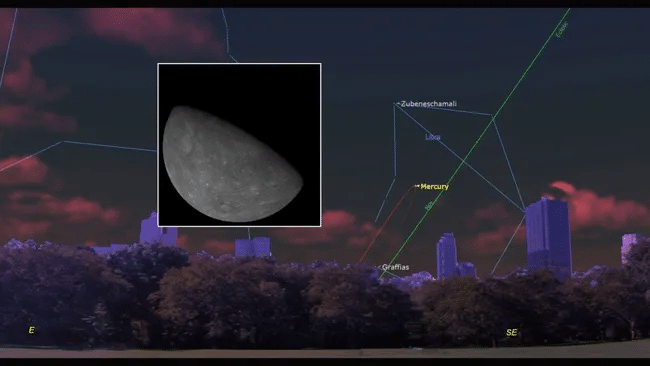
Prime Viewing Date: December 7
Per Space.com, Mercury reaches its greatest elongation on December 7, meaning it’s farthest from the Sun in the sky. This positioning offers the best chance to view the planet. Although it will be only 21 degrees away from the Sun, it will still shine brightly, glowing at magnitude -0.4. On this day, Mercury will rise nearly two hours before the Sun, allowing sufficient time for careful observers to spot it.
The optimal moment to look for Mercury is about 80 minutes before sunrise, when the sky remains darker and the planet’s glow becomes more evident. Viewers in the Northern Hemisphere will benefit from the clearest and most rewarding views during this event.
Visibility and Brightness of Mercury
On December 7, Mercury will shine at its most brilliant for 2025, appearing as a yellow-orange point of light in the dawn sky. This brightness is a notable increase from its usual faintness, making it visible without any optical equipment. With binoculars or telescopes, observers can also witness Mercury’s phases, similar to the lunar phases, shifting from crescent-shaped to half-lit as it moves.
Because of its swift path, Mercury’s visibility won’t last long. For several weeks in December, the planet remains accessible to the naked eye before gradually moving closer to the Sun and fading from view. Timely observation is crucial to enjoy this celestial spectacle.
Understanding Mercury’s Swift Orbit
Mercury’s close proximity to the Sun contributes to its rapid orbital velocity, traveling at approximately 30 miles per second. This swift movement causes it to change position noticeably within the sky, never lingering in one area for long. Its orbit is slightly tilted, making Mercury alternate between appearing in the morning and evening sky as it goes through its phases.
Mercury reached perihelion, its closest approach to the Sun, on November 23. At this point, it moves at its highest speed. Approaching its greatest elongation in early December, the planet becomes brighter and more visible, peaking in viewing potential—perfect timing for those eager to spot this fast-moving world.
- Categories:
- News







0 comments
Sign in to Comment