
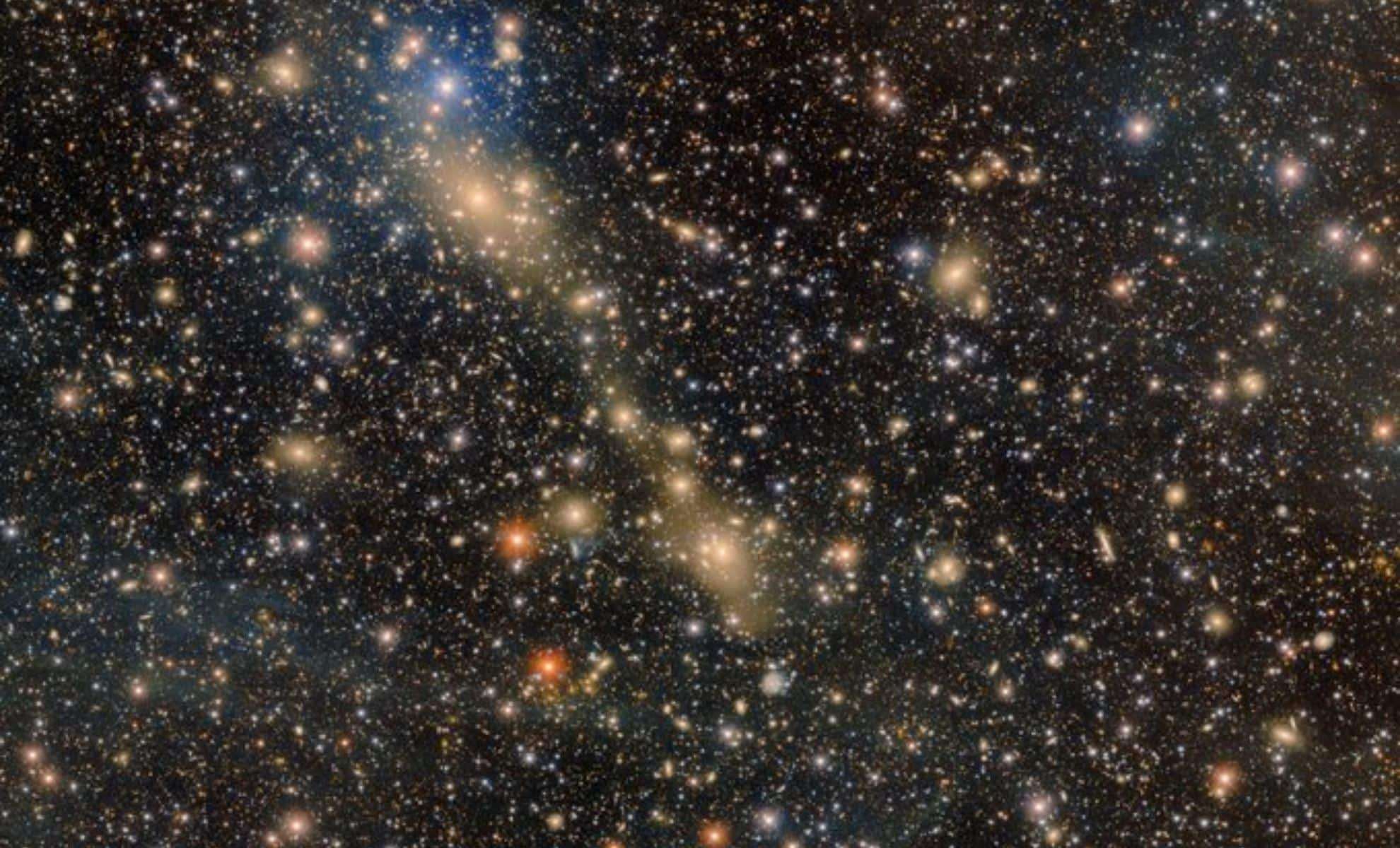
Astronomers have obtained the first visible-light proof of an enormous million-light-year-long stellar bridge being ripped from one colossal galaxy and drawn into another within the Abell 3667 galaxy cluster, situated approximately 700 million light-years away. Featured in the August 5 issue of The Astrophysical Journal, this discovery uncovers an intense cosmic collision between two galaxy clusters, each hosting its own brightest cluster galaxy (BCG), locked in a powerful gravitational encounter.
An Intense Cosmic Merger Unfolds
The formation of Abell 3667 is credited to the merger of two smaller galaxy clusters nearly a billion years ago, each carrying a central dominant galaxy known as the brightest cluster galaxy (BCG). Presently, these galactic titans are engaged in a vigorous merger, actively stripping stars from one another.
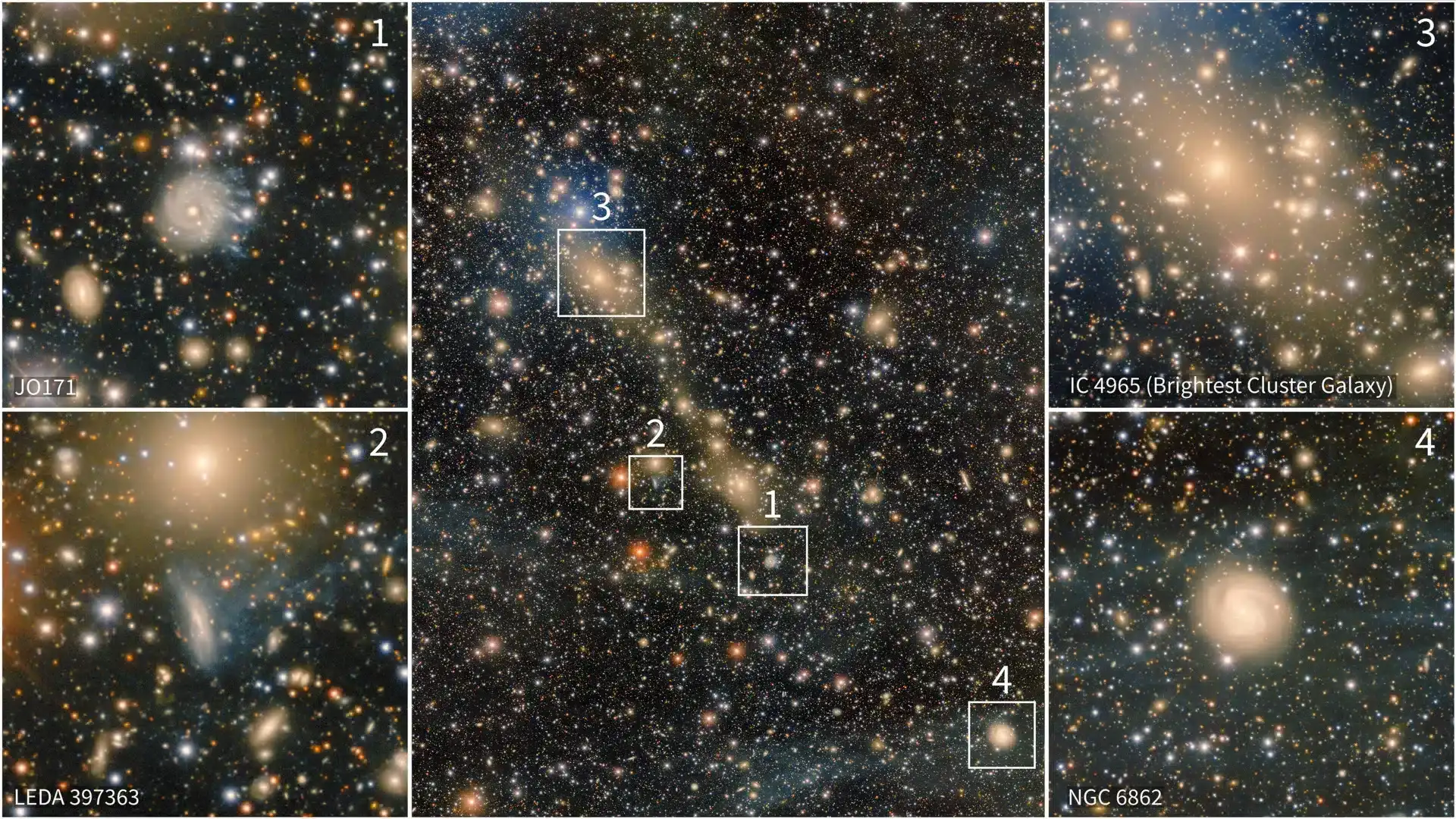
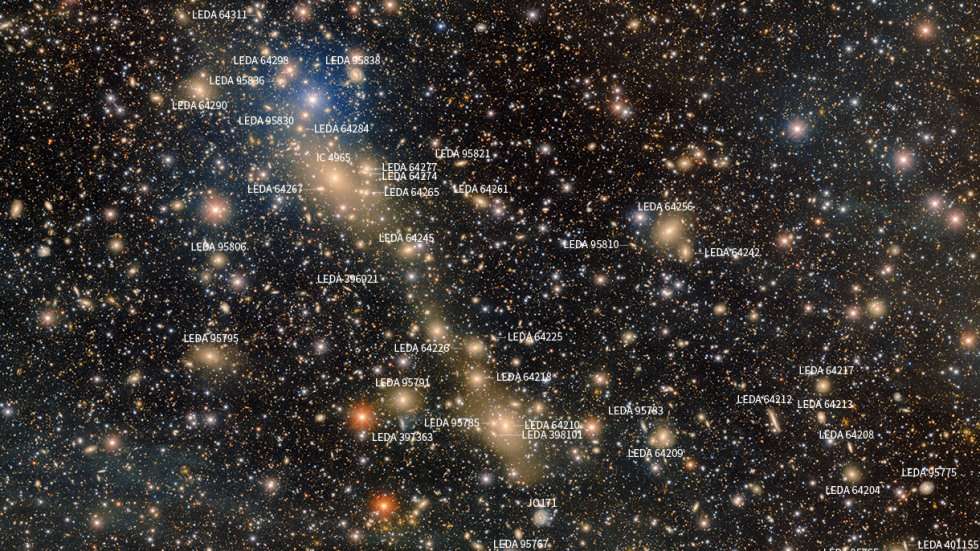
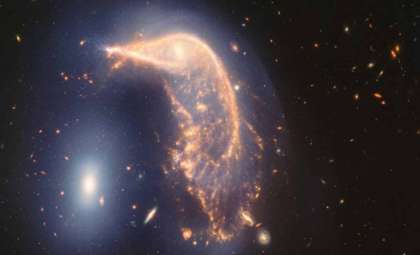
Using the Dark Energy Camera (DECam) on the Víctor M. Blanco Telescope in Chile, astronomers produced detailed images revealing a stellar bridge connecting the lenticular galaxy IC 4965 with the intriguing jellyfish galaxy JO171. As JO171 dives further into the cluster’s core, gas streams are peeling away from its outer ring, gradually ceasing star formation in parts of the galaxy.

Anthony Englert, lead scientist from Brown University, described the finding as “a tremendous surprise,” noting that although models predicted such stellar bridges, “they hadn’t been observed in optical wavelengths until now.”
Unearthing the Subtle Glow
Capturing the faint light emitted by the stellar bridge demanded over a decade of cumulative telescope observations. Englert’s team combined 28 hours of data gathered over several years by various astronomers using DECam.
“We were fortunate that many astronomers had targeted Abell 3667, allowing us to coalesce those numerous datasets,” Englert explained. The final composite delivers one of the most profound optical perspectives of this cluster to date, exposing the delicate framework of stars drifting through intergalactic space.
Previous X-ray and radio studies indicated a rapid merger was underway, but this is the first optical confirmation. This stellar bridge not only physically links two galaxies but also offers insight into the intense cosmic forces sculpting the universe’s architecture.
Illuminating Dark Matter Through Intracluster Light
The faint glow between clusters does more than trace merger history. Because this emission often mirrors the layout of dark matter, it provides astronomers an indirect method to chart this elusive substance, believed to account for around 80 percent of the universe’s mass.
“The patterns of this intracluster light reflect the distribution of dark matter, granting us a way to ‘visualize’ the invisible,” explained co-author Ian Dell’Antonio of Brown University. Understanding dark matter’s dynamics during immense galactic collisions is key to unraveling how cosmic structures emerge and evolve.
This breakthrough also signals the potential discoveries anticipated from the Vera C. Rubin Observatory. Scheduled to commence operations between late 2024 and early 2026, the Rubin Observatory will undertake the Legacy Survey of Space and Time (LSST), delivering comprehensive maps of the southern sky with unprecedented resolution over a decade.
“Our current achievement represents just a glimpse of what Rubin will reveal,” Englert stated. “It will revolutionize the study of intracluster light.” Equipped with a telescope twice the size of Blanco and housing the largest digital camera ever designed, Rubin is expected to detect hundreds of similar stellar structures.
- Categories:
- News







0 comments
Sign in to Comment