
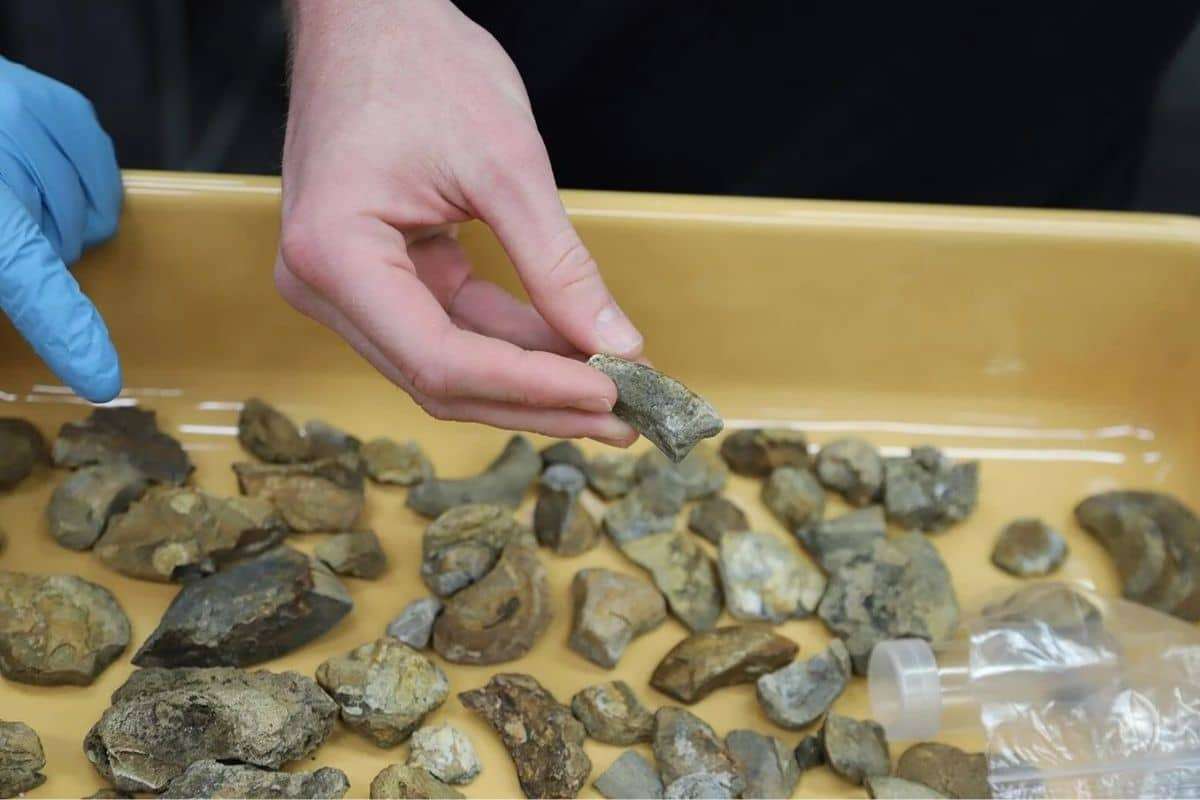
An extraordinary fossil find in Oklahoma is capturing attention in paleontology circles after a geology professor and his student stumbled upon one of the most ancient gemstone-quality ammonite fossils ever documented.
An Unexpected Treasure Just Before Break
Right before spring break, Dr. Chris Shelton from Rogers State University (RSU) brought his student Kolby Dooling to a familiar fossil-rich area. Though the site had yielded fossils before, nothing matched the remarkable specimen Dooling discovered that day.
“Just before spring break, I took one of my students, Kolby Dooling, to a site that I’d taken other students to before, one that had always been a good place to explore,” said Shelton. “We’d noticed these fossils before, but this time, Kolby brought a very large iridescent piece to me. It was clear he had discovered something extraordinary with this ammonite fossil.”
Add Cosmo Herald as a Preferred Source

A Shimmering Relic From Ancient Oceans
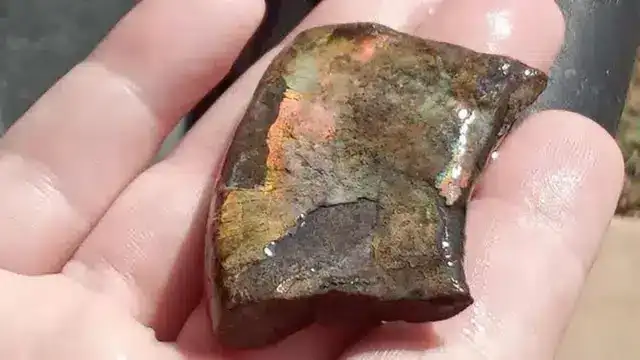
The fossil is from an extinct class of marine mollusks called ammonites, which are closely related to today’s squids and octopuses. This particular fossil stands apart because it shines with the vivid sheen of a precious gemstone, thanks to its unique mineral makeup.
Its shell displays a preserved mother-of-pearl glow due to the presence of aragonite, a mineral famous for its ability to diffract light and create dazzling colors. This feature points to the fossil potentially being classified as genuine ammolite, a rare and valuable gemstone primarily sourced from Alberta, Canada.
“Ammolite is very unique as it’s a biological gemstone, similar to pearls, formed from the fossilized shells of ancient cephalopods—mollusks related to modern squids—that exhibit vibrant, iridescent colors and patterns due to the microstructure of the original aragonite,” explained Shelton. “They’re particularly rare and sought after by collectors.”
Older Than Dinosaurs
While most iridescent ammonite fossils date from the Mesozoic Era—the time when dinosaurs thrived—this fossil predates that by a wide margin. It originates from the Carboniferous Period, more than 300 million years ago, long before dinosaurs appeared.
This discovery is exceptional because such fossils with preserved aragonite are rare in such ancient strata. Prior to this, only the Buckhorn Asphalt Lagerstätte in Oklahoma’s Arbuckle Mountains was known to contain fossils with this mineralization from that time period.
Continuing The Quest For Ancient Treasures
After their initial finding, Shelton and Dooling returned to the site and discovered further fossilized remains, including ancient shark fragments and other marine creatures. Their next step involves conducting extensive analyses and preparing their findings for publication in a scientific journal.
“We plan to do more expeditions, more collection trips to the site to gather more samples,”said Shelton. “From there, we’ll run many more analytical tests on the fossils to confirm our belief and based on the findings, Kolby and I will write and submit a peer-reviewed paper for acknowledgement of our discovery within the scientific community.”
For Kolby Dooling, the discovery has been a career-defining moment. Dr. Shelton stressed the value of hands-on experience, saying, “Taking students out into the field, bridging the gap between classroom theory and real-world fossil hunting, gives them the chance to connect directly with Earth’s history.”
- Categories:
- Science




0 comments
Sign in to Comment