

Choosing silence over confrontation during disputes is often seen as a mark of cool-headedness. The absence of raised voices or visible stress gives the impression that the situation is well-managed.
However, recent findings challenge this common perception.
Research published in Scientific Reports from Columbia Business School reveals that conflict avoidance frequently stems from anxiety rather than genuine composure. Through 13 experiments, the team identified a phenomenon termed zero-sum aversion: a habitual reluctance to engage in scenarios where one person's gain might mean another's loss, even when speaking up would likely result in a better outcome for the silent party.

The Hidden Price of Avoiding Conflict
The study evaluated volunteers in varied contexts including negotiations, performance appraisals, job interviews, and economic games involving actual money. Participants consistently preferred choices that kept their success independent of others’, even when competitive options promised greater rewards or success chances.

In a real-money lottery exercise, despite the competitive choice improving odds to a 40% advantage, 89% of participants opted out of direct competition.
Another finding showed MBA candidates seeking nearly 14% higher salaries to work for companies that assess employees relative to peers rather than by absolute standards. This salary gap remained after accounting for participants’ expected individual performance.
Fear of Conflict as the Underlying Cause
Investigators explored why people avoid zero-sum setups. Participants predicted that competitive contexts would foster heightened tension, hostility, and workplace strife. This expectation of conflict—not fairness or cooperative motives—best explained their avoidance.
Notably, when informed beforehand that conflict was acceptable or even encouraged, zero-sum aversion diminished considerably, with participants more willing to engage. This indicates that fear of interpersonal friction, rather than personality or social preferences, largely drives conflict avoidance.
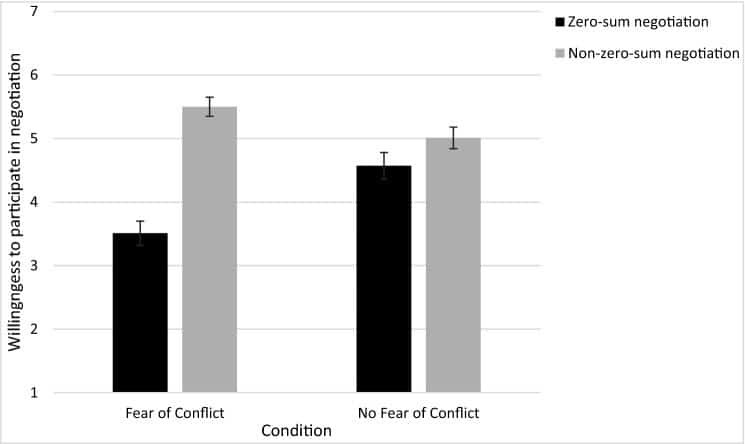
This avoidance extended beyond individual choices; managers also steered clear of competitive evaluation systems for their teams, expecting such systems to spark discord.
When Silence Transforms From Choice to Habit
Beyond these experiments, existing psychological research reveals a deeper aspect of conflict avoidance often missed by the study.
Some individuals learn in early life that voicing disagreement triggers negative consequences such as punishment, relationship strain, or lack of affection. For these people, holding back becomes an ingrained response rather than a conscious decision.

This pattern typically correlates with high agreeableness, a strong desire for harmony, or attachment styles emphasizing relationship preservation over personal expression. In close relationships, avoiding visible conflicts often gives a false sense of peace while underlying issues remain unaddressed.
The psychological danger lies in sustained silence accumulating hidden costs like bitterness, emotional distancing, and blurred self-awareness. What starts as protective behavior may eventually cause significant harm.
Insights and Limitations of the Research
The Columbia team found zero-sum aversion unaffected by gender or by participants’ leanings toward prosocial or individualistic values. The pattern recurred across diverse groups, from online participants to MBA students and community members, and across both hypothetical and real financial choices.
However, the study did not explore whether avoiding conflict leads to worse long-term outcomes in relationships or careers. The authors also highlight that shunning zero-sum situations is not always irrational. If confrontations carry real social or reputational risks, avoidance can be a prudent choice. They label the behavior irrational only when the conflict is inconsequential, such as in anonymous, one-time interactions with no social consequences.
- Categories:
- News













0 comments
Sign in to Comment