
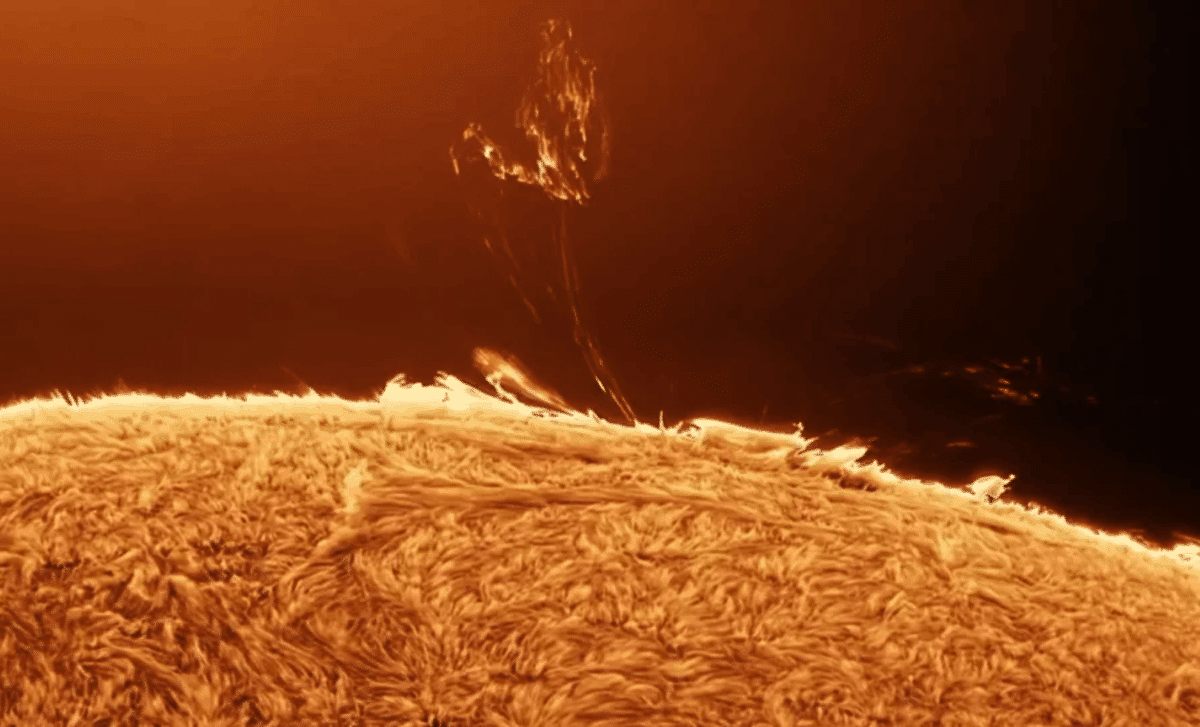
Astrophotography offers a unique window into cosmic phenomena, but some captures are truly extraordinary. Mark Johnston, a passionate astrophotographer, has recently recorded an awe-inspiring close-up of the Sun, showcasing a brilliant plasma cloud shaping vivid patterns above its surface. His video reveals intricate solar activity, shedding light on the Sun’s magnetic complexity.
Exploring the Sun’s Glowing Plasma: A Detailed Look at Solar Prominences
Johnston’s newest footage provides fresh perspectives on the Sun’s dynamic processes. The video highlights a swirling mass of hydrogen plasma hovering over the Sun’s edge, suspended by powerful magnetic fields. This spectacular display creates a mesmerizing visual effect as the plasma flows and twists.
The structure captured is identified as a solar prominence—vast, illuminated columns of plasma projecting from the Sun’s photosphere into the corona. These prominences, largely composed of ionized hydrogen and helium, are anchored and shaped by magnetic field lines. When the stability of these fields is disrupted, they can erupt, launching plasma outward into space.

Employing advanced gear such as the TEC160FL refractor telescope, enhanced by a Baader Energy Rejection Filter and Solar Spectrum etalon, Johnston seized these fleeting solar moments in remarkable clarity. As he describes, “The video shows a cloud of hydrogen plasma suspended above the sun’s limb on magnetic fields.” This close-up offers not only captivating visuals but also valuable data for scientists studying solar prominence longevity and dynamics.
How Solar Prominences Help Decode Solar Behavior
Beyond their visual appeal, solar prominences serve as critical indicators for understanding the Sun’s magnetic activity and the effects of solar weather impacting Earth. These enormous plasma arches reach hundreds of thousands of miles outward, providing important clues about the Sun’s magnetic field structure. Typically, they develop gradually over several hours or days and may remain visible for extensive periods.
As detailed by Space.com, these prominences are anchored to the photosphere, the Sun's outer visible layer, and stretch into the corona. The plasma traces the magnetic lines generated by the solar dynamo beneath the surface. Instabilities in these fields can cause prominences to erupt, releasing streams of plasma. Such eruptions sometimes trigger geomagnetic storms, which can disrupt communications and satellite systems on Earth.
The fluid, twisting motion captured in Johnston’s footage strikingly demonstrates the Sun’s energetic environment, with plasma seemingly moving in an elegant, choreography-like pattern above the solar surface. This footage offers a vivid glimpse into the Sun’s magnetic forces at work.
Behind the Scenes of Johnston’s Exceptional Solar Imaging
Achieving such detailed solar visuals involved a combination of expertise, patience, and high-caliber instruments. Johnston’s imaging apparatus featured the TEC160FL refractor telescope, optimized for capturing crisp, high-resolution solar views. Coupled with a Baader Energy Rejection Filter and a Solar Spectrum etalon, he was able to isolate the hydrogen-alpha wavelength characteristic of solar plasma emissions.
The hydrogen-alpha wavelength is vital for observing solar prominences, as it highlights the red glow of ionized hydrogen gas in the Sun’s outer layers. Since the Sun’s intense brightness can overwhelm many optical instruments, this precise filtering is essential to reveal fine plasma details and subtle dynamics that might otherwise be missed.
Johnston comments on his upgraded equipment:
“I have a new upgrade on my solar etalon filter and when the seeing is good, I’m getting some fabulous results.”
This quote exemplifies the progress in solar astrophotography technology, demonstrating how continuous enhancements enable ever-clearer and more compelling views of our closest star.
Prioritizing Safety When Observing the Sun
While these images are awe-inspiring, they underline the risks of solar viewing without appropriate safeguards. The Sun’s powerful rays can inflict severe eye injury, making the use of proper protective gear indispensable for safe observation. Johnston’s remarkable footage, achieved using high-quality solar filters, reveals the Sun’s features safely and effectively—something unsafe to attempt with the naked eye.
Anyone interested in examining solar phenomena must utilize certified solar filters that block hazardous ultraviolet and infrared radiation. Whether viewing through telescopes or binoculars, direct eye exposure to the Sun without protection can cause permanent damage in moments.
- Categories:
- Space








0 comments
Sign in to Comment