
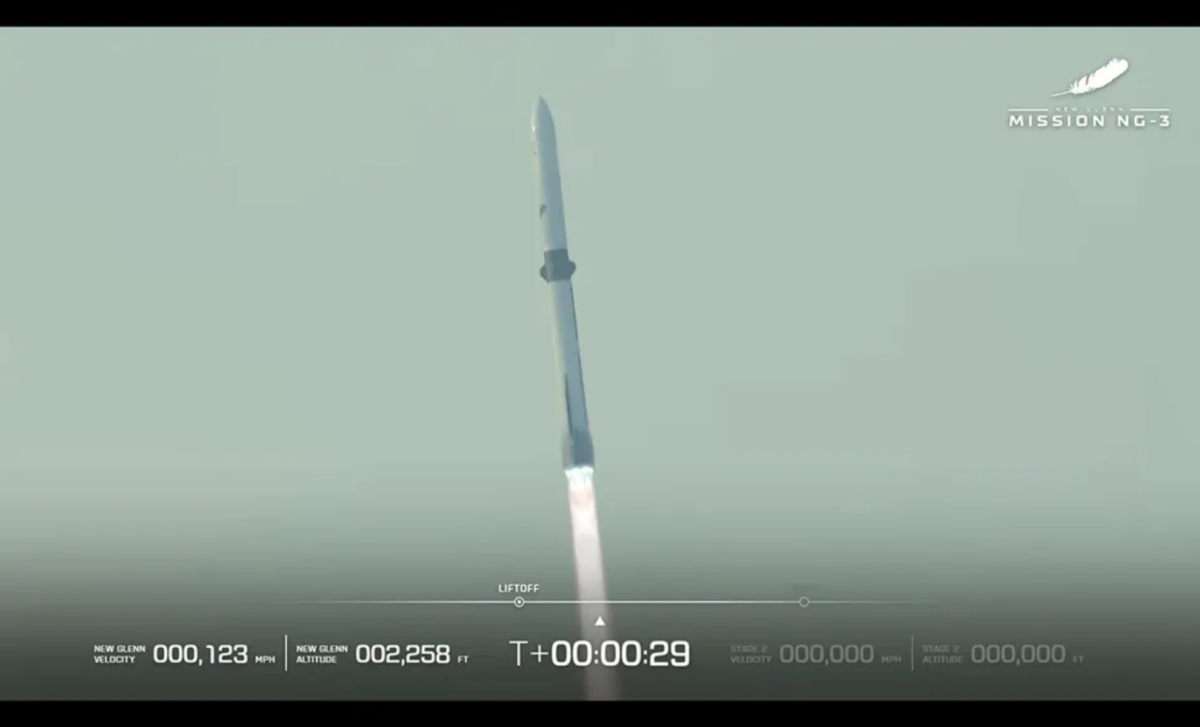
Blue Origin faced a significant challenge in its heavy-lift rocket program as the New Glenn experienced an upper stage failure during its third mission, abruptly ending what began as a promising flight and introducing new uncertainties about the rocket’s reliability in delivering payloads to orbit.
Encouraging Start Undermined by Critical Upper Stage Issue
The third deployment of the New Glenn rocket showed encouraging progress initially, bolstering hopes that Blue Origin might be catching up with longer-established players in the orbital launch market. As reported by Space news, the rocket lifted off successfully and completed complex early mission phases including separation events. However, a failure occurred in the upper stage, a crucial part responsible for delivering the payloads to their intended orbits, which brought the mission to an early end.
Although the payload was able to separate and power on, its designed orbit was not achieved, rendering its trajectory unsustainable. The company explained, “While the satellite separated from the launch vehicle and powered on, the altitude is too low to sustain operations with its on-board thruster technology and will de-orbited,” further noting, “The cost of the satellite is expected to be recovered under the company’s insurance policy.” This situation reflects a partial success where some systems work properly, but others reveal critical weaknesses that still need addressing.

Design Adjustments and Reusability Plans Face Scrutiny
Beyond the immediate hardware malfunction, attention is turning to the engineering choices and testing protocols used for the New Glenn. The rocket embodies a substantial effort in developing reusable and scalable launch technology as Blue Origin seeks to rival other high-frequency, reusable launch providers.
In a recent update, CEO Dave Limp provided insights on alterations made for this flight. “With our first refurbished booster we elected to replace all seven engines and test out a few upgrades including a thermal protection system on one of the engine nozzles,” he remarked on social media on April 13. “We plan to use the engines we flew for NG-2 on future flights.” This highlights a fast-paced development cycle aimed at rapid hardware iteration to accelerate progress.
While this rapid modification approach has potential to advance innovation, it also introduces complexity that can challenge mission dependability. Each system upgrade demands thorough validation during flight conditions. Although it is unclear if the upper stage malfunction is linked directly to these upgrades, it underscores how intricately connected rocket systems can affect mission outcomes.
Growing Demand Meets Development Challenges
Despite the setback, Blue Origin remains committed to scaling its launch capabilities to address surging demand. The commercial space industry is witnessing an uptick in satellite deployments, fueled by communication networks, Earth observation initiatives, and defense requirements.
At the Satellite 2026 conference, Laura Maginnis, New Glenn mission management’s vice president, emphasized the company’s efforts to expand operational capacity. “We’re looking at increasing our resources, our tooling, our processes, obviously leveraging a lot of great systems engineering and innovation that we put into the system to allow us to scale very quickly at this point,” she remarked during a panel on March 24.
She also noted robust market interest, saying, “The market demand, as everyone has said, is significant, and we’re excited to meet it,” yet refrained from specifying launch numbers planned for the year. This reflects cautious optimism as the industry balances clear demand with the technical and operational challenges required to meet it.
This recent failure complicates Blue Origin’s expansion goals by potentially causing delays, necessitating more testing, and impacting customer trust. In the competitive launch environment, achieving reliable performance is as critical to business success as it is to engineering.
- Categories:
- News











0 comments
Sign in to Comment