

A remarkable radio burst detected by a Russian observatory has captured the interest of scientists worldwide. Known as FRB 20190203, this fast radio burst originates from a remote sector of the cosmos, roughly 2.3 billion light-years away from Earth. Its distinct features and extraordinary brightness have stirred curiosity among researchers, some of whom consider it might represent a technosignature—a potential indicator of advanced extraterrestrial intelligence. This finding has reignited global discussions on the possibility of other intelligent beings in the universe.
Uncommon traits: What insights does this signal provide?
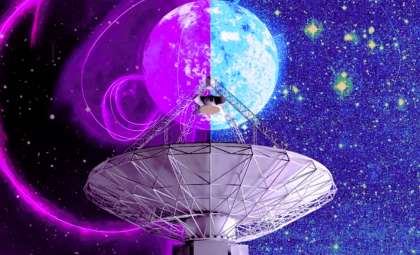
The intriguing signal was recorded by Russia’s Large Phased Array (LPA) radio telescope. Designed to detect radio emissions at specific frequencies, LPA caught this exceptional event during a routine technical check.
This FRB appeared as a burst lasting about 211 milliseconds. It features an impressive dispersion measure of 134.4 pc/cm³, an exceptionally strong flux density of 20 Jansky (Jy), and a frequency centered at 111 MHz. Such parameters are remarkable for fast radio bursts, which typically present higher frequencies and dispersion metrics.

Unlike the repeating fast radio bursts found in other studies, this one has not recurred, deepening the puzzle surrounding its nature.
Understanding fast radio bursts
Fast radio bursts (FRBs) were first observed in 2007. These fleeting phenomena last from 0.08 to 26 milliseconds, yet release immense amounts of energy in that brief time span.
Despite many efforts, the source of FRBs remains elusive. They unleash energy comparable to that emitted by our Sun over a span of days. Their origin could lie within our galaxy or stem from distant star systems or possibly intelligent extraterrestrial life.
Current research connects some FRBs to certain astrophysical sources like magnetars—the highly magnetized neutron stars. However, unusual inconsistencies in the data prevent a conclusive understanding.
Tracing an extragalactic provenance

The characteristics exhibited by FRB 20190203 strongly indicate it originated beyond our galaxy. The dispersion measure, crucial for estimating distance, implies the signal journeyed about 2.3 billion light-years before detection by LPA.
To explain, dispersion happens as radio waves interact with free electrons in space's interstellar and intergalactic mediums. A longer travel distance results in greater dispersion due to denser regions encountered en route.
Compared to other fast radio bursts, this event shares similarities with emissions from extreme cosmic environments, such as supernova debris or areas dominated by intense magnetic fields.
The signal’s extraordinary brightness and uniqueness suggest it may stem from a singular cosmic event or a phenomenon not yet recognized.
Possible origins: natural causes or extraterrestrial signals?
Since they were first detected, FRBs have inspired numerous theories. While most experts favor natural astrophysical explanations, some speculative ideas remain part of ongoing debates.
- magnetars and synchrotron radiation
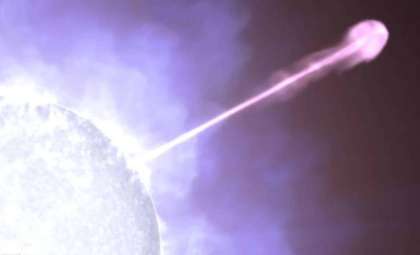
The leading scientific hypothesis points to synchrotron radiation generated by a magnetar. These neutron stars possess magnetic fields billions of times stronger than Earth’s, capable of producing intense radio bursts through complex mechanisms not yet fully understood. Their immense energy output could explain these powerful signals. - supernovae and cosmic strings
Certain FRBs may be linked to supernovae or catastrophic stellar end-of-life stages. Another more theoretical proposal involves cosmic strings, hypothetical defects in spacetime that might emit bursts when disrupted or interacting. - extraterrestrial technosignatures
A fascinating, albeit controversial, idea is that some FRBs represent technosignatures—structured signals sent by an advanced alien civilization. Though often relegated to science fiction, the precise nature of specific repeating FRBs fuels such speculation.
For FRB 20190203, the lack of repetition and relatively low frequency complicate the technosignature interpretation. Nonetheless, the absence of a definitive explanation means this hypothesis cannot be dismissed outright.
Broader scientific and existential significance
This discovery prompts profound questions about the cosmos and our place within it. While scientists approach such anomalies with caution, the prospect that these signals might originate from intelligent life fosters considerable interest.
- progress in detection technology: The emergence of such discoveries emphasizes the need for enhanced observational instruments. Facilities like the LPA in Russia and the CHIME telescope in Canada have expanded our capabilities, uncovering signals previously hidden. Continued innovation could unlock deeper mysteries behind FRBs.
- rethinking humanity’s cosmic role: Should technosignatures ever be confirmed, it would profoundly challenge our traditional, human-centered understanding of the universe.
Advancing fast radio burst studies
The exploration of FRBs remains in its early stages. The observation of FRB 20190203 marks a crucial development, extending the range of known fast radio bursts and inspiring new questions.
Future research goals include:
- Conducting long-term monitoring programs to find comparable signals.
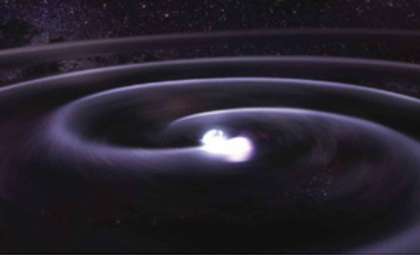
- Exploring associations with other cosmic events, such as gamma rays and gravitational wave occurrences.
- Improving signal detection technologies to identify even more transient bursts.
The enigma surrounding fast radio bursts continues to fascinate. While many answers remain out of reach, every new discovery edges us closer to a fuller comprehension of the universe—or perhaps even contact with extraterrestrial intelligences.
So, is this merely a natural occurrence, or could it be an intentional message from distant beings? One thing is clear: the cosmos still holds countless secrets awaiting discovery.
- Categories:
- Astronomy








0 comments
Sign in to Comment