
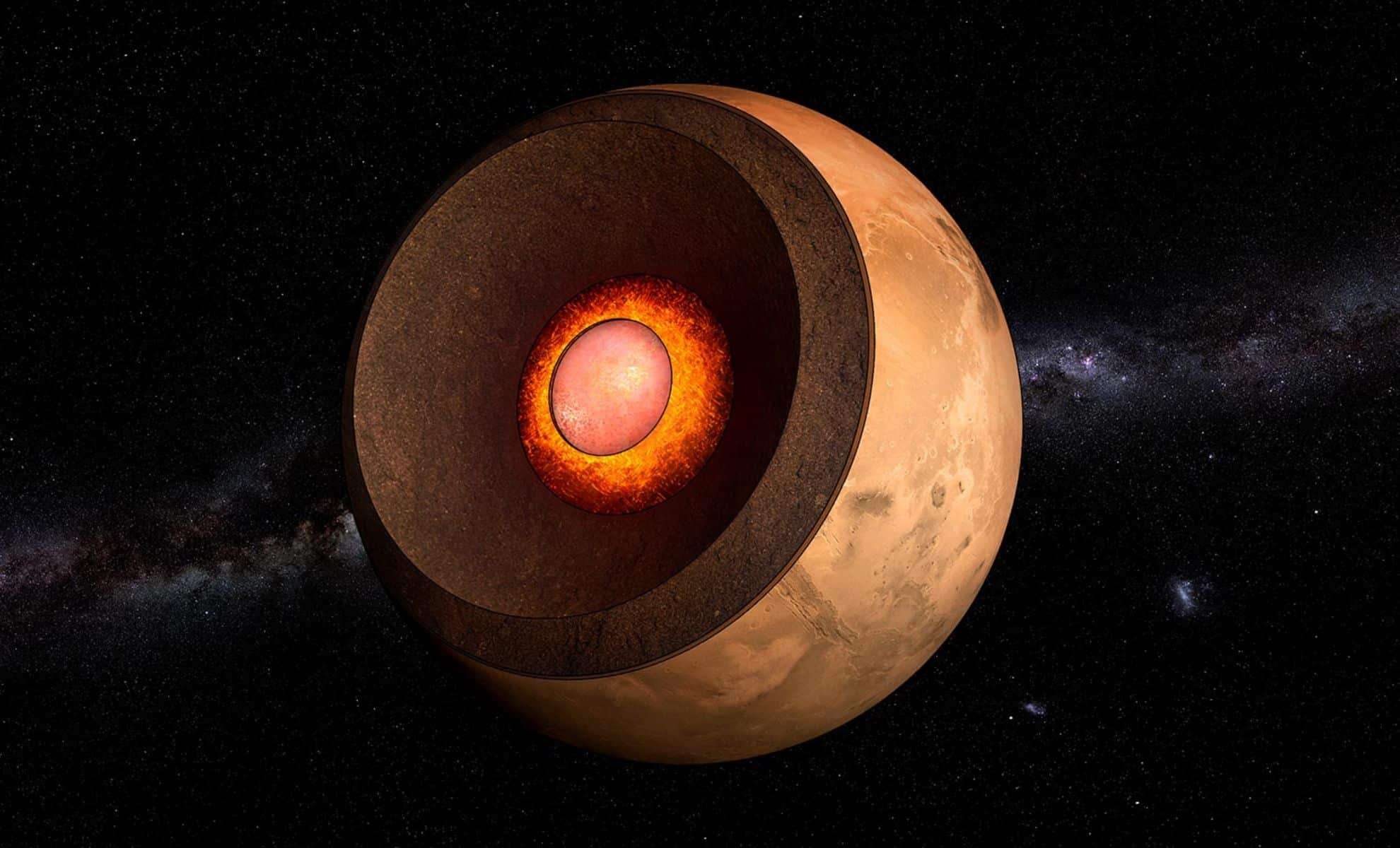
Innovative research from the University of Texas Institute for Geophysics presents a captivating explanation for Mars’ unusual ancient magnetic properties. The study indicates that the Red Planet’s core might have been entirely molten in the past, resulting in a magnetic field concentrated solely in the southern hemisphere.
A Long-Standing Magnetic Enigma
Scientists have long understood that Mars currently lacks a global magnetic field, a condition that likely left its atmosphere vulnerable to erosion by solar wind.
Data from the Insight lander reveal that Mars once possessed a magnetic shield capable of protecting its atmosphere and sustaining liquid water on its surface.

What baffled researchers was the magnetic field’s strange confinement to only the southern hemisphere, with the northern hemisphere noticeably lacking magnetic signatures. This hemispheric asymmetry has remained unexplained—until this new theory emerged.
A Fresh Perspective: Mars’ Entirely Molten Core
In the paper by Chi Yan and team, scientists propose that Mars once had a completely molten core billions of years ago, which generated a magnetic field.
This contrasts with the traditional view of Mars having a solid inner core surrounded by liquefied outer layers, similar to Earth.
The fully molten core concept suggests that Mars’ magnetic field arose from an unusual mechanism distinct from Earth’s conventional dynamo process, shaped by the planet’s internal characteristics.
Thermal Variations Driving the Unequal Magnetic Field
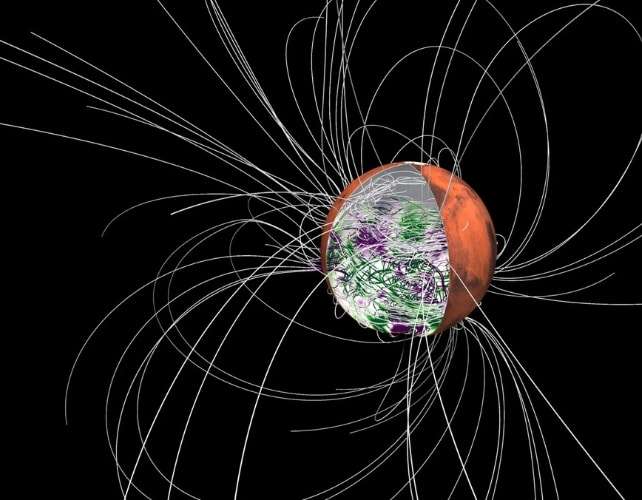
A core element of this hypothesis is that temperature differences within Mars influenced its magnetic field distribution. The scientists theorize that a marked disparity in thermal conductivity between the northern and southern hemispheres may have caused the magnetic asymmetry.
Simulations indicate the southern hemisphere had greater thermal conductivity, facilitating more efficient heat release. This might have fueled a stronger dynamo effect primarily beneath the southern hemisphere, intensifying the magnetic field there.
Put simply, most of the core’s activity would have been concentrated beneath Mars’ southern half.
Supercomputer Simulations Illuminate Mars’ Magnetic History
To validate their hypothesis, researchers employed supercomputers at the Maryland Advanced Research Computing Center to recreate early Martian conditions.
By modeling fluid motions in a molten core and altering crustal heat flow, they discovered that simulations best aligned with data from the Insight mission and Mars Global Surveyor when Mars’ core was fully molten with significant hemispheric thermal contrasts.
Consequences for Understanding Mars’ Past Habitability
This finding carries important weight for Mars’ habitability studies.
With a historic magnetic field, Mars could have shielded its atmosphere from solar wind stripping, preserving atmospheric conditions and potentially retaining liquid surface water—essential elements for life.
This fresh model offers a new framework for viewing Mars as a once potentially life-supporting world and guides future explorations to uncover signs of ancient life.
- Categories:
- Science












0 comments
Sign in to Comment