
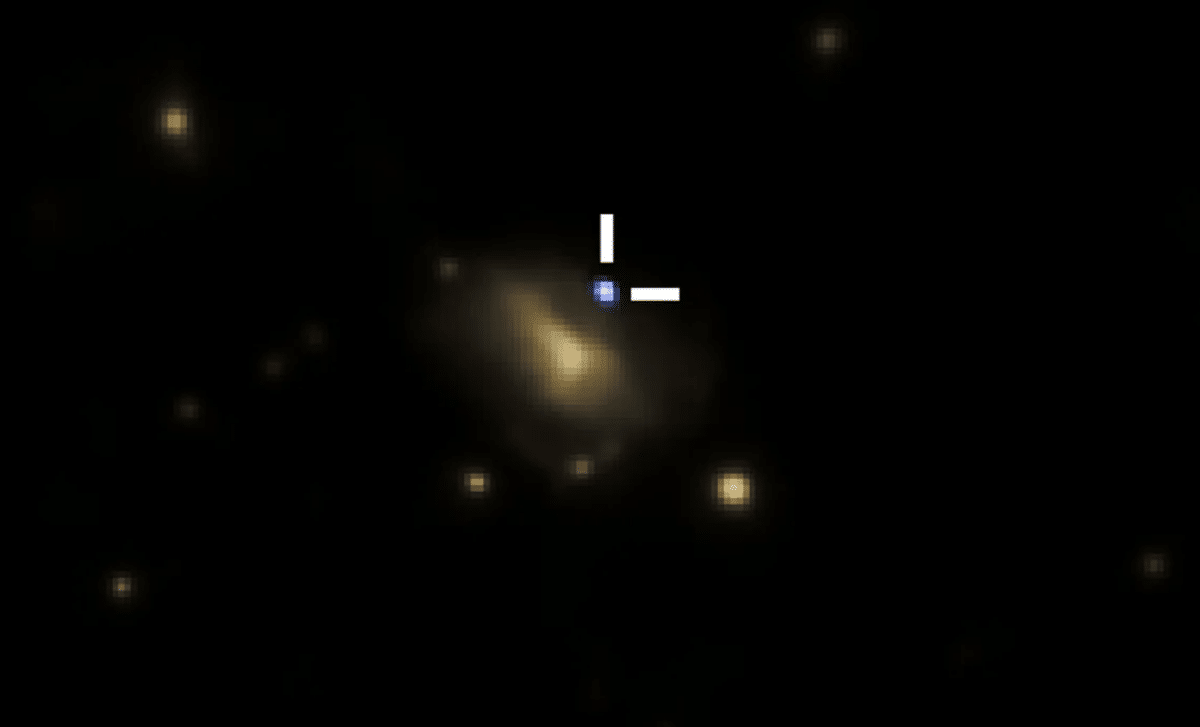
Recent research published on arXiv provides new insights into the puzzling phenomenon known as Luminous Fast Blue Optical Transients (LFBOTs). These strikingly bright blue flashes have confounded astronomers for years, but the study focusing on the event AT 2024wpp is revealing that black holes, not conventional stellar explosions, play a key role in their formation.
Decoding the Enigma of LFBOTs
Luminous Fast Blue Optical Transients (LFBOTs) are brief yet intense bursts of blue light lasting only a few days. Despite their short duration, their powerful emissions and unusual traits have created a major puzzle for researchers. These bursts produce ultraviolet signals alongside faint traces of X-rays and radio waves, indicating their roots extend beyond common cosmic events such as supernovae or typical black hole accretion. Among these phenomena, AT 2024wpp stands out as one of the brightest, guiding scientists toward a fresh understanding.
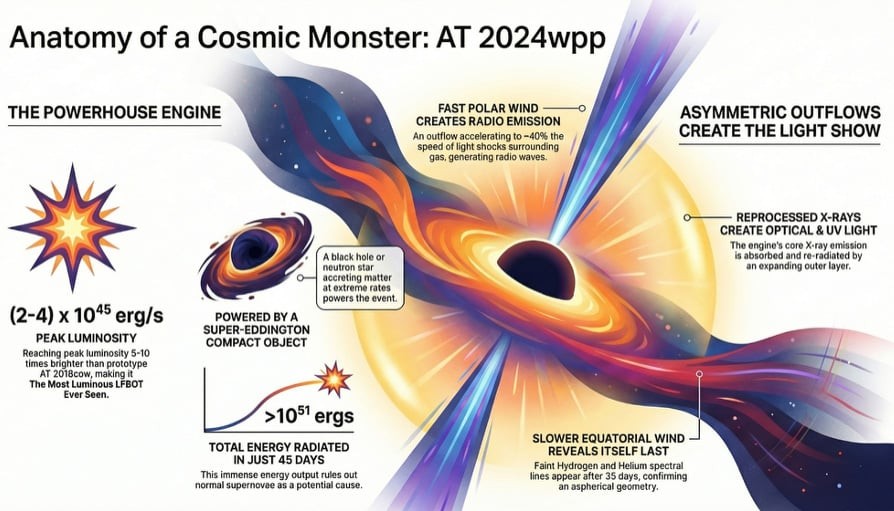
AT 2024wpp’s luminosity exceeds what could be produced by a typical supernova, shining approximately 100 times brighter. To put this in perspective, supernovae convert up to 10% of a star’s mass into energy, yet the radiated power from AT 2024wpp surpasses this by a wide margin. Natalie LeBaron, a graduate student at UC Berkeley and lead author of the study available on arXiv, explains, “The enormous energy output from these bursts cannot be explained by the death of a massive star or any conventional stellar explosion.” This revelation challenges existing theories about the origins of such intense cosmic flashes.

The Impact of Black Holes on LFBOT Production
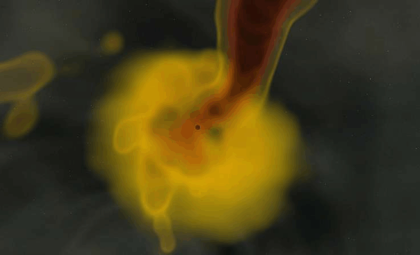
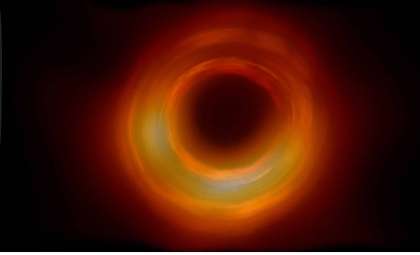
Although the full mechanism behind LFBOTs remains unclear, current evidence strongly implicates black holes as the driving force. Unlike typical black holes that consume ambient gas, the black hole linked to AT 2024wpp appears to have obliterated a companion star. Notably, this black hole has a mass around 100 times that of the Sun, smaller than the supermassive black holes usually tied to stellar disruption events.
This finding upends previous assumptions by demonstrating that a comparatively modest black hole can unleash extraordinary bursts of energy. The study highlights that LFBOTs operate through a more intricate process than standard models involving star collapse or supermassive black hole interactions.
“The main message from AT 2024wpp is that the model that we started off with is wrong,” says LeBaron. “It’s definitely not caused by an exploding star.”
This decisive remark redirects scientific focus towards alternative explanations and expands our understanding of black hole interactions in the universe.
Connecting AT 2024wpp to Gravitational Wave Astronomy
The significance of AT 2024wpp reaches beyond explaining luminous flashes, offering new opportunities to study black hole phenomena. Gravitational wave observatories typically investigate black hole mergers, but establishing links between these events and electromagnetic signals has been challenging. LFBOTs, such as AT 2024wpp, provide a novel observational avenue.
Raffaella Margutti, associate professor at UC Berkeley, emphasizes that theoretical frameworks explaining massive black holes detected through gravitational waves might benefit from analyzing LFBOTs. These transients present “a completely different angle” on how such black holes form and evolve.
Additionally, examining the locations of LFBOTs within their host galaxies gives researchers vital context about black hole environments. Margutti points out that these transients allow precise mapping, deepening our grasp of the conditions leading to massive black hole and companion star pairings.
Insights into the Life Cycle of Companion Stars and Black Holes
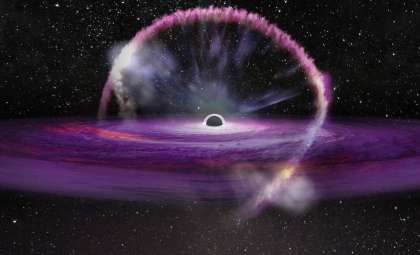
Key to this research is identifying the destroyed companion star, believed to be an aging Wolf-Rayet star. These massive stars, known for their intense stellar winds and significant mass loss, are common candidates in violent end-of-life interactions. When drawn too close to a black hole, the star is ripped apart in a catastrophic tidal event.
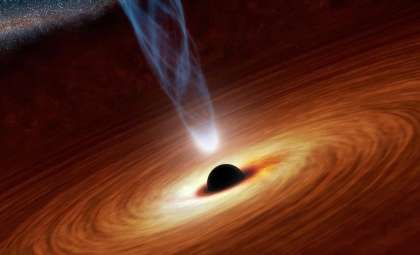
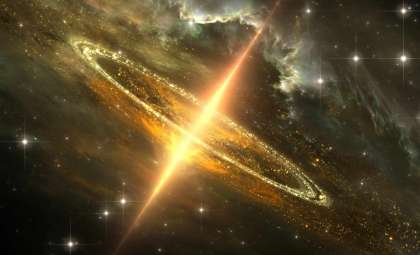
The resulting debris spirals toward the black hole, forming an accretion disk that emits the powerful ultraviolet and X-ray radiation characteristic of LFBOTs. Some material escapes in high-speed jets moving near 40% of the speed of light, whose collision with surrounding gas zones generates the observed radio emissions.
The findings imply that such extreme occurrences might be more prevalent than once thought, hinting at intricate connections between black holes and their stellar neighbors. This research opens new pathways for exploring black hole growth and the dynamic relationships within their galactic neighborhoods.
- Categories:
- Space

0 comments
Sign in to Comment