
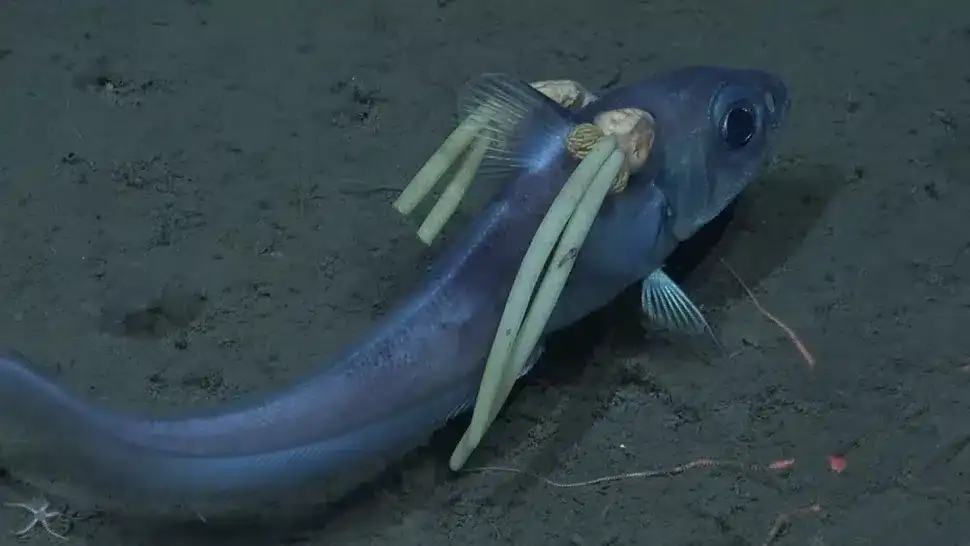
Captured by the Schmidt Ocean Institute, fascinating footage displays a deep-sea rattail fish carrying two parasites latched firmly on both sides of its head. These parasites, identified as Lophoura szidati, are blood-feeding copepods embedded partially within the fish’s muscle tissue.
Discovery of Tail-Ending Parasites at Nearly 1,600 Feet Below Ocean Surface
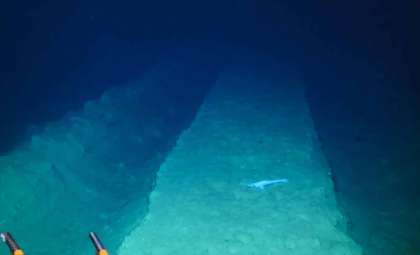
The rattail fish, from the genus Macrourus, was observed at a depth of approximately 1,604 feet (489 meters) near the isolated volcanic South Sandwich Islands in the South Atlantic.
Known as grenadiers or rattails, these deep-sea dwellers occupy chilly oceanic environments ranging from both the North and South Atlantic to the Southern Ocean. Their distinctive large heads and tapered tails allow Macrourus species to survive in dark, high-pressure habitats, spanning depths between 1,312 and 10,450 feet (400 to 3,185 meters).
During this unusual observation, the fish hosted a pair of female L. szidati, which displayed long, pendulous sacs hanging from their bodies.
These sacs hold hundreds of maturing eggs, creating an eerie yet ornamental silhouette that masks their reproductive function.

Mesoparasites That Leave Lasting Scars on Their Hosts
The organisms are categorized as mesoparasites, meaning they inhabit partially inside and partially outside of their host.
James Bernot, an evolutionary biologist at the Smithsonian National Museum of Natural History, explains, “They extract blood and bodily fluids with scraping mouthparts embedded within the fish’s muscles.”
The video shows the copepods’ heads deeply anchored inside the fish’s flesh, while the rear portions with egg sacs remain external. These front anchors help the parasites maintain their grip as they mature.
Bernot also noted that “traces of the embedded heads persist in hosts for years after the parasites perish,” keeping a haunting footprint of their parasitic existence.
New Insight Into Parasitic Life in Southern Ocean Depths
Though parasitism in deep water is documented, encounters in Antarctic regions are rare. The L. szidati copepods rank among the most frequent parasites found on Macrourus fish here, but direct observations of their attachment and reproduction remain scarce.
Research suggests these parasites begin bonding with their hosts during a larval phase, embedding themselves in the fish’s skin and gradually developing into mature parasites.
Bernot remarked, “As invertebrate mothers, copepods are quite nurturing, carrying their eggs in sacs until they hatch into swimming nauplius larvae, which molt through multiple stages before seeking their own hosts.”
This finding sheds light on parasitic dynamics in Antarctica’s deep waters, a largely unexplored zone. It highlights how even the tiniest, most unusual marine creatures contribute crucially to the underwater ecosystem’s delicate balance.
- Categories:
- News







0 comments
Sign in to Comment