
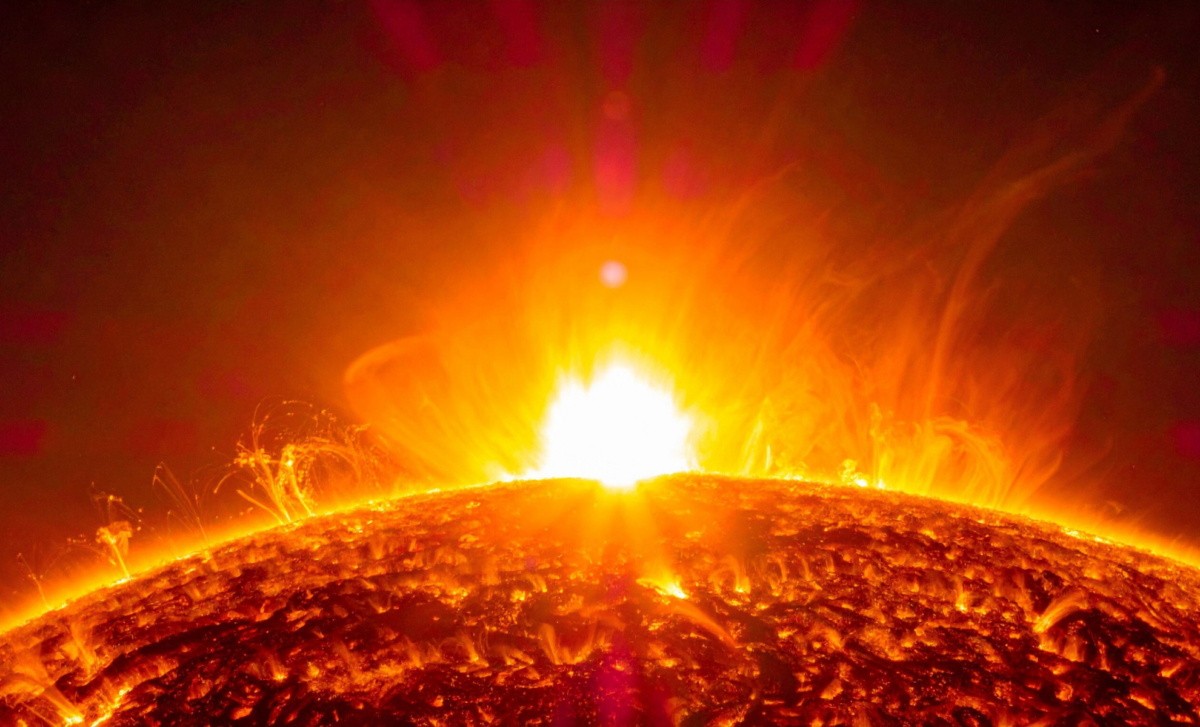
Researchers at NJIT’s Center for Solar-Terrestrial Research (NJIT-CSTR) have identified the hidden origin of intense gamma rays produced during solar flare events. These high-energy rays had long mystified scientists, but the investigation has now linked them to a distinct group of particles within the Sun’s atmosphere. By integrating gamma-ray and microwave data from solar flares, the team has developed groundbreaking insights that could transform solar flare physics and refine space weather prediction models.
Decoding the Origins of Gamma Rays in Solar Flares
For many years, it has been apparent that solar flares emit characteristic gamma-ray signatures, yet the precise source and generation mechanism remained unclear. As Gregory Fleishman, lead author and NJIT-CSTR physics professor detailed in Nature Astronomy, “While solar flares’ gamma rays were known, their origin and production process weren’t understood. This gap hindered our grasp of the responsible particles and their potential influence on space weather. Our combined gamma-ray and microwave observations from a flare finally unraveled this mystery.”
This pivotal revelation came through collaboration involving NASA’s Fermi Gamma-ray Space Telescope and NJIT’s Expanded Owens Valley Solar Array (EOVSA). Analyzing the September 10, 2017 flare, the team detected a previously unidentified class of extremely energetic particles, responsible for the gamma emissions. These particles possessed energies of several million electron volts (MeV), far exceeding typical flare particle energies.

Bremsstrahlung: Key to Gamma-Ray Emission
A central discovery was bremsstrahlung—a process where high-energy electrons encounter the Sun’s plasma and emit gamma rays. This mechanism underlies the powerful radiation produced during solar flare episodes. Fleishman explains,
“Unlike the typical electrons accelerated in solar flares, which usually decrease in number as their energy increases, this newly discovered population is unusual because most of these particles have very high energies, on the order of millions of electron volts, with relatively few lower-energy electrons present.”
Recognizing this highly energetic particle population sheds light on how solar flares accelerate particles to extreme energies. The acceleration is triggered when magnetic energy stored in the Sun’s corona is rapidly released during flare eruptions, causing charged particles to speed up dramatically. This insight stands to enhance solar flare models and boost our capacity to anticipate space weather threats impacting satellites and exploration missions.
Pinpointing High-Energy Particles via Advanced Observations
Utilizing sophisticated instruments, the NJIT team simultaneously tracked microwave and gamma-ray emissions from the solar flare, enabling them to isolate a distinct atmospheric region housing concentrated high-energy particles. Known as Region of Interest 3 (ROI 3), this area exhibited clear markers of vigorous particle acceleration and decaying magnetic fields. By combining gamma-ray readings from Fermi with microwave data from EOVSA, the researchers established a direct link between the accelerated particles and the bremsstrahlung gamma rays.
Fleishman notes potential advances stemming from this finding:
“We see clear evidence that solar flares can efficiently accelerate charged particles to very high energies by releasing stored magnetic energy. These accelerated particles then evolve into the MeV-peaked population we discovered.”
Next Steps and Open Questions
This breakthrough raises intriguing questions yet to be resolved, such as whether these particles are electrons or their antimatter counterparts, positrons. As Fleishman points out,
“One big unknown is whether these particles are electrons or positrons. Measuring the polarization of microwave emissions from similar events could provide a definitive way to tell them apart. We expect to gain this capability soon with the EOVSA-15 upgrade.”
The forthcoming EOVSA-15 expansion will add 15 antennas and cutting-edge ultra-wideband receivers, greatly enhancing the array’s ability to observe solar flares and more precisely characterize the particles that create gamma rays.
Boosting Space Weather Forecasting with New Insights
Gaining a comprehensive understanding of how solar flares affect their space environment is fundamental to advancing space weather prediction. The newly found high-energy particles could have major consequences for satellites and other technologies operating in space. Incorporating these findings into solar flare models promises to improve the accuracy of forecasting space weather, thereby mitigating risks to astronauts and spacecraft.
Fleishman concludes, “This discovery bridges key gaps in our knowledge of solar flare processes and holds promise for better models that ultimately strengthen space weather prediction.”
- Categories:
- Space






0 comments
Sign in to Comment