
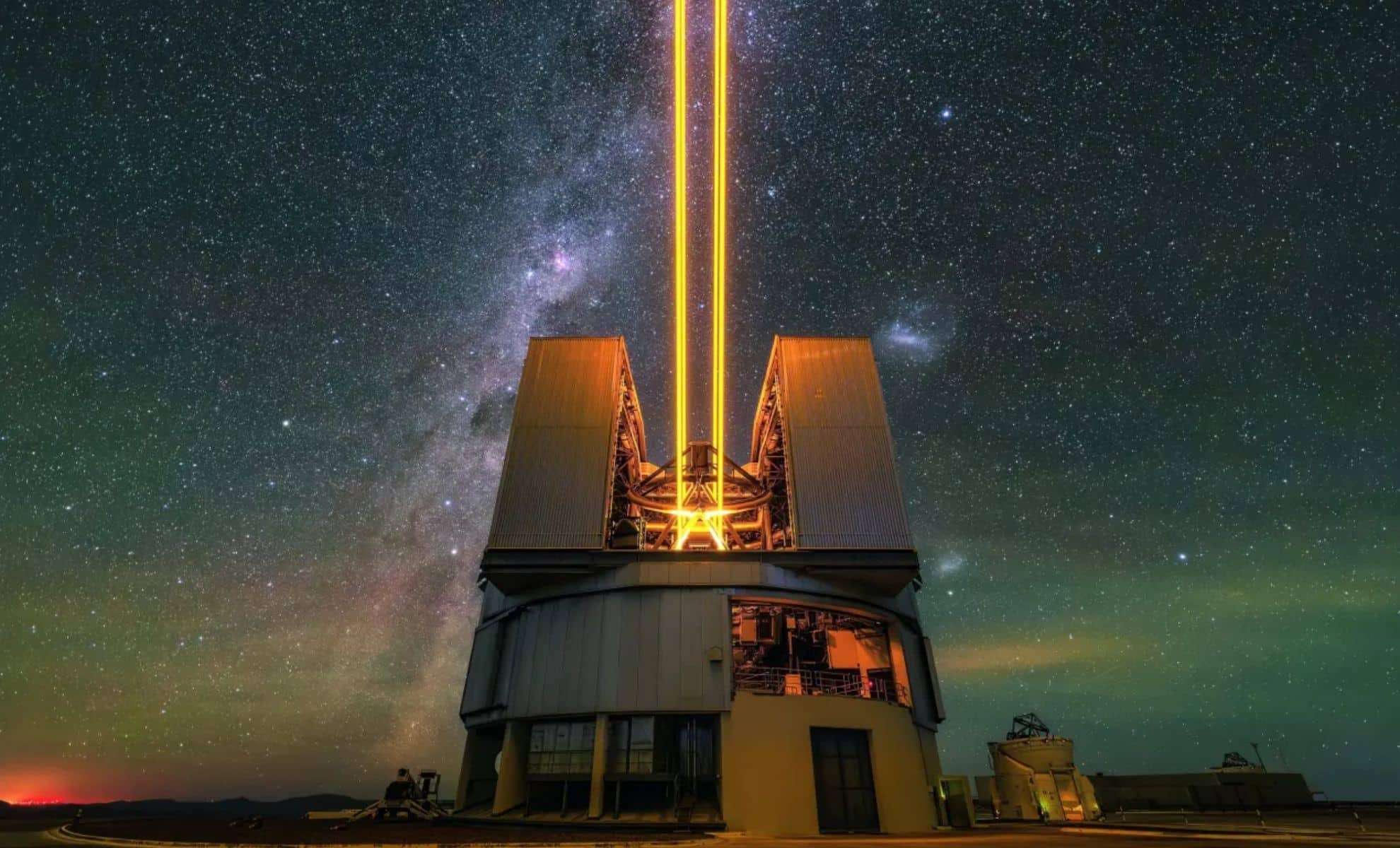
Situated at Chile's Paranal Observatory, the UT4 telescope goes beyond merely observing stars—it generates artificial stars to counteract atmospheric disturbances.
By projecting intense laser beams skyward, the telescope fabricates guide stars that assist in correcting distortions induced by Earth's turbulent atmosphere. This sophisticated technique, known as adaptive optics, allows UT4 to capture cosmic images with a clarity comparable to those taken by space-borne observatories.
An Unforgettable Evening at Paranal
In the arid expanses of the Atacama Desert, Paranal Observatory hosts the Very Large Telescope (VLT), a quartet of 8-meter telescopes ranking among Earth's most potent. Within this group, the UT4 telescope is distinguished by its capacity to emit striking laser beams into the nighttime sky.

According to SciTechDaily, these laser emissions generate artificial stars, functioning as guide stars that measure and compensate for atmospheric distortion affecting incoming starlight.
The lasers activate sodium atoms approximately 90 kilometers above Earth, causing them to emit a bright glow. These illuminated points serve as references to evaluate atmospheric effects on light from distant stars, enabling real-time adjustments for clearer observational data.
Enhancing Cosmic Image Precision With Laser Technology
Atmospheric turbulence often causes distant stars to flicker and blur, presenting obstacles for terrestrial telescopes. To address this, UT4 employs the 4 Laser Guide Star Facility (4LGSF), creating synthetic stars high in the atmosphere.
By monitoring distortions affecting these artificial stars, the telescope can dynamically correct for atmospheric interference. Its advanced adaptive optics system continually tweaks the secondary mirror to counteract these distortions.
This swift correction process empowers the telescope to yield extraordinarily sharp images, nearing the clarity levels achieved by space telescopes.
Advancing the Very Large Telescope's Potential
UT4's laser-assisted capabilities represent just the starting point. Upcoming upgrades will equip the other three VLT telescopes with laser systems, elevating image resolution across the array.
These enhancements will strengthen the VLT Interferometer, which merges light from all four telescopes to function as an immense "virtual" telescope boasting unparalleled cosmic observation power.
Close to Paranal, the Extremely Large Telescope (ELT) is nearing completion and will utilize at least six lasers. This state-of-the-art observatory promises the most detailed ground-based astronomical imagery ever captured, pushing research frontiers further.
Leveraging laser technology alongside adaptive optics, Paranal Observatory continues to empower astronomers to uncover the universe’s secrets with remarkable precision, achieving observational quality once reserved only for spaceborne instruments.
- Categories:
- Astronomy





0 comments
Sign in to Comment