

Scientists from the Institute of Oceanology at the Chinese Academy of Sciences (IOCAS) have uncovered an immense hydrogen-abundant hydrothermal system in the western Pacific Ocean. This remarkable feature, located west of the Mussau Trench on the Caroline tectonic plate at a depth exceeding 3,000 meters, emerges in an area previously regarded as geologically uneventful.
The newly identified Kunlun hydrothermal field spans more than 11 square kilometers, dwarfing the famous Atlantic Lost City vent by over a hundredfold in size. Yet, its significance goes well beyond sheer dimensions.
“It shows that serpentinization-driven hydrogen generation can occur far from mid-ocean ridges,” said Professor Weidong Sun, corresponding author of the study. “That challenges long-held assumptions in deep-ocean geology.”
Add Cosmo Herald as a Preferred Source

Utilizing the Fendouzhe manned submersible alongside in situ Raman spectroscopy, the researchers recorded hydrogen concentrations ranging from 5.9 to 6.8 mmol/kg in diffuse hydrothermal fluids. When combined with measurements of flow speed and discharge mapping, they estimated an annual hydrogen emission of approximately 4.8 × 10¹¹ moles, equating to roughly 1 million metric tons every year. This output represents nearly 5% of the world’s overall natural underwater hydrogen flux, originating from a single location.
Deep-Sea Hydrogen Origins
Traditionally, oceanic hydrogen was linked mainly to mid-ocean ridges, where tectonic plates separate and magma rises from Earth’s interior. There, water interacts with olivine-rich rocks through a process called serpentinization, producing hydrogen gas as a byproduct.
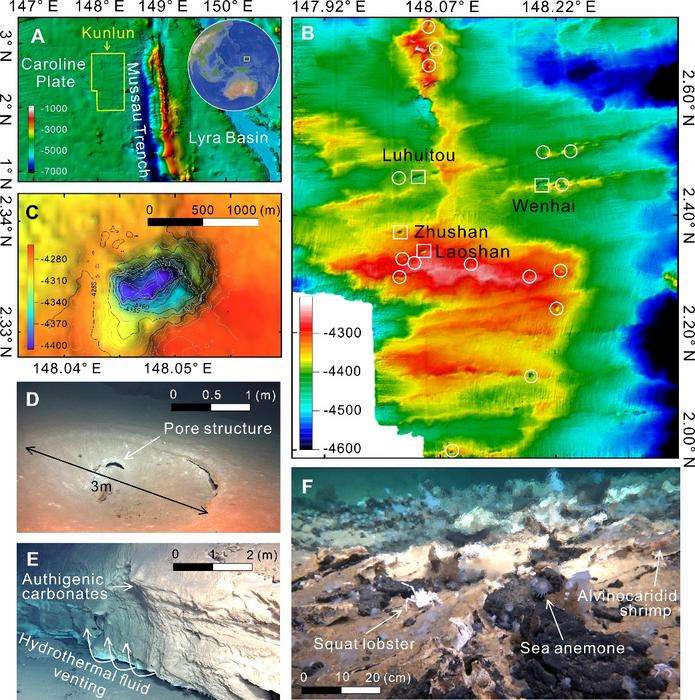
Until now, the consensus was that significant hydrogen production required proximity to such ridge environments. The Kunlun site challenges this, as its geological formations—including pipe swarms, carbonate structures, kimberlite-like depressions, and breccia fields—demonstrate serpentinization occurring deep within an intraplate setting, far from any mid-ocean ridge.
“This discovery confirms that hydrogen-generating reactions are not confined to seafloor tectonic boundaries where new crust forms,” the researchers state. This finding significantly broadens the search for undersea hydrogen sources in previously unconsidered tectonic zones. Kunlun highlights how natural hydrogen emissions from Earth’s interior may be more abundant and widespread than earlier believed.
An Untapped Carbon-Neutral Energy Resource
Although not a mining proposal, the team acknowledges Kunlun's vast energy potential. At current green hydrogen market prices, the site’s yearly output of about 1 million tons would represent around €5 billion in value. Notably, this hydrogen is generated by geological processes rather than energy-intensive industrial methods like electrolysis, requiring no freshwater—just natural geochemical activity beneath thousands of meters of ocean.
This positions Kunlun as a promising carbon-neutral hydrogen reservoir that could potentially be tapped without the environmental costs of pipelines, hydraulic fracturing, or mining—if responsibly managed. The researchers emphasize caution, describing the field as a natural research site and stating, “this discovery is not an invitation to drill the seafloor.”
Nevertheless, the site is poised to attract interest from nations and corporations investing in hydrogen-driven energy transitions. Kunlun offers a rare example of a naturally scalable hydrogen source with a potentially minimal carbon footprint.
Dark Depths Host Unique Life — Possibly Linked to Earth’s Origins
Hydrogen isn't the only remarkable feature of Kunlun. The team found distinct biological communities flourishing without sunlight near hydrothermal vents. Using submersible imagery and biological sampling, they observed ecosystems thriving on chemosynthesis—the conversion of chemical energy into biological energy. Species such as shrimp, squat lobsters, tubeworms, and anemones were clustered around warm hydrothermal flows, many likely utilizing hydrogen as an energy source.
“What’s particularly intriguing is its ecological potential,” said Prof. Sun. “These organisms may depend on hydrogen-fueled chemosynthesis.”
This discovery closely connects with hypotheses about the emergence of life on our planet. Similar environments—rich in hydrogen and alkaline fluids interacting with solid rock in stable deep ocean settings—have long been considered plausible environments for life’s origins. Unlike the Lost City, Kunlun exhibits more stable geological features and a steady hydrothermal flow, potentially offering a longer-lasting, more favorable evolutionary habitat.
For the field of astrobiology, this finding broadens the scope beyond Earth. Comparable conditions might exist beneath the icy shells of moons like Europa or Enceladus, where subsurface oceans interact with rocky interiors without sunlight.
- Categories:
- News





0 comments
Sign in to Comment