
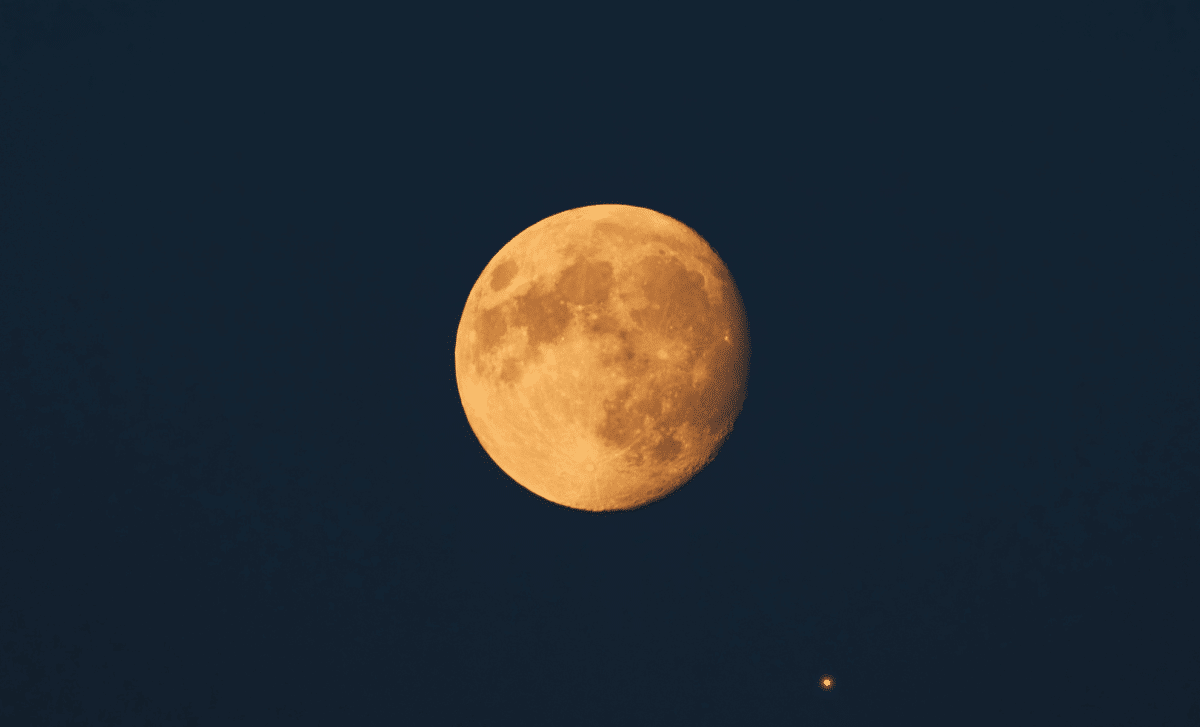
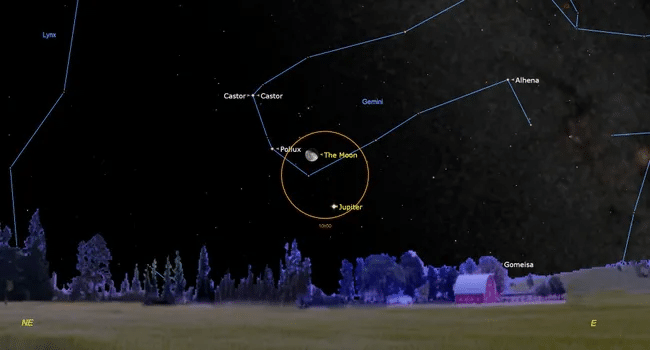
Sky enthusiasts are treated to an extraordinary spectacle this evening as the Moon and Jupiter draw close together in the night sky. Whether you’re a casual observer or a dedicated astronomer, this rare alignment presents a perfect opportunity to admire two of the night’s brightest objects. No special gear is necessary — simply gaze toward the east-northeast shortly after dusk to catch the waning gibbous Moon alongside the radiant glow of Jupiter.
An Unmissable Celestial Encounter: The Moon Meets Jupiter
Sunday night will see the Moon shining at about 72% illumination, casting a gentle luminosity over the night. Positioned just beneath it, Jupiter will shine as a brilliant, unwavering “star,” outshining almost every other object you can see. This close approach unfolds around 10 p.m. local time, lasting briefly but visible to anyone stepping outside. The two bodies will be separated by roughly 4.5 degrees—a distance about half the width of a clenched fist held at arm’s length—making it a simple yet stunning sight for all to enjoy.
Beyond visual delight, Space.com notes that Jupiter currently resides against the backdrop of Gemini the Twins, granting it extended visibility across the night sky, especially for Northern Hemisphere viewers. This positioning brings a special viewing window for people not often able to see Jupiter shining so vividly.

When and How to Catch This Celestial Show
The exact timing of this phenomenon depends on your location in the U.S. For those on the East Coast, the conjunction peaks shortly after 1:45 a.m. Monday. Pacific Time observers will witness the event earlier, around 10 p.m., as the Moon ascends in the eastern horizon. Since the Moon’s position in relation to Jupiter shifts during the night, knowing the timing will maximize your viewing experience.
As night progresses, the Moon will move eastward away from Jupiter and Pollux, another shining star in Gemini. By dawn, the duo will have parted ways, ending this magical alignment. Late-night viewers will enjoy observing how these positions evolve as the night rolls on.
Understanding Why Jupiter Is Particularly Bright Now
The brilliance of Jupiter tonight stems from its location along the ecliptic plane at a high declination of +23 degrees. This northern position allows the gas giant to remain above the horizon longer and climb higher in the sky—perfect for observers in the Northern Hemisphere who get to witness its glow well into the night.
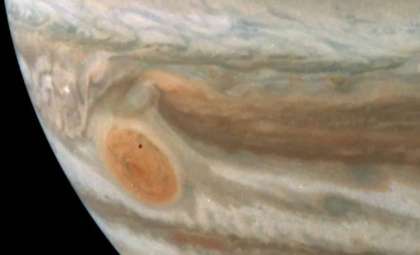
Especially in the southern United States, Jupiter will be near its highest point in the sky, or zenith, as it crosses the meridian during the early morning. This makes it an ideal time for telescope users eager to observe the planet’s characteristic features, including its iconic Galilean moons.
Beyond the Conjunction: Exploring Jupiter’s Moons Through a Telescope
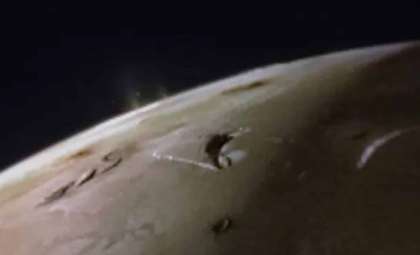
If you have a telescope at your disposal, Sunday offers more than just a view of the celestial pairing. Jupiter is currently one of the best planets to observe, and even modest instruments reveal its four largest moons—Io, Europa, Ganymede, and Callisto. Watching these moons shift positions against the planet creates a captivating, ever-changing display.
Optimal viewing conditions require Jupiter to be at least 30 degrees above the horizon, so the clearest telescope views will come around midnight when the planet is higher in the sky. Observing earlier, when it’s lower, can result in distortion due to atmospheric turbulence near the horizon.
- Categories:
- Astronomy




0 comments
Sign in to Comment