

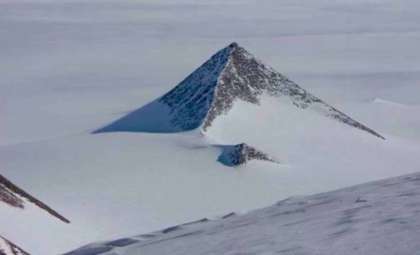
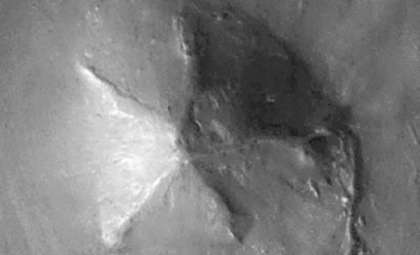
A strikingly geometric mountain peak in Antarctica has captured worldwide intrigue due to its nearly perfect pyramid appearance. Located within the frozen expanse of the Ellsworth Mountains, this peak was identified through satellite images and rapidly became the subject of imaginative theories, ranging from relics of ancient cultures to extraterrestrial influences. Nonetheless, experts confirm that the explanation is grounded in natural geological processes.
Google Earth Discovery Ignites Online Discussion
The intrigue began when explorers on Google Earth pinpointed a sharply defined, pyramid-shaped mountain situated at 79°58’39.25”S 81°57’32.21”W in the remote Heritage Range. Viewed from above, the mountain exhibits four distinct sides converging to a sharp apex, with steep inclines descending into the surrounding ice. This unusual shape quickly sparked social media conversations speculating whether the peak was evidence of a hidden ancient civilization beneath Antarctica's ice sheet.
Images and videos surged online, prompting claims about possible engineered structures beneath the snow. Some observers argued the precision of the form was too exact to be the work of natural forces, especially given the site's extreme isolation.

Scientific Analysis Provides a Natural Explanation
As the excitement grew online, geologists and earth scientists offered more pragmatic insights. Professor Eric Rignot of the University of California emphasized that the formation is simply a naturally occurring mountain resembling a pyramid. “This mountain’s shape, while unusual, arises from natural processes,” he noted, highlighting how phenomena such as erosion and freeze-thaw weathering can sculpt rock into sharp, pyramid-like forms over time.
Geologist Dr. Mitch Darcy from the German Research Centre for Geosciences further clarified the peak’s identity as a nunatak—an exposed rocky summit emerging above surrounding ice fields.
“This one has the shape of a pyramid, but that doesn’t make it a human construction,” he explained.
According to Darcy, the mountain’s steep, angular faces are the product of eons of climatic wear and glacial ice movement. This aligns with studies from the US Geological Survey, which documents numerous sharp, triangular nunataks within the Heritage Range shaped by glacier activity and tectonic forces. Such formations frequently exhibit pyramid-like contours, especially where retreating ice reveals older geological structures.
Ellsworth Mountains Reveal Stunning Geological Features
The so-called pyramid is only one of many remarkable natural phenomena in the Ellsworth Mountains, which stretch over 400 kilometers across Antarctica’s western sector. Divided into the Sentinel and Heritage subranges, the region boasts towering summits, expansive glaciers, and rock formations dating back more than 150 million years.
The peak drawing attention stands approximately 4,150 feet high, relatively modest compared to neighboring mountain giants. However, the area is renowned for fossil finds over 500 million years old, making it a key site for tracing Earth’s ancient geological and climatic history.
Despite severe temperatures often plunging below -50°C, ongoing scientific expeditions continue to investigate the region's secrets, shedding light on Antarctica’s evolutionary past and tectonic evolution.
Natural Formations Often Mimic Familiar Shapes
Despite expert explanations, the pyramid hypotheses have not lost momentum. Many remain convinced the distinct outline cannot be solely attributed to nature. From a scientific standpoint though, this is likely a case of pareidolia—where humans interpret ambiguous patterns as meaningful shapes.
Mauri Pelto, an environmental science professor at Nichols College (link), remains unconcerned by the ongoing speculation. “At least they’re thinking about something,” he remarked, noting that even unconventional theories can encourage public interest in Earth's complex processes.
- Categories:
- News







0 comments
Sign in to Comment