
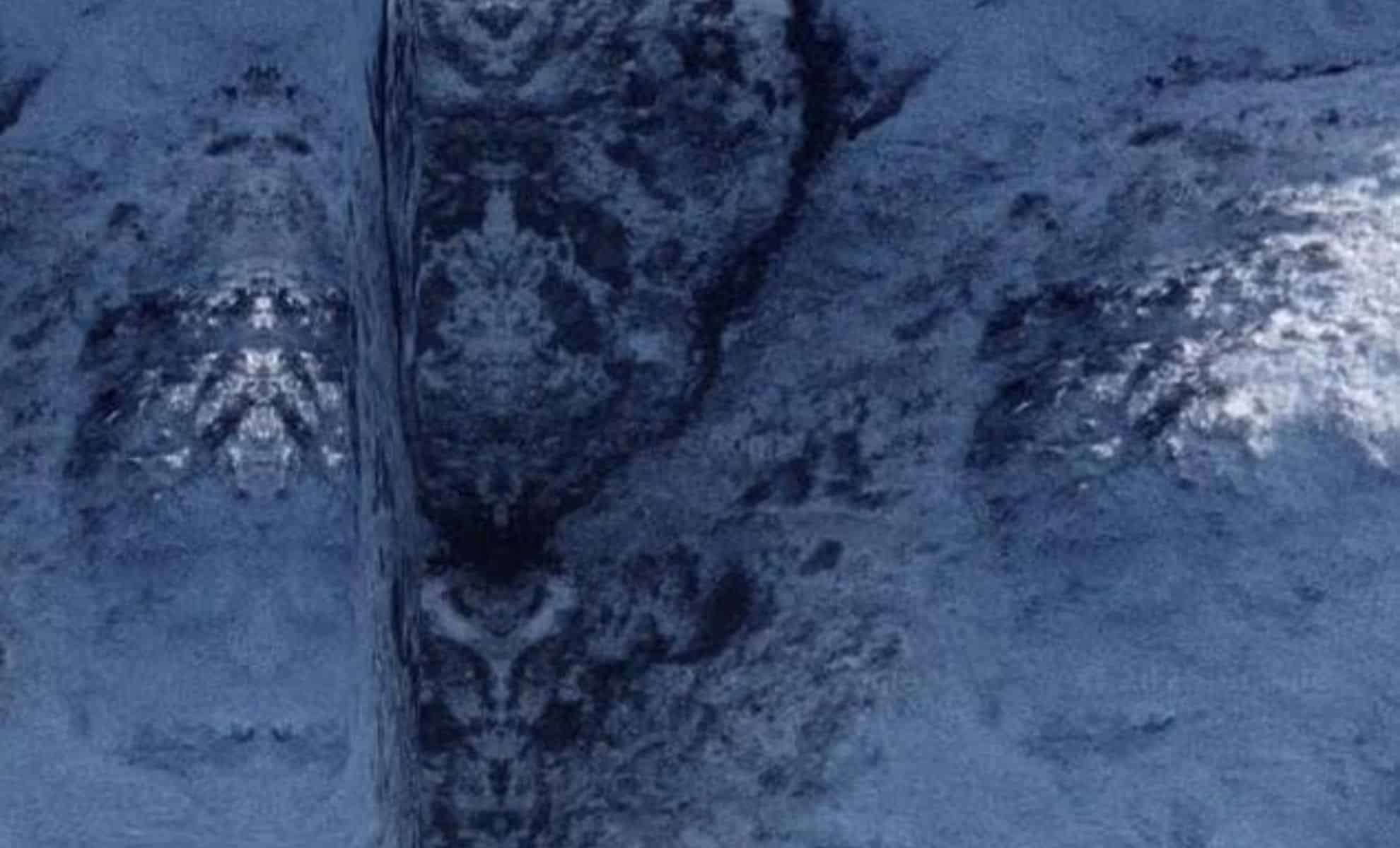
Explorers on Google Maps have uncovered a curious natural feature that is fueling extraterrestrial theories. Nestled in Chile’s isolated mountainous terrain, a contour resembling a human face has intrigued many viewers. This unusual sight has prompted suggestions ranging from ancient alien activity to hidden extraterrestrial outposts. Nevertheless, researchers offer a more rational interpretation.
An Intriguing Find in Southern Chile’s Wilderness
The Daily Mail reports that this enigmatic facial formation emerges from a secluded island off Chile’s southern coast. The unusual pattern was noted by Scott C. Waring, a known UFO enthusiast who shares his discoveries online. He revealed the coordinates 55°32’35” S, 69°15’56” W and posted a video demonstrating the feature on YouTube.
The footage quickly attracted attention, particularly among alien enthusiasts. Some viewers speculated the formation might be part of an "alien stronghold." Waring himself commented, “The oldest aliens in our universe might be seen as angels or demons with such powers…or even god or gods.”

Being distant from populated areas, this geographic anomaly has provoked interest and various theories. To many onlookers, the face-like shape seems far too precise to be a product of natural geological processes.
Understanding the Role of Pareidolia
Despite the excitement, scientists attribute the image to a well-known psychological effect called pareidolia. This phenomenon causes humans to identify familiar shapes, especially faces, in random visual stimuli.
Dr. Robin Kramer, an expert in facial recognition at the University of Lincoln, elaborated: “Our brain’s face detection system is highly tuned, often erring on the side of spotting faces where none exist to avoid missing actual faces.”
This evolutionary trait likely aided early humans in quickly identifying potential threats or allies by interpreting ambiguous patterns as faces, which proved advantageous for survival.
Linking Geological Features to UFO Lore
Seeing faces in unusual settings is a common occurrence. Landforms and random objects often trigger interpretations of humanoid features. Waring’s discovery, among others, has strengthened the belief in connections to ancient extraterrestrial civilizations or covert alien activities.
Comments on the video further indicate fascination, with one user mentioning, “I spotted similar patterns in Antarctica that defied explanation. Initially, I considered them digital glitches, but now they might resemble ancient Nasca glyphs.”
While captivating, experts warn that pareidolia often creates illusions of faces where there are none, causing natural formations to be mistaken for extraordinary artifacts.
The Human Brain’s Innate Fascination with Faces
Research highlights that individuals vary in their tendency to identify faces in random visuals. Professor Kevin Brooks from Macquarie University noted, “We generally classify anything roughly face-like as a face until evidence suggests otherwise, as a safety mechanism.” This instinct is deeply rooted in human cognition.
Dr. Susan Wardle of the National Institutes of Health pointed out that while pareidolia isn’t usually indicative of mental health issues, people with strong paranormal beliefs are more prone to detecting faces in random patterns. She referenced a 2012 study from Finland showing that individuals with religious or paranormal convictions are statistically more likely to perceive faces in unexpected places, showing the interplay of culture and psychology in this phenomenon.
- Categories:
- News






0 comments
Sign in to Comment