
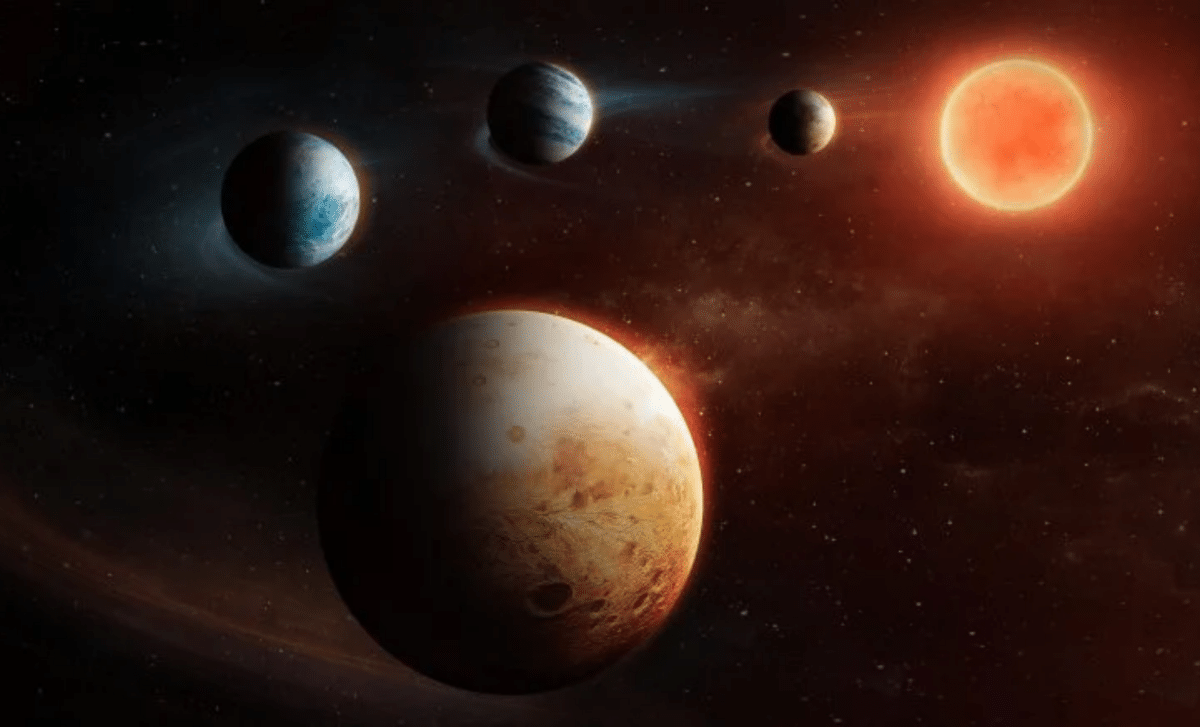
A recently discovered planetary system is challenging established ideas about planetary origins, as astronomers detect a rocky planet situated where conventional models say it shouldn’t exist, a new study in Science reveals.
An Unconventional Planetary Setup
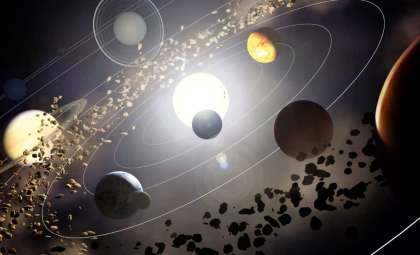
In a distant star system, researchers have identified a peculiar arrangement that contradicts traditional planetary formation theories. This system features a small rocky planet located beyond two large gas giants—an unexpected configuration. Typically, gas giants form farther out in the colder regions of protoplanetary disks, while rocky planets develop in the warmer inner areas where lighter elements are scarce. The existence of a rocky world outside of these gas giants suggests the system’s evolutionary path diverged from conventional expectations.
Thanks to precise measurements from the CHEOPS space telescope, managed by the European Space Agency, scientists have been able to capture detailed data on planet sizes and orbital dynamics. This advanced instrument detects faint changes in starlight caused by planets crossing their host star, enabling the discovery of several planets in the system, including one whose unusual location and composition immediately stood out.

“It is thanks to the precision of CHEOPS that we were able to detect this new planet,” says Monika Lendl (UNIGE). “Since rocky planets do not usually form beyond gas giants, this one completely overturns our theories!”
Indications of a Delayed Planet Formation
The results presented in Science indicate this rocky planet likely formed under conditions sharply different from its giant neighbors. Gas giants normally grow large atmospheres early on by capturing hydrogen and helium from the surrounding protoplanetary disk. A rocky planet forming alongside them would typically accumulate enough gas to become a giant planet too.
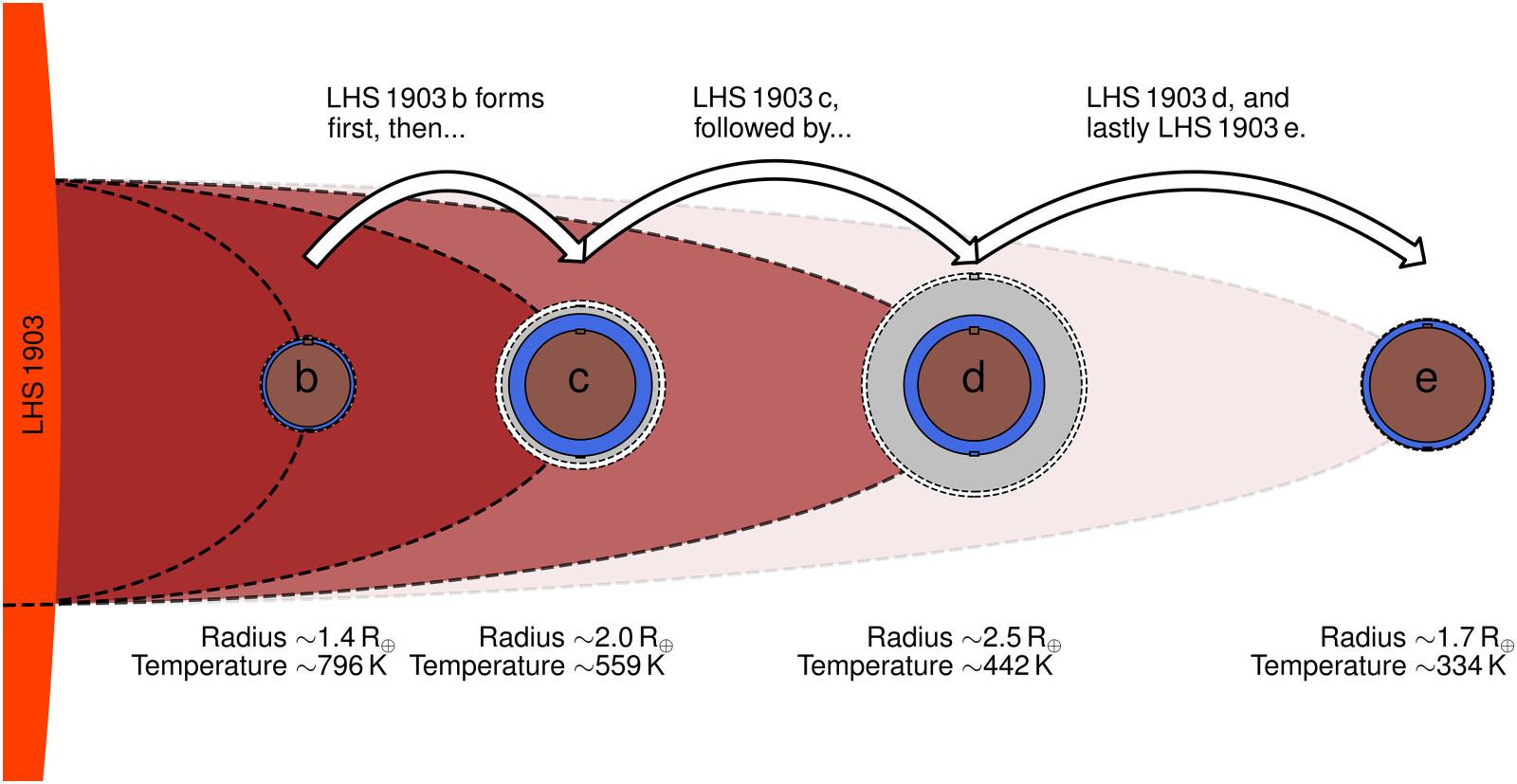
The fact that this distant planet lacks a thick gaseous atmosphere suggests it formed much later, after most of the gaseous material in the disk had dispersed, leaving primarily heavy elements behind. This timing would prevent the planet from acquiring a dense gas envelope, preserving its rocky nature despite orbiting far from its star.
“Indeed, the fourth planet should have gathered and kept a significant gas envelope,” explains Yann Alibert (Space Research and Planetary Sciences Division-UNIBE). “Our theory is that it formed post-gas dissipation in the disk, meaning it appeared after the system’s two gas giants.” This scenario suggests planets can form in staggered phases rather than simultaneously, depending on local environmental conditions.
A Challenge to Conventional Planetary Evolution Models
This discovery carries broad implications beyond just one star system. If rocky planets can emerge late and far out in a planetary disk, it hints at far more complex and dynamic planetary system development than previously assumed. Traditional models depict planet formation as an orderly, concentric zone process with stable orbital zones. This system suggests a more turbulent history where timing and material availability significantly influence planetary types and locations.
Researchers are reevaluating how common such unusual planetary setups might be. Finding similar systems elsewhere could mean that distant rocky planets have been missed in earlier surveys, potentially altering strategies for locating habitable, Earth-like exoplanets by widening the range of possible environments.
Advanced observatories like CHEOPS play a vital role in this endeavor. Their capability to detect minute differences in planet size and orbital paths allows scientists to uncover planetary oddities that standard methods might overlook. Each new observation adds insight into the evolutionary stories of planetary systems.
- Categories:
- Astronomy


0 comments
Sign in to Comment