
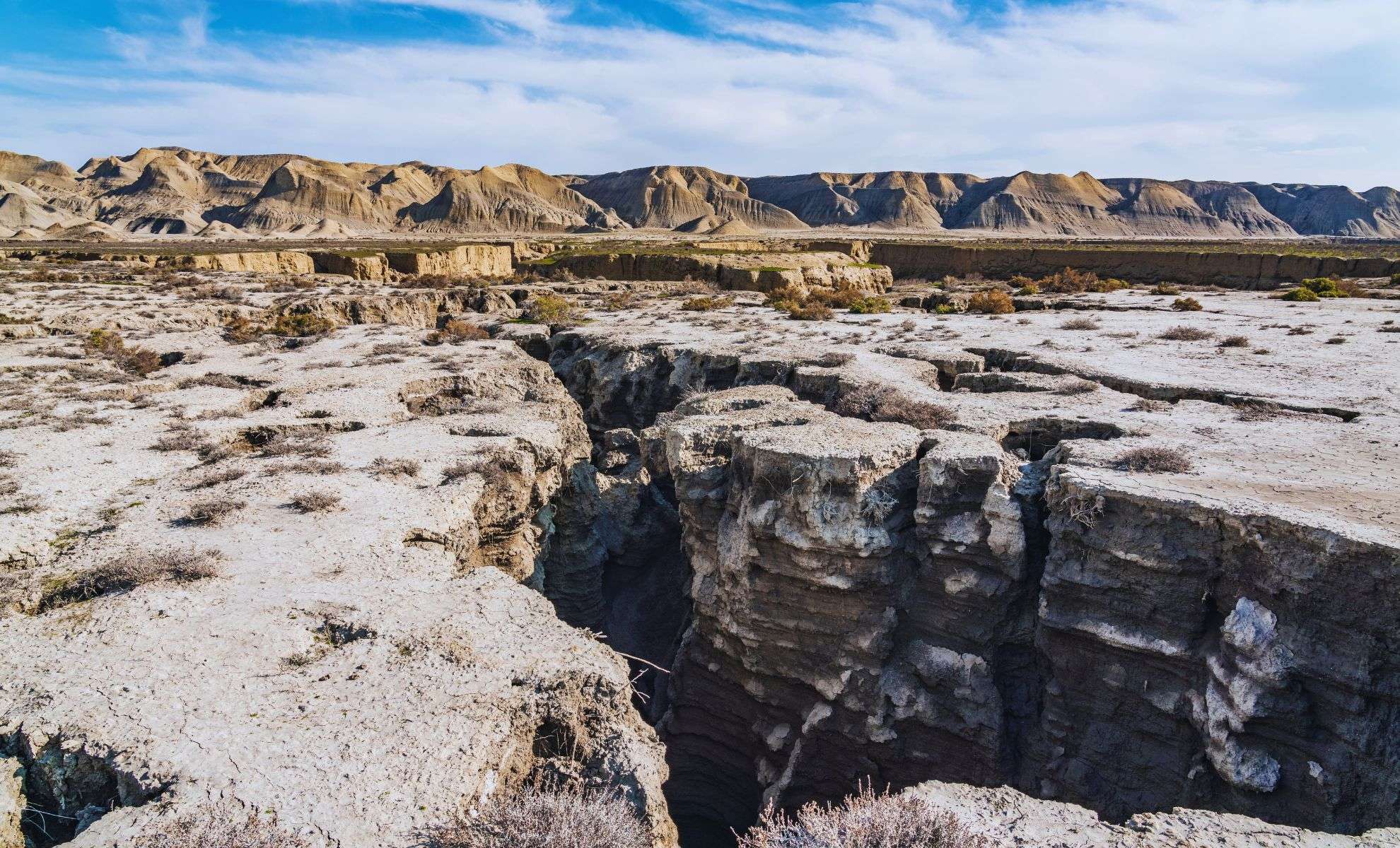
Far beneath the Earth's crust, beyond the reach of sunlight, life thrives on an unexpected energy source. Recent research shows that the fracturing of rocks during earthquakes emits bursts of hydrogen and oxidizing agents, fueling extensive microbial communities deep underground.
Seismic Faults as Microbial Havens
Scientists from the Guangzhou Institute of Geochemistry (GIGCAS), under the guidance of Professors He Hongping and Zhu Jianxi, recreated earthquake-like conditions to understand rock fracture chemistry. Their tests revealed that breaking minerals such as quartz and basalt generate reactive radicals which cleave water molecules, producing hydrogen gas and hydrogen peroxide.
As described by Xiao Wu, the lead author of the study, "hydrogen generated by faulting during seismic activity can be up to 100,000 times greater than hydrogen from other sources." These chemical reactions provide a continual energy supply that sustains microbial life in the deep Earth's crust, remote from sunlight.

The Subsurface Biosphere’s Energy Network
The rocky crust harbors approximately 15% of Earth's total biomass, mainly composed of bacteria and archaea. Over billions of years, tectonic movements and frequent minor earthquakes have fractured rocks repeatedly, exposing reactive mineral surfaces. This process triggers the release of energy stored in peroxy bonds within silicate grains, simultaneously activating countless nanoscale chemical sites.
Experimental fault motions conducted for only four hours produced up to 160 micromoles of hydrogen, far surpassing hydrogen outputs from serpentinization or natural radiolysis. Annually, this equates to about 33.1 moles per square yard, enough to support dense microbial mats underground.
Given that some subterranean microbes survive on energy as low as 10⁻¹² watts per cell, even minor seismic events release millions-fold more energy than needed, turning fractured rock zones temporarily into nutrient-rich refuges.
Energy from Rock and Rust Interactions
Hydrogen serves as fuel only when paired with an electron acceptor. The study highlights iron cycling as crucial. Reactive hydrogen atoms reduce ferric iron (Fe³⁺) into ferrous iron (Fe²⁺), while hydrogen peroxide oxidizes Fe²⁺ back to Fe³⁺ in adjacent pores. This cyclic redox process enables certain microbes to harness energy through iron transformations, effectively drawing power from mineral rusting.
Experiments on granite revealed microorganisms can utilize electrons from iron embedded within rocks. Over time, the chemical energy released by seismic events tapers off, allowing microbial populations to adapt, grow, and colonize these fractured habitats.
Long-term data from boreholes drilled into the Canadian Shield demonstrated repeated iron oxidation and reduction over several years, supporting the theory that microbial communities exploit fracture-induced chemical energy. Such deep subterranean energy cycles could be widespread, revealing far more habitable niches in Earth’s crust than previously recognized.
Implications for Life on Mars, Europa, and Other Worlds
This work broadens the search for extraterrestrial life. Rocky planets and moons like Mars, Europa, and Enceladus may undergo similar fracturing from impacts, tidal flexing, or cooling. These processes could trigger comparable geochemical reactions underground. Mars missions have already detected iron minerals capable of redox shifts and extensive crack networks visible via orbiting satellites.
This study offers a quantitative model to guide upcoming space explorations. Instruments designed to detect hydrogen, methane, or varying iron oxidation states could target fracture zones, where chemical energy converges with biological potential. This suggests that the most promising locations to search for life on Mars might lie not on the surface, but within these hidden, cracked rock layers.
On Earth, glaciers exhibit similar phenomena: as they move over basaltic bedrock, hydrogen release fuels microbes in subglacial lakes. Whether caused by tectonic stresses, landslides, or ice flow, mechanical forces appear vital drivers for subsurface ecosystems worldwide.
- Categories:
- News




0 comments
Sign in to Comment