

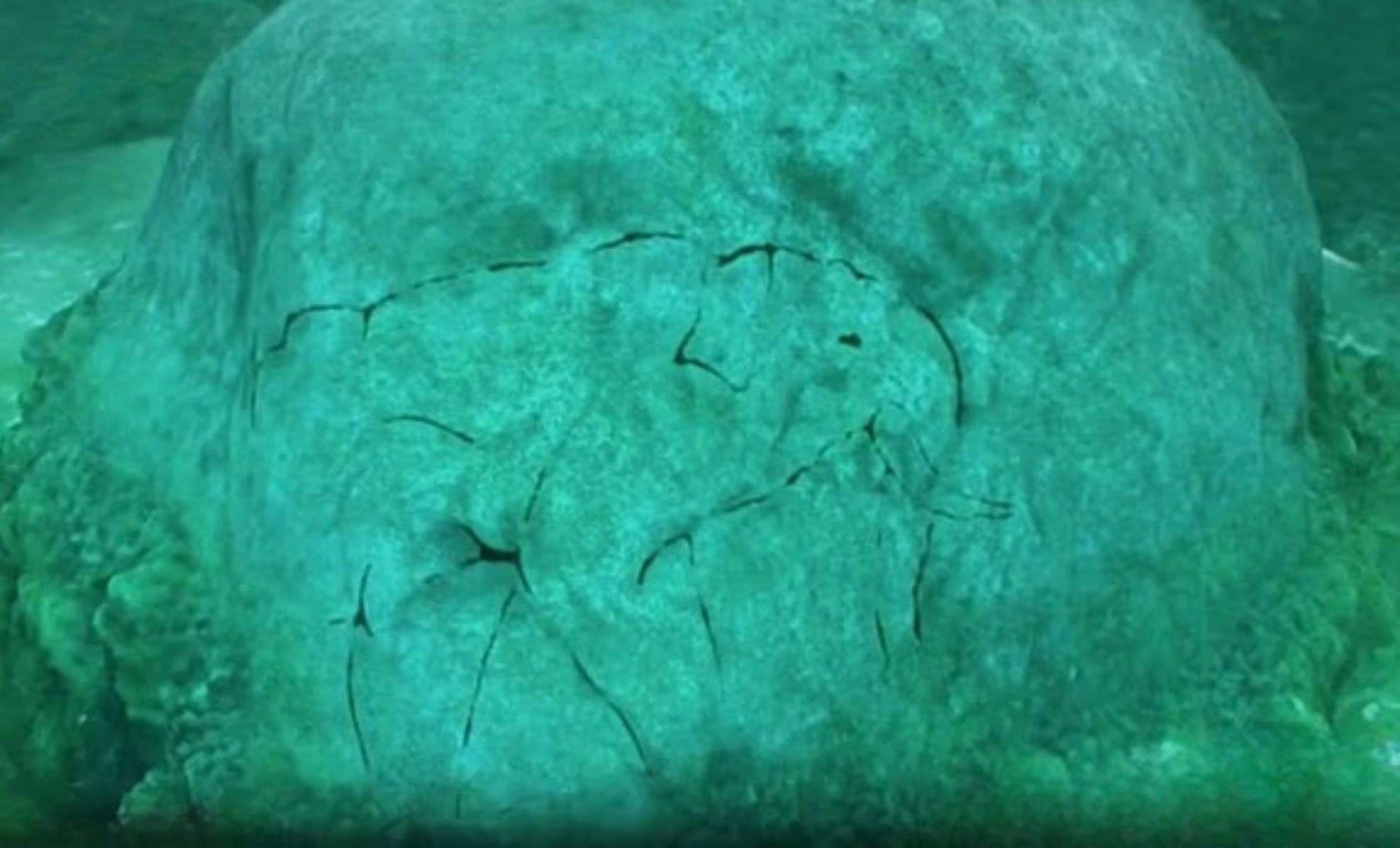
Situated approximately 40 feet beneath Grand Traverse Bay's waters, this submerged monument was initially discovered in 2007 through a sonar scan aimed at finding a sunken ship. Since its detection, the site has intrigued experts with its large stones arranged thoughtfully, culminating in a hexagonal shape, along with an unusual rock thought by some to bear early human carvings.
New research suggests the location is far more significant historically than previously believed. The confirmation of a mastodon engraving on one of the stones could revolutionize our understanding of prehistoric life in this area.
Revelation of Ancient Rock Art
A central feature of this site is a substantial granite rock, measuring around 3.5 feet tall and 5 feet wide, which experts have now recognized as displaying a mastodon relief carving. As reported by Daily Mail, earlier skepticism attributed the marks to natural fissures. However, advanced sonar and underwater imaging, conducted by researchers from Northwestern Michigan College, have made the depiction unmistakable, showing detailed features like a trunk and tusks belonging to Ice Age megafauna.

Dating back to approximately 7000 BC, this carving stands as one of North America's earliest examples of prehistoric art. According to UNILAD, this find extends the timeline for such artistic activity by about 5,000 years.
“When we saw it, we were amazed,” said Dr. Mark Holley, the adjunct professor who led the team behind the discovery.
@philomena_cunk_historyStonehenge Lake Michigan | Interesting Facts | Philomena Cunk Style History | #creatorsearchinsights #cunk #philomenacunk #history #stonehenge #lakemichigan
♬ original sound – Philomena Cunk
An Extensive Underwater Complex with Multiple Functions
The monument extends over a mile on the lake floor, featuring large stones arranged in a blend of ritualistic and practical designs. Two notable granite circles, measuring approximately 40 and 20 feet in diameter, connect to the line of stones, sparking debates over their intended uses. Dr. John O’Shea of the University of Michigan suggests the formation could have acted as a funnel, channeling large wildlife toward hunters, a technique recognized in early human cultures.
This hunting hypothesis aligns with the placement of the stones and the surrounding terrain's layout. Speaking to Daily Mail, O’Shea highlighted that early people frequently employed such strategies to direct animal movements. If valid, this implies not just habitation but advanced planning and cooperation among communities in the early Holocene period.
Reevaluating Early Human Presence in North America
This discovery challenges previous beliefs about the timeline and nature of human activity on the continent. Archaeologists generally place significant human occupation at around 13,000 years ago, associated with the Clovis culture. While the Lake Michigan site’s age might not surpass this, it unmistakably reveals complex behaviors and symbolic art much earlier than confirmed before.
The research team intends to return later this year to extract sediment cores near the site. These samples will help determine if the stones were constructed when the location was dry land. Confirmation of this would support the view that humans created large, coordinated structures in the Great Lakes region nearly 9,000 years ago, indicating a sophisticated early society.
- Categories:
- News










0 comments
Sign in to Comment