
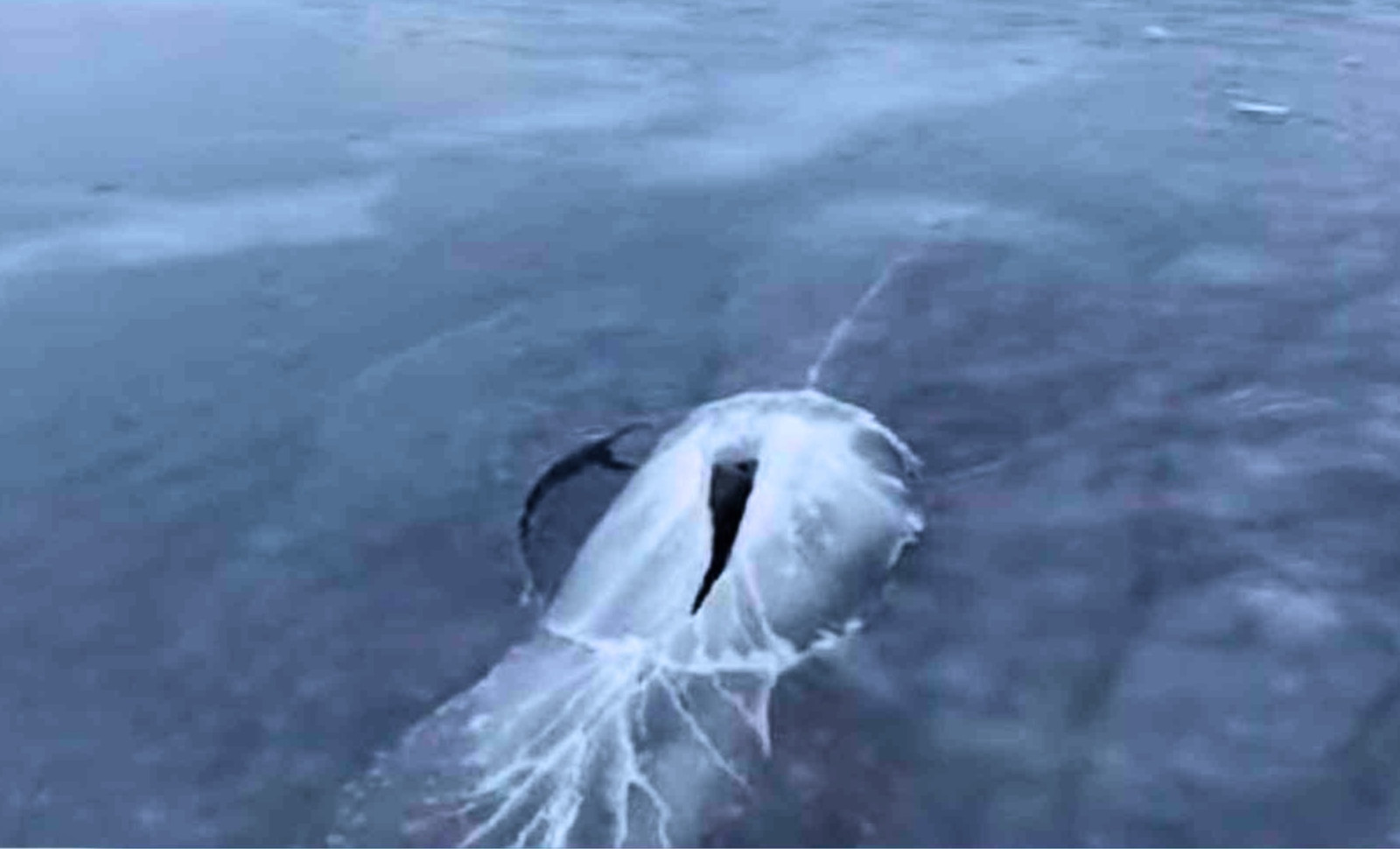
Over Disko Bay in western Greenland, a research drone captured a rare sight: a bowhead whale pushing through nearly two feet of solid sea ice, breaking the frozen layer to surface for air before diving back underwater.
This captivating video goes beyond simple wildlife observation by illustrating a vital survival behavior that polar researchers are beginning to quantify accurately. This understanding is especially urgent as the ice these whales rely upon continues to vanish at unprecedented rates in the satellite era.
The bowhead whale is uniquely adapted for this challenging task. It possesses the thickest blubber of any whale species, spanning 17 to 19 inches, while its massive, curved skull measures over 16.5 feet—about one-third of its entire length. According to NOAA Fisheries, bowheads regularly break through up to 8 inches of sea ice to breathe, and Alaska Native hunters have documented instances of whales surfacing through ice as thick as 2 feet. The Disko Bay footage falls well within these known extremes.

Scientific Insights From Aerial Observations
The significance of this video extends to the precise measurements it enables. Dr. Fredrik Christiansen and his team at Aarhus University have been employing drone photogrammetry to evaluate the size and health of bowhead whales in Disko Bay. During spring 2022 research, they gathered 232 measurements from 154 adult whales and 50 from juveniles, findings published in Polar Biology.
Using aerial images, the researchers calculate key dimensions such as body length, width, and height, which they then use to estimate blubber volume. Their data reveals that adult bowheads accumulate between 82 and 163 pounds of blubber daily, translating to 44 to 88 liters of stored energy. This is crucial because bowheads are capital breeders, relying on stored energy reserves built up in feeding periods to fuel migration and reproduction phases.
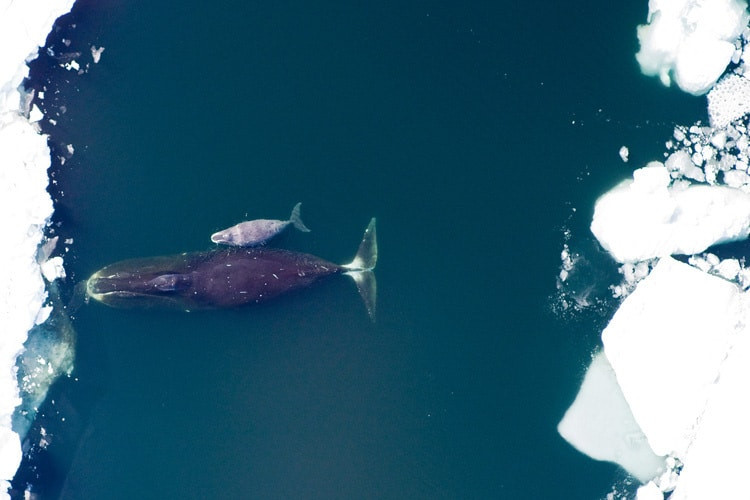
“This behavior occurs frequently during the cold winter and spring seasons in Disko Bay,” Christiansen shared with Discover Wildlife.
Accumulating such substantial blubber requires a tremendous food intake. Bioenergetic models linked to drone observations estimate that adult bowheads need around 1,017 to 2,174 kilowatt-hours daily. To fulfill this energy demand, they consume approximately 225 to 481 pounds of prey each day, mostly small zooplankton filtered via their baleen plates. Juveniles require less but still consume an estimated 37 to 49 pounds daily.
The primary prey species in Disko Bay is the Calanus copepod, a lipid-rich crustacean that remains dormant in dense concentrations near the seabed through winter and early spring. Bowheads dive deep—between 50 and 100 meters, occasionally exceeding 400 meters—staying underwater for dives up to 40 minutes to reach them.
Top Predator Impact on Arctic Food Chains
A 2021 Frontiers in Marine Science study modeled predation dynamics, finding that when targeting the densest copepod aggregations, bowheads may consume between 26% and 75% of the Calanus population in Disko Bay annually. Such efficiency is essential; less accurate foraging would result in energy deficits that could jeopardize their survival.
The study also highlighted that bowhead consumption matches or exceeds the combined intake of three other key zooplankton predators: jellyfish, chaetognaths, and predatory copepods. This intense predation pressure means that if bowhead numbers increase, some whales may need to expand their range to find sufficient food.
Interestingly, not all Calanus copepods in Disko Bay originate locally. Current tracking models show some are transported from distant areas like Baffin Bay or Greenland’s continental shelf, traveling hundreds to thousands of kilometers before accumulating in the bay’s depths. This journey introduces a delay of 6 to 10 months between the original phytoplankton bloom and when the bowheads feed on these copepods, illustrating how Disko Bay serves as a convergence point for energy produced far away.
Declining Ice, Emerging Threats
The solid ice that bowheads break through to breathe is diminishing. NASA satellite data reveal that the minimum Arctic sea ice in September has decreased by 12.2% per decade since 1981–2010 averages. Thinner, less stable ice affects where and when calanoid copepods congregate and also increases Arctic shipping traffic, leading to risks like vessel collisions, underwater noise pollution, and entanglement in fishing gear.
According to NOAA Fisheries, threats facing the Western Arctic bowhead population—which currently numbers about 15,229 individuals—include climate change, noise pollution, environmental contaminants, and entanglement hazards.
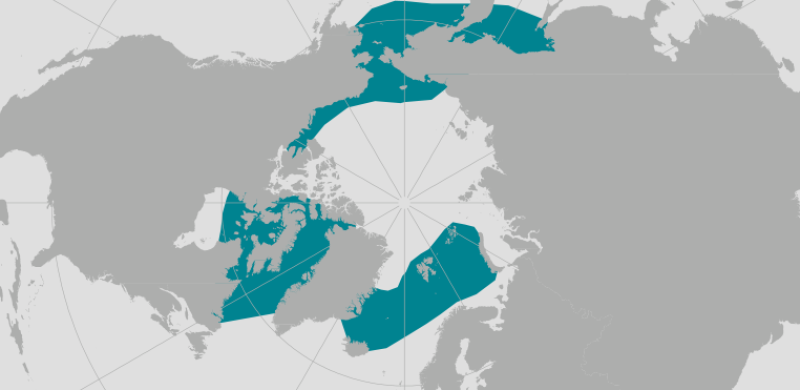
Orca predation has become a growing concern as well. About 8% of subsistence-harvested bowheads have scars from killer whale attacks, and this incidence has increased over recent decades, NOAA Fisheries reports. Aerial surveys between 2009 and 2018 identified orca attacks as the leading cause of death among bowhead carcasses recovered in the region.
While a single drone video can’t determine whether bowhead populations in Disko Bay are flourishing or declining, this imagery combined with years of photogrammetry data, energy use modeling, and sea ice measurements provides sensitive indicators. Each surfacing through an ice hole becomes a meaningful data point, helping scientists monitor health trends in real time. For bowhead whales, every breath taken through the ice contributes to understanding how a fragile Arctic ecosystem is coping under pressure.
- Categories:
- News



0 comments
Sign in to Comment