

The European Space Agency (ESA) along with ClearSpace has announced a groundbreaking project: PRELUDE, an upcoming in-orbit servicing and debris removal mission planned for 2027. This mission will deploy two compact spacecraft in low Earth orbit to demonstrate advanced autonomous close-proximity maneuvers and navigation techniques, paving the way for routine orbital servicing and enhanced space safety.
Designed for Autonomy and Precision in Space
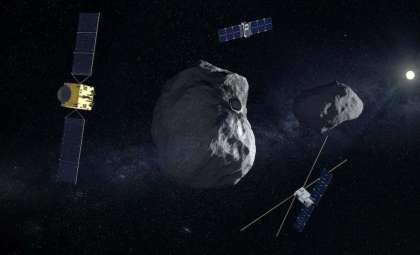
PRELUDE represents more than just a technological test; it marks a significant advancement in autonomous spacecraft capabilities. The mission aims to prove autonomous rendezvous and close approach maneuvers in real spaceflight conditions with the help of precise tracking, vision-based sensing, and a sophisticated onboard guidance, navigation, and control (GNC) system, enabling the spacecraft to operate independently from ground control.

“Our PRELUDE spacecraft will possess the ability to autonomously perceive and track another space object with precision, without relying on commands from Earth,” explained ClearSpace CEO Luc Piguet in an interview with SpaceNews. Such autonomy is critical for future missions that involve satellite maintenance, lifespan extension, or debris mitigation amid growing congestion in orbit.

With robust fault-tolerant architecture and intelligent onboard control software, the spacecraft will safely execute repeatable maneuvers around target objects. This effort represents an essential step toward ensuring that spacecraft can confidently and securely operate in close quarters within orbital environments.
An ESA-Backed Effort Spearheaded by ClearSpace
ClearSpace leads PRELUDE’s system architecture and engineering, overseeing the GNC development, mission control, and execution. The propulsion systems and onboard sensors are co-developed with multiple partners throughout Europe's aerospace industry.
According to SpaceNews, the mission is planned to last between seven and twelve months, contingent on the volume and complexity of close-approach operations performed. An ESA Space Safety representative stated, “Our aim is to rigorously test and validate GNC technologies through systematic proximity operations and progressively confirm autonomy and safety capabilities.”
This deliberate, stepwise strategy balances technological validation with risk mitigation. PRELUDE serves as a foundational project within ESA’s broader vision to establish Europe as a leader in the emerging field of in-orbit services.
Advancing Europe’s Vision for Sustainable Orbital Operations
ESA views PRELUDE as a key component supporting its commitment to commercial and sustainable activities in space. “This operation,” stated Tiago Soares, head of ESA's Clean Space and Circular Economy Office, “strengthens Europe’s role in promoting safe, sustainable space development and helps enable in-orbit services with commercial potential.”
As satellite deployments surge and orbital environments become increasingly congested, the urgency for active debris management escalates. PRELUDE aligns with ClearSpace’s goal to build spacecraft capable of extending satellite lifetimes, repositioning assets, or guiding them safely out of orbit at mission end.
Piguet emphasized the importance of gradual market development, saying, “PRELUDE is part of a continuous evolution, not a sudden shift from testing to commercial service. The in-orbit servicing market is emerging, and ClearSpace is already engaged in both institutional and commercial projects. Our readiness stems from an extensive mission portfolio, engineering experience, and ongoing collaboration with customers.”
PRELUDE Strengthens ClearSpace’s Expanding Mission Lineup
Founded in Switzerland in 2018 and now based in Luxembourg, ClearSpace has progressively solidified its presence in orbital servicing. In 2020, ESA awarded the company the contract for ClearSpace-1, a mission to capture a defunct satellite component. Initially focused on a VESPA adapter, the mission scope was revised in 2024 to target the deorbit of the Proba-1 satellite, scheduled for launch in 2029.
PRELUDE serves as a critical technical and operational precursor, delivering data and operational insights vital for the success of ClearSpace-1 and subsequent projects. “Thus,” said Piguet, “PRELUDE lowers risks and builds mission assurance across ClearSpace’s entire portfolio.”
With growing space traffic and the mounting risk of collisions, the capability to autonomously detect, approach, and interact with orbital objects is poised to become a fundamental asset for satellite operations. PRELUDE advances this capability toward future deployment.
- Categories:
- Space







0 comments
Sign in to Comment