
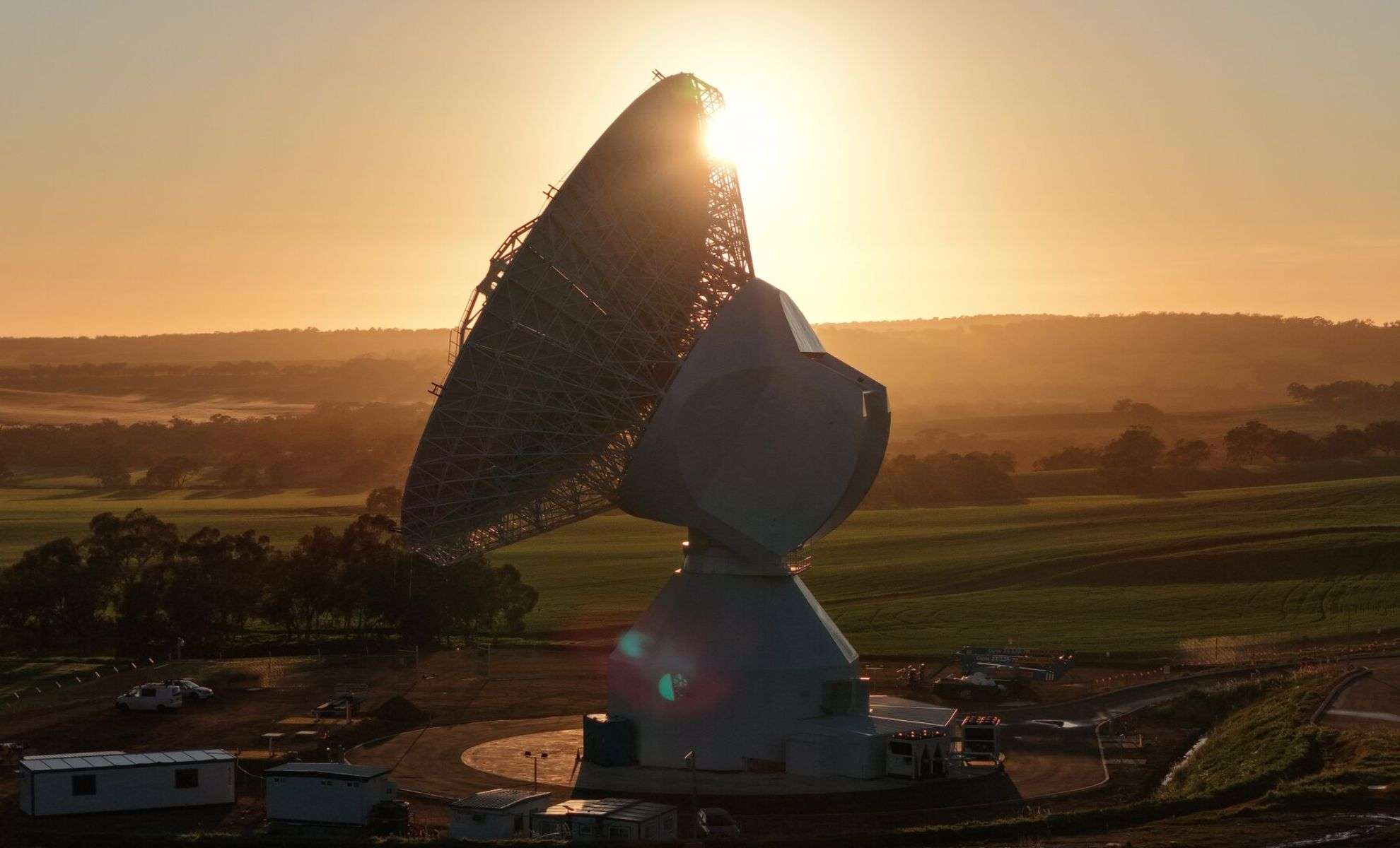
A significant advancement in space exploration has emerged in Western Australia, where the European Space Agency (ESA) has launched one of its most sophisticated deep space tracking stations. Positioned just north of Perth in the secluded town of New Norcia, this impressive deep space antenna is now operational, ready to aid some of the most daring interplanetary missions ever undertaken.
The newly built 35-meter-wide structure, known as New Norcia 3 (NNO-3), enhances ESA's ability to monitor deep space missions and bolsters international collaboration in the quest to unravel solar system mysteries. This installation represents a pivotal achievement in technological innovation and cross-border scientific partnership.
Designed To Capture Faint Space Signals
Weighing more than 700 tonnes, NNO-3 is ESA’s fourth deep space antenna globally and the second on-site at New Norcia, making it the first facility of its kind to operate two such advanced systems. The entire construction project had an estimated value of $67 million, including $3.2 million in contributions from the Australian government, showcasing the cooperative spirit of the undertaking.

ESA Director General Josef Aschbacher highlighted the growing demand for powerful ground stations to handle the immense data streaming from observations of “billions of stars and galaxies.” Equipped with cryogenic amplifiers chilling down to -260 degrees Celsius, this antenna minimizes background noise, enabling it to detect extremely weak transmissions from distant spacecraft.
As stated by Suzy Jackson, the facility manager representing Australia’s CSIRO, the antenna's exceptional sensitivity means it could quite literally “receive a phone call from Mars,” due to its advanced transmitters and precision engineering ensuring continuous contact with missions at the very edge of space exploration.
Enabling Vital Missions and Planetary Protection
The NNO-3 antenna will play a key role in supporting landmark ESA projects such as JUICE, tasked with studying the ice-covered moons of Jupiter, which are prime targets in the search for life beyond Earth, and Euclid, which investigates the elusive properties of dark matter and dark energy.
Mehran Sarkarati, ESA’s head of ground station engineering, described the station’s ability to send commands and receive large amounts of crucial scientific information, including high-resolution images and spatial data. The antenna serves as a vital link between Earth and robotic missions exploring Mars, Venus, the Sun, and numerous asteroids.
In addition to ESA missions, it provides support for ventures by NASA, JAXA, and ISRO, reinforcing its importance as an international scientific resource. Sarkarati emphasized the antenna’s role in fostering global collaboration: “It’s also a tool for international cooperation,” uniting spacefaring countries in achieving shared objectives.
From Regional Growth to Cosmic Exploration
The small town of New Norcia, known historically for its Benedictine monastery, has gained newfound recognition thanks to this high-profile space facility. Pauline Bantock, president of the Shire of Victoria Plains, expressed the community’s excitement about the international spotlight and the opportunities the antenna’s presence brings.
In response to anticipated visitor interest, Western Australia’s science minister Stephen Dawson declared $350,000 in funding for developing amenities such as observation platforms, informative displays, and parking areas. This funding supports plans to transform the site into a center for education and tourism.
Australian astronaut Katherine Bennell-Pegg, present at the opening ceremony, expressed enthusiasm about NNO-3’s potential to fuel future space breakthroughs. She highlighted JUICE’s mission to probe Jupiter’s moons—key locations in the hunt for life—and spoke about upcoming efforts targeting asteroids and planetary defense, aiming to deepen our understanding of impact threats and mitigation strategies. “We want to learn how we can protect Earth by deflecting potential hazards,” she noted.
Owing to its unique position, the antenna also aids tracking for European launch vehicles such as Vega-C and Ariane 6. Additionally, it contributes vital data to missions like Biomass, which employs satellite sensors to monitor terrestrial forests, bolstered by the on-site calibration transponder.
- Categories:
- News






0 comments
Sign in to Comment