
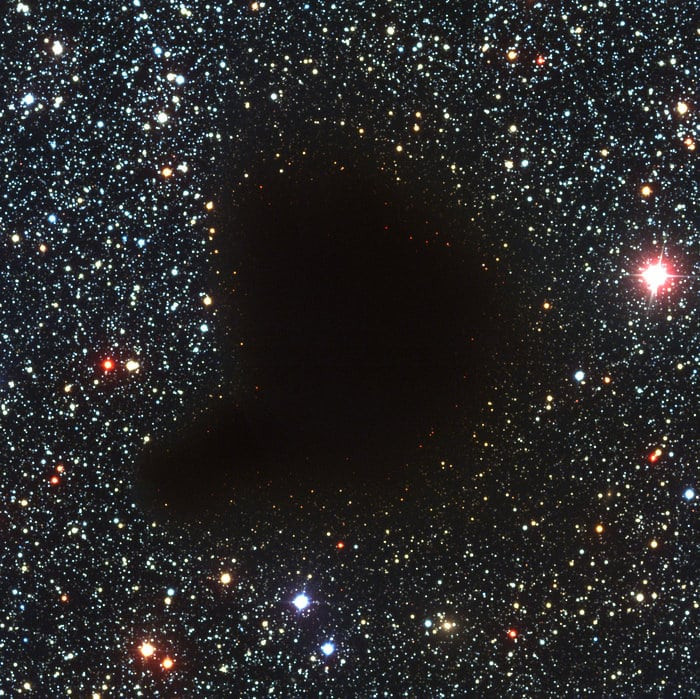
Researchers have achieved a groundbreaking milestone by directly observing cosmic rays deep inside a dense molecular cloud devoid of stars. This significant achievement offers new insights into how these elusive particles influence the formation of stars and planets. The investigation, led by scientists at the Technion-Israel Institute of Technology, centered on Barnard 68, a frigid gas cloud located 400 light-years from Earth.
In contrast to typical stellar nurseries, Barnard 68 lacks any stars and remains isolated, making it an ideal location to study cosmic ray effects without external disturbances. By detecting the subtle infrared emissions produced by these particles, the team captured their impact within this otherwise serene cosmic environment.
Cosmic Rays: Invisible Catalysts in Star Birth
Cosmic rays are high-speed particles, primarily protons and atomic nuclei, traveling near light speed throughout space. Scientists have long hypothesized that these energetic particles influence the chemistry and physics inside molecular clouds, but direct measurement of their effects in star-forming regions has been challenging.

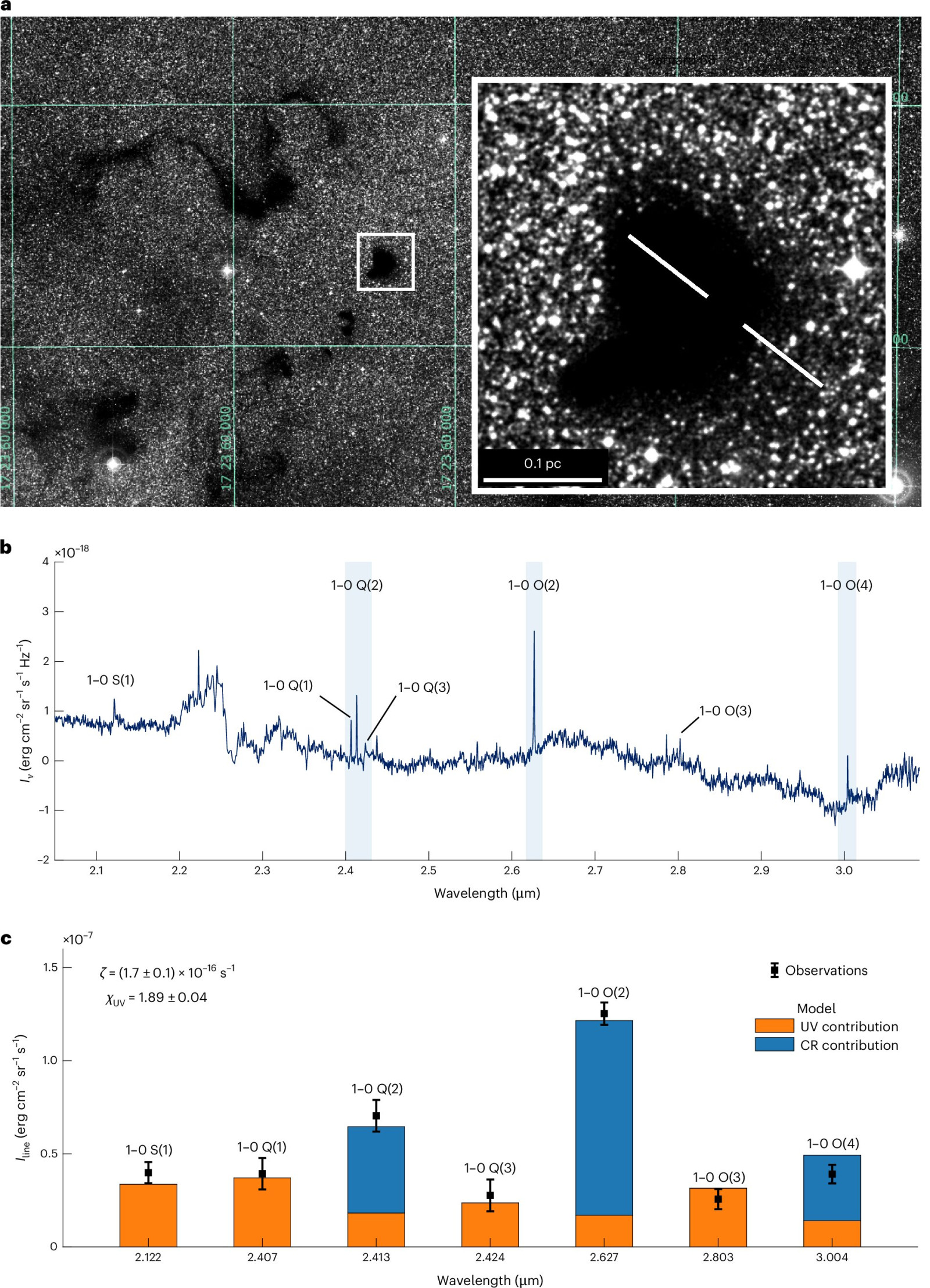
Within Barnard 68, the team succeeded in detecting a direct cosmic ray signature affecting the cloud's hydrogen gas. As Dr. Shmuel Bialy explained, cosmic rays collide with hydrogen molecules, ejecting electrons and triggering vibrations that produce a faint infrared glow. This emission acts as a distinctive "fingerprint" of cosmic ray activity.
“This infrared radiation serves as a unique fingerprint of the interaction between cosmic rays and hydrogen in the nebula,” he explained.
Barnard 68: An Ideal, Calm Laboratory
Barnard 68 was selected not only for its closeness but also due to its unique qualities: a cold, dense assembly of gas and dust free from stars. Its position in front of more distant stars allows it to obscure their light, enabling researchers to isolate radiation specifically generated by cosmic ray interactions.
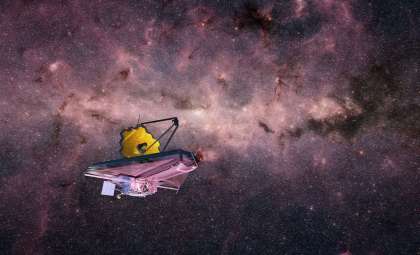
The faint infrared glow recorded by the James Webb Space Telescope could not be explained by typical energy sources, such as ultraviolet light from close stars. According to Amit Chemke, a graduate student on the project, the cosmic ray signature perfectly matched the theoretical models, confirming the particles as the origin of the emission.
“The signals detected by the space telescope matched perfectly with the predictions of the theoretical model we developed,”Chemke said.
Could This Unlock New Understandings of Star Formation?
The findings, published in Nature Astronomy, do more than quantify cosmic ray presence; they highlight these particles’ role in ionizing gas molecules—a key process initiating the gravitational collapse of clouds that leads to star birth.
“Previously, researchers had to take a roundabout approach by observing rare molecules such as protonated molecular hydrogen or molecular ions and then attempting to calculate the ionization rate from their concentrations,” noted Dr. Brandt Gaches, leader of the Emmy Noether Group dedicated to the Next Generation of Cosmic Ray.
Additionally, this discovery connects cosmic rays to the formation of fundamental molecules like water, ammonia, and methanol, which are crucial ingredients for planet development. These energetic particles not only influence star creation but also foster the early stages of planet formation, possibly paving the way for life.
Moving forward, scientists intend to apply this observational technique to other molecular clouds within the Milky Way. Still, as Dr. Bialy pointed out, studying denser, star-rich regions will pose challenges due to overlapping energetic sources. Nevertheless, this pioneering research paves new pathways for understanding the cosmos.
- Categories:
- Space



0 comments
Sign in to Comment