

Experts have uncovered a previously unknown water channel within the ‘Ain Braq aqueduct that once provided vital water flow to the historic city of Petra, famously carved into the red sandstone cliffs of modern-day Jordan. This city evolved into a bustling hub of governance and commerce despite its challenging dry climate. As the capital of the Nabataean kingdom prior to its absorption into the Roman province of Arabia, a reliable and well-engineered water supply was essential for its survival.
The water system supported far more than basic needs: it nourished public baths, irrigated farmland, sustained gardens, filled temple basins, and maintained a sacred fountain called a nymphaeum. For years, researchers believed they had grasped the workings of Petra's aqueducts. However, discoveries along the city's southeastern border now point to a far more complex and ingenious hydraulic system than previously recognized.
Unearthing a Forgotten Water Channel
This breakthrough comes from the Urban Development of Ancient Petra initiative led by Niklas Jungmann of Humboldt University, Berlin. During an extensive examination of cisterns, basins, an ancient dam reservoir, and the known section of the aqueduct, researchers stumbled upon an unexpected find.

“The discovery of numerous water structures on the plateau directly above the rock slopes with the presumed aqueduct channel and the dam, raised broader questions about the engineering and chronology of this area,” he said.
According to the analysis published in Levant, the aqueduct was more complex than having only the previously documented terracotta-lined channel. The team identified the trace of a secondary conduit that once contained a sealed lead pipe embedded in mortar. This pipe extended for roughly 380 feet (116 meters).
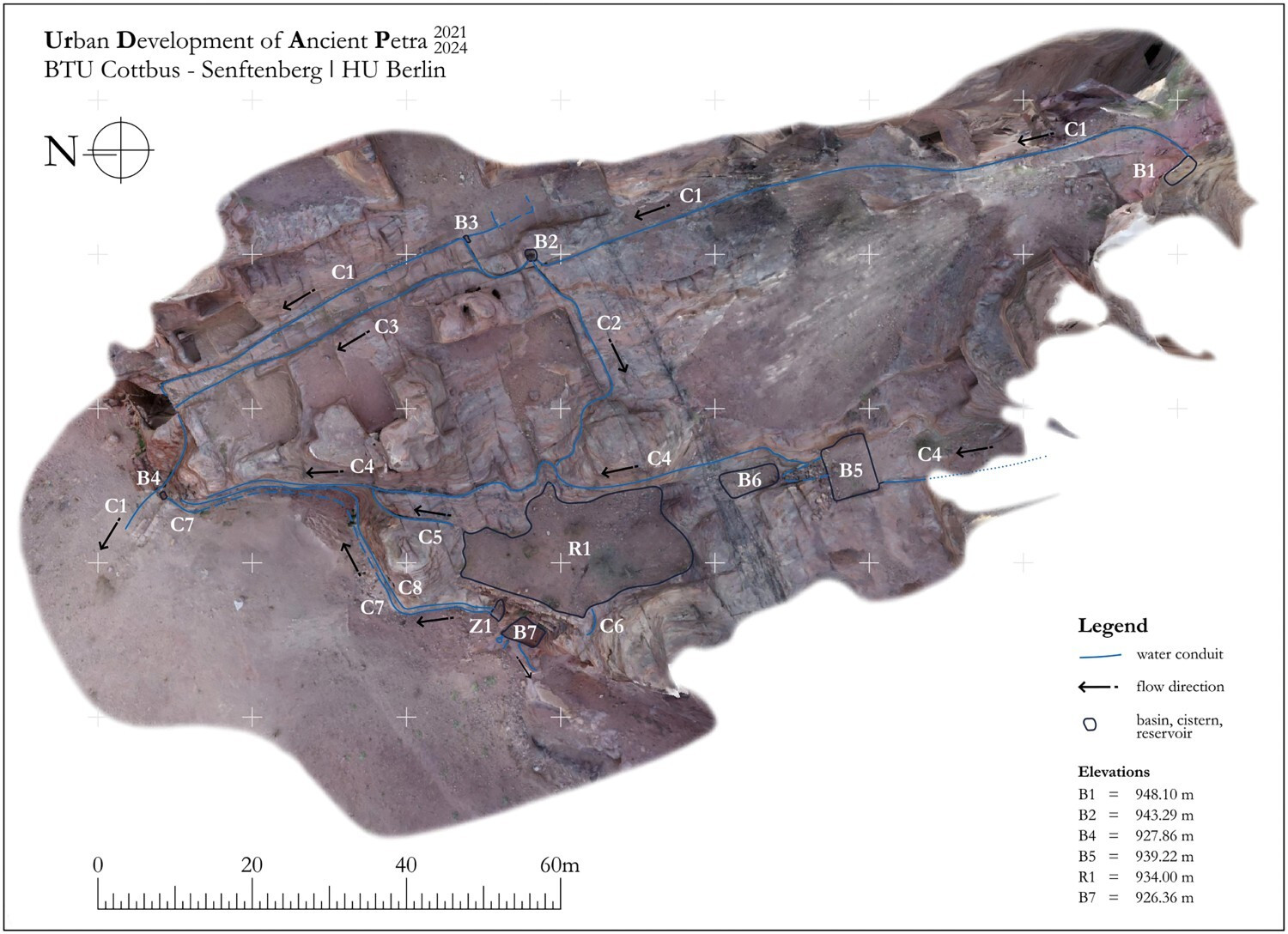
Though much of the lead pipe is gone, its former presence was revealed through distinct, consistent impressions on the stone base, distinguishable from the irregular marks left by terracotta pipes.
Material Traces Verify Pipeline Composition
Further fieldwork in Petra’s central district uncovered Nabataean conduit blocks preserving fragments of lead pipe embedded in ancient mortar. Jungmann highlighted that the dimensions and the surface pattern of these pipe fragments corresponded precisely to those found in the earlier discovery.
“Overall, this study underscores the potential for further research into Nabataean water management,” explained Jungmann.
The relatively large diameter of the lead pipe compared to the terracotta pipes found nearby also points to a specialized role within Petra’s water system.
An Ingenious Pressurized Siphon System
Experts infer that this elongated lead pipe operated as an inverted siphon, which channels water from a supply tank into a pressurized pipeline that crosses valleys or other depressions.
“While some hypotheses about the aqueduct’s two branches into the city have been proposed above, more fieldwork is required in order to provide a fuller understanding of the distribution system and its evolution over time.”
The pipe’s alignment heading west strongly indicates it fed reservoirs on az-Zantur hill. Previous suggestions that the conduit detoured to other areas before arriving here were dismissed, as maintaining continuous pressure is vital for the inverted siphon’s function, requiring an unbroken pipeline.
- Categories:
- Science











0 comments
Sign in to Comment