
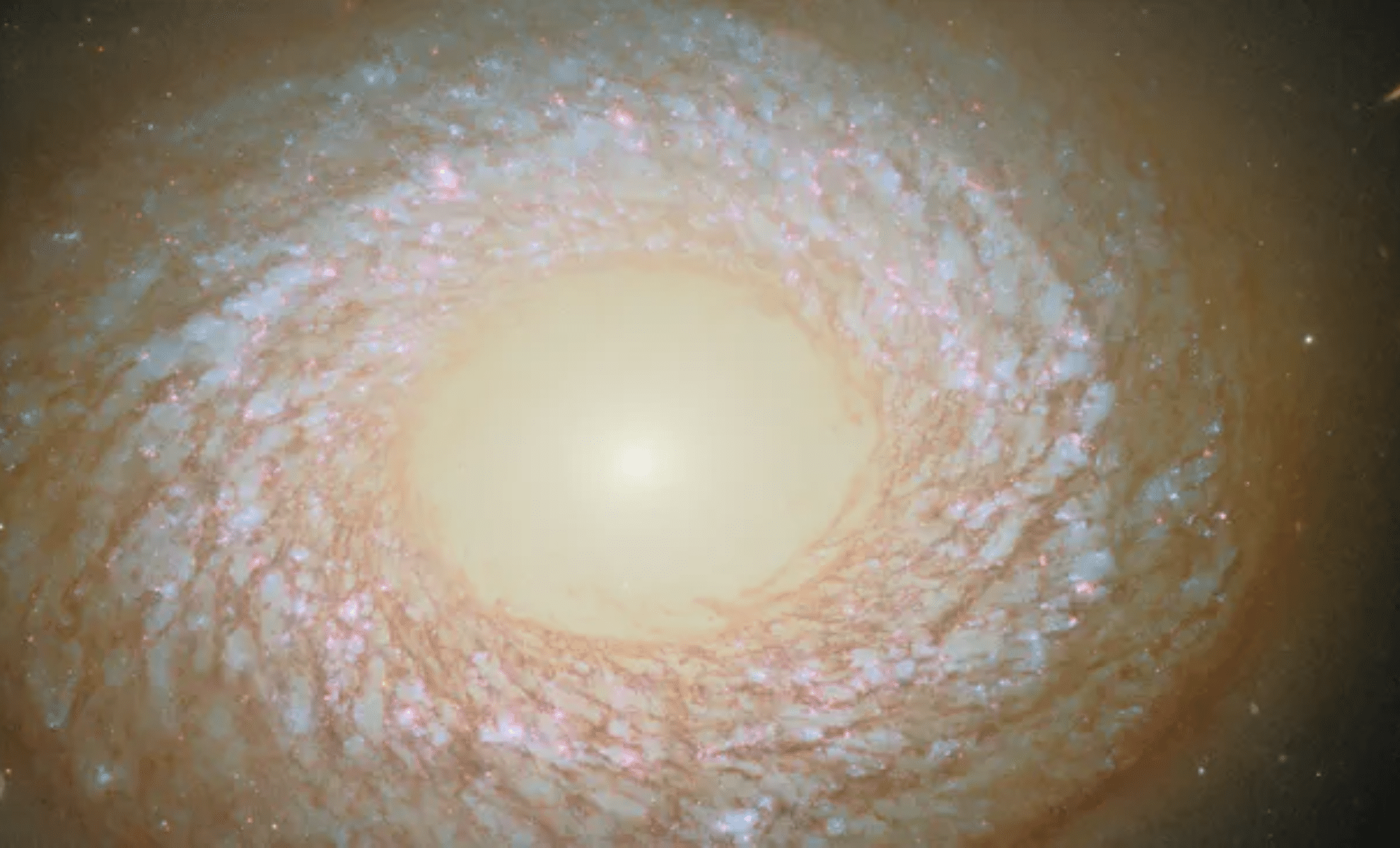
Scientists are continuously discovering galaxies that push the boundaries of existing classifications. A recent investigation by the Hubble Space Telescope team, highlighted by NASA, reveals NGC 2775, a galaxy whose unusual structure defies neat categorization. Its hybrid qualities blend features of both spiral and elliptical galaxies, offering a rare window into the phases of galactic transformation.
The Enigmatic Structure of NGC 2775
Situated roughly 67 million light-years from Earth within the constellation Cancer, NGC 2775 presents a morphology that challenges simple galaxy classification. Its core is smooth and depleted of gas, traits typical of elliptical galaxies, yet it is encircled by a dusty ring filled with youthful star clusters, reminiscent of a spiral galaxy. This strange combination has prompted some astronomers to label it a lenticular galaxy, a transitional type that exhibits characteristics of both major galaxy classes.
Thanks to Hubble’s high-resolution imaging, astronomers can scrutinize NGC 2775 in exceptional detail. Unlike observations from ground-based telescopes, Hubble’s clarity reveals faint traces of spiral arms and active star-forming zones nestled within the dusty ring. These observations suggest that NGC 2775 is undergoing a gradual and intricate evolutionary process.

Understanding Galactic Change Through Transitional Traits
Galaxies such as NGC 2775 offer valuable insights into the universe’s evolutionary history. Transitional galaxies often bear marks of former galaxy mergers, tidal forces, and ongoing star formation. Notably, NGC 2775 displays a hydrogen tail extending beyond 100,000 light-years, indicating past interactions or mergers with nearby galaxies. These cosmic encounters can trigger star formation in peripheral rings while leaving the central core comparatively inactive.
Examining these hybrid galaxies enables astronomers to decipher processes like the fading of spiral arms, the formation of rings, and the development of barred structures. Hubble’s combined imaging and spectral analyses provide a comprehensive perspective detailing how stellar populations, gas, and dust coexist and influence each other over millions of years. Such studies enhance models of galactic life cycles, bridging gaps between theoretical frameworks and actual observations.
Hubble’s Vital Role in Exploring Hidden Galactic Details
The sharp imaging capabilities of Hubble are crucial in exposing the subtle complexity of NGC 2775. Freed from atmospheric interference, Hubble’s space-based vantage point allows astronomers to detect and study dim rings, compact star clusters, and diffuse gas clouds in unprecedented clarity. Utilizing ultraviolet, optical, and infrared wavelengths enables researchers to analyze the age, makeup, and motion of the galaxy’s diverse stellar populations.
This extraordinary level of detail also sheds light on broader questions related to galaxy formation and cosmic history. Discovering features like dust-enshrouded star-forming rings within predominantly elliptical cores helps chart the complex array of galactic architectures. Each newly studied transitional galaxy contributes to understanding that galactic evolution is multifaceted, shaped by both internal dynamics and external cosmic encounters over billions of years.
Why Astronomers Are Drawn to NGC 2775
Aside from its scientific importance, NGC 2775 fascinates both scientists and enthusiasts because it disrupts straightforward assumptions. While most galaxies fall into distinct categories—spiral, elliptical, or irregular—NGC 2775 occupies a border region demonstrating the diversity and complexity inherent in galaxy life cycles. Its dusty rings, smooth nucleus, and extended hydrogen tail narrate a history of cosmic mergers, star creation, and slow morphological shifts.
These transitional galaxies serve as natural testbeds for theories in astrophysics. By comparing NGC 2775 with similar objects, researchers probe whether traits like diminishing spiral arms are common or reliant on unique interactions. This comparative approach sharpens models of galaxy behavior and evolution, improving predictions about how galaxies such as the Milky Way may evolve over cosmic time.
- Categories:
- News









0 comments
Sign in to Comment