

In April 1986, an explosion at the Chernobyl nuclear power station in Ukraine triggered the most severe nuclear accident in history. For ten days, poisonous radioactive particles spread uncontrollably throughout the environment. Over 50 tons of radioactive materials drifted across Europe, causing widespread devastation.
Among the numerous horrors uncovered in the aftermath was one particularly chilling discovery—the infamous “Elephant’s Foot.” This highly radioactive mass has become a grim emblem of the disaster’s lethal aftermath.
The Nature of the ‘Elephant’s Foot’
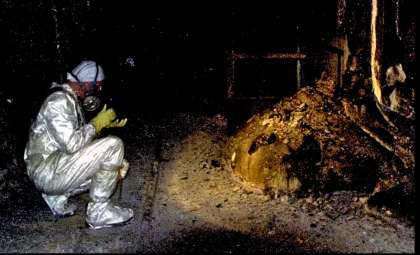
As detailed by Unilad, eight months post-explosion, investigators ventured into the now-ruined Reactor No. 4 at Chernobyl. There, they uncovered a black, molten substance with a texture similar to lava, which had burned its way through the reactor’s basement before solidifying into a massive, eerie chunk. This hardened blob, which earned its nickname due to its resemblance to an elephant’s foot, was a toxic mixture of corium—a fusion of sand, melted concrete, and uranium. Despite its deceptively benign name, the Elephant’s Foot was incomparably dangerous.

Corium, the substance composing the Elephant’s Foot, is one of the rarest and deadliest materials formed naturally by nuclear disasters. Only five such formations have been documented worldwide. At its peak, the Elephant’s Foot emitted an extraordinary radiation level nearing 10,000 roentgens per hour, far exceeding the dangerously low 50-100 roentgens needed to cause severe radiation sickness in humans.
Radiation Exposure and Its Effects
The health risks linked to being near the Elephant’s Foot were alarmingly severe. Even very brief exposure could cause serious damage. Standing close for 30 seconds could trigger symptoms like dizziness and exhaustion, two minutes would cause internal cell hemorrhaging, and just five minutes would likely result in death within 48 hours. Shockingly, some investigators underestimated the peril when encountering the deadly form.
Recently resurfaced footage on social media shows hazmat-suited workers dangerously close to the mass, capturing how precarious their proximity was. These individuals, known as liquidators, were charged with documenting and analyzing the substance. Radiation expert Artur Korneyev recounted his own experience, explaining that despite working years after the meltdown, he still battles cataracts and other health problems caused by radiation exposure.
Approximately 30 people died from immediate blast trauma and acute radiation syndrome (ARS) in the seconds to months after the Chernobyl disaster in April 1986.
— Morbid Knowledge (@Morbidful) May 11, 2024
Eight months after the nuclear accident, workers made a surprising discovery.
When they entered a corridor below… pic.twitter.com/7Tp7pw44ly
Ongoing Studies and Scientific Insights
Decades later, the Elephant’s Foot retains its intense radioactivity, standing as a stark symbol of Chernobyl’s catastrophic impact. Scientists have sought to reproduce its chemical makeup in labs to safely investigate its properties. In 2020, researchers at the University of Sheffield succeeded in creating a miniature model of the Elephant’s Foot using depleted uranium, a less radioactively aggressive variant commonly utilized in military technology.
Researchers from Electrochemistry in Russia emphasized: “While simulant-based studies offer valuable and safer experimental opportunities, their findings should be interpreted with cautious realism.” For now, the Elephant’s Foot remains a haunting testament to the devastating potential of nuclear accidents gone awry.
- Categories:
- News












0 comments
Sign in to Comment