
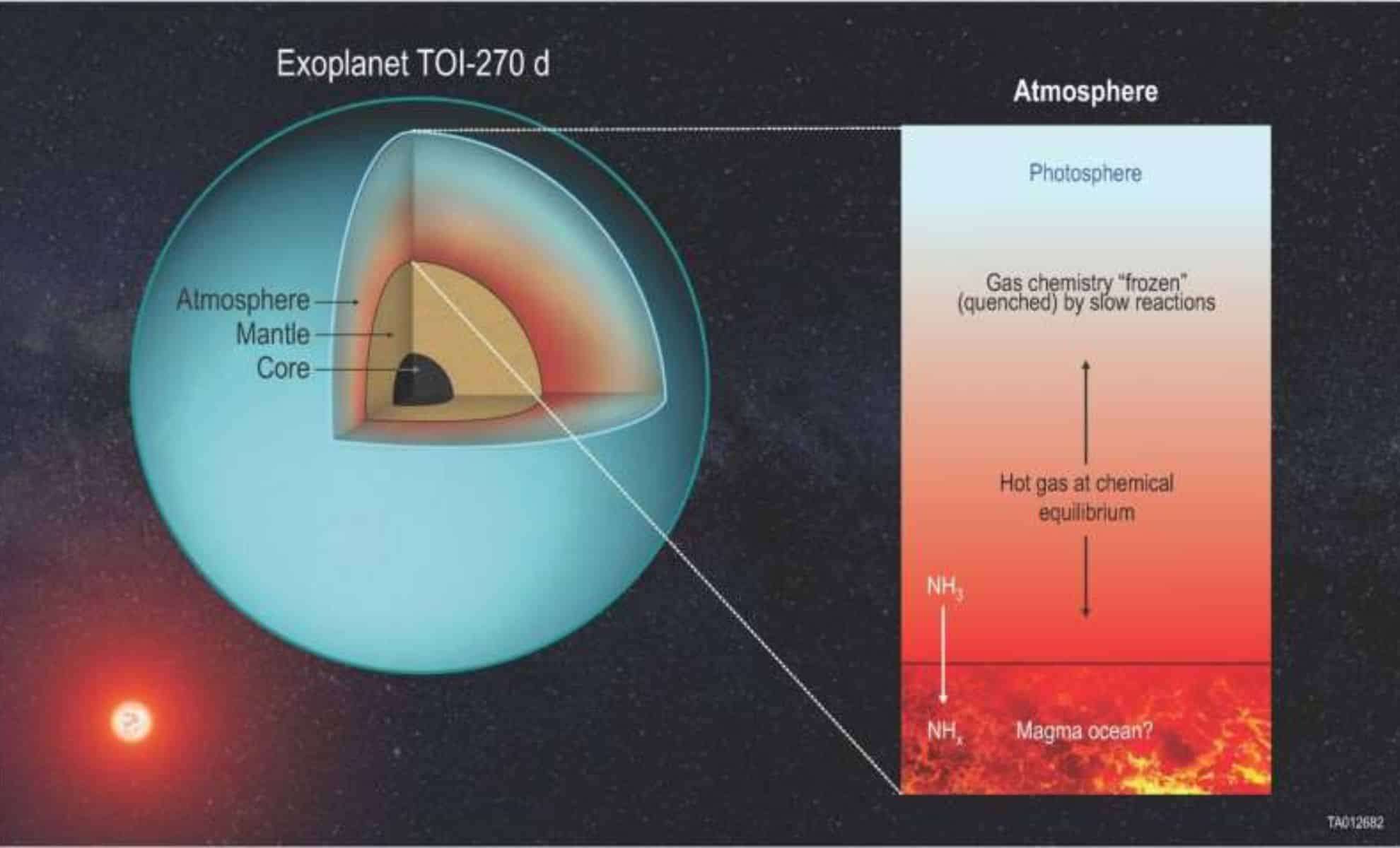
A recent investigation conducted by the Southwest Research Institute (SwRI) has unraveled the enigmatic atmosphere surrounding TOI-270 d, an exoplanet situated approximately 73 light-years away. Analysis using data from NASA’s James Webb Space Telescope (JWST) reveals this super-Earth is enveloped in a dense and intensely hot atmosphere. Scientists now consider TOI-270 d a vital archetype for studying a broad group of unusual planets, leading to its nickname the “Rosetta Stone” exoplanet. The detailed research appears in a paper accepted by The Astrophysical Journal and is accessible via arXiv.
Exploring the Enigma of TOI-270 d
Classified as a sub-Neptune, TOI-270 d exceeds Earth's size but is smaller than Neptune. These planets are common throughout the cosmos but absent from our solar system, heightening their scientific intrigue. Earlier theories suggested TOI-270 d might be a Hycean planet—meaning a water world with a hydrogen-rich envelope—but the latest observations from JWST tell a different story.
Current evidence points to TOI-270 d as a rocky planet with a molten surface beneath an atmosphere where temperatures soar beyond 1,000°F, surpassing even those measured on Venus. According to lead author Dr. Christopher Glein, such extreme conditions offer a rare window into planetary development under alien circumstances. He remarked, “The level of atmospheric detail we’ve obtained from such a small exoplanet is astonishing and opens new avenues for understanding its unique story.” The detection of molecules like carbon dioxide, methane, and water allows researchers to apply geochemical analyses to uncover how such peculiar planets form and transform.

The Puzzle of Absent Ammonia Clarified
An unexpected finding was the lack of ammonia, a chemical expected in hydrogen-rich atmospheres. The team’s interpretation suggests that the and interactions with a magma ocean likely break down or trap ammonia before it can accumulate in detectable quantities. Instead, the atmosphere may be largely composed of nitrogen gas produced through high-temperature chemical reactions.
Glein highlighted the wider impact of these conclusions: “Though TOI-270 d probably isn’t hospitable, it presents an outstanding case for studying alternative planetary formation and evolution pathways,” he explained. “We’re uncovering the astonishing variety of planetary systems that exist in the universe.”
This innovative framework combines geochemical processes with atmospheric modeling to clarify not only atmospheric composition but its origin. The absence of nitrogen-rich materials may also be linked to TOI-270 d’s early formation from building blocks, like many chondritic meteorites, that contain little nitrogen.
Changing Paradigms in Exoplanet Research
These discoveries showcase that JWST’s observational power extends well beyond planet detection, enabling profound chemical analysis of extraterrestrial atmospheres and insights once limited to solar system bodies. “The data collected on TOI-270 d by Bjorn Benneke’s team is groundbreaking,” Glein stated, emphasizing the exceptional clarity obtained for such a small planet.
The findings also challenge prior theories proposing sub-Neptunes as potential early habitability candidates. Instead, TOI-270 d’s extreme heat and complex chemistry identify it as a hostile environment, yet one rich in scientific potential. Glein drew parallels to evolutionary biology in emphasizing planetary diversity: “A foundational set of ingredients and interactions can yield a vast diversity of planetary forms.”
Insights Into Planet Formation and Evolution from TOI-270 d
With over 5,800 known exoplanets catalogued, TOI-270 d provides a crucial example of how rocky worlds evolve under intense conditions. Future missions such as the LUVOIR and Habitable Worlds Observatory aim to extend these geochemical tools to many more distant planets.
“This is merely one fascinating planet,” Glein remarked. “It will be thrilling to discover what secrets upcoming exoplanet studies will reveal.”
- Categories:
- News












0 comments
Sign in to Comment