
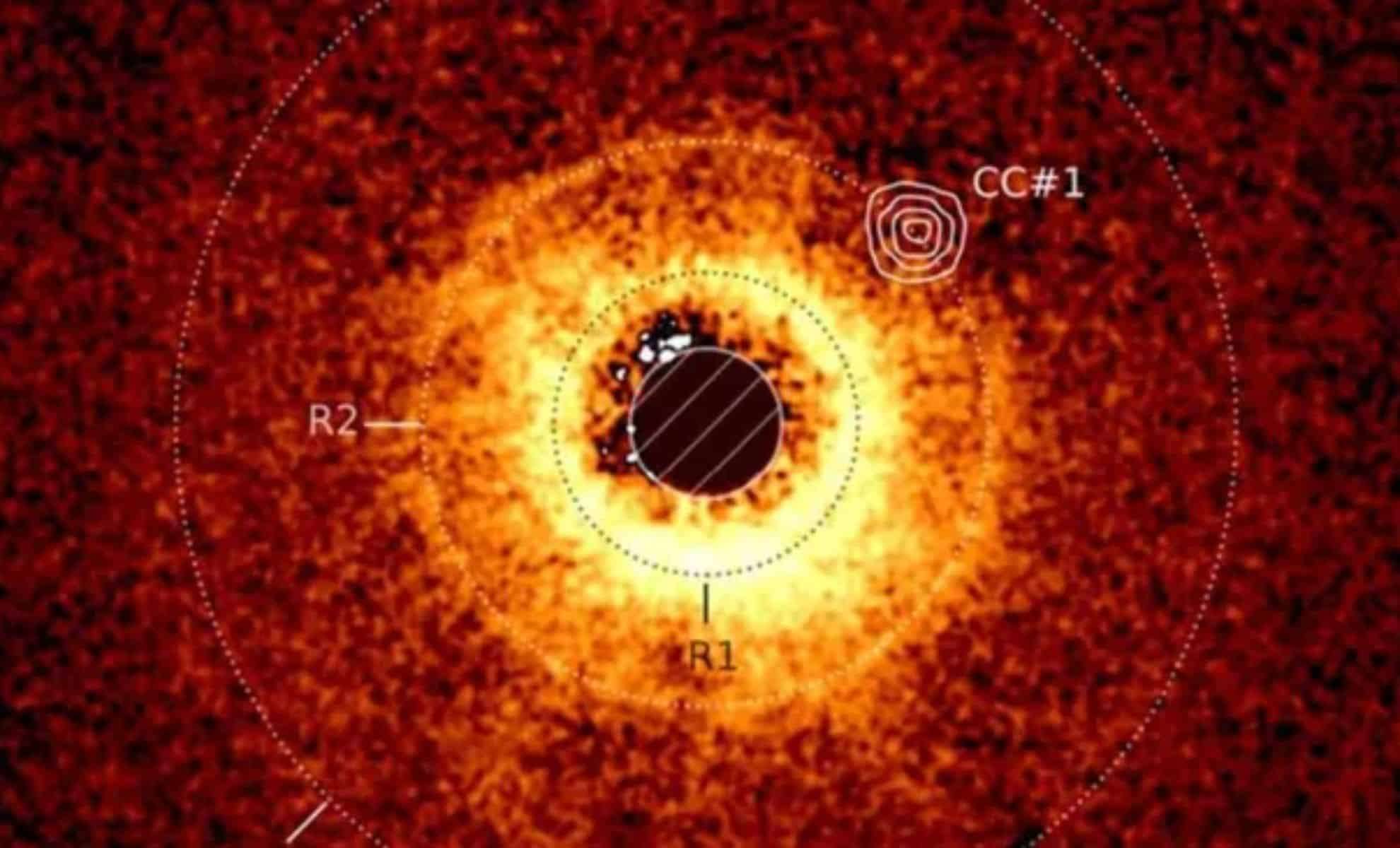
The James Webb Space Telescope (JWST) has achieved a groundbreaking milestone by revealing its inaugural exoplanet, designated TWA 7b. Beyond simply adding to the roster of known exoplanets, this marks a pioneering step in directly imaging distant worlds. Situated approximately 111 light-years from Earth, TWA 7b stands out as the lightest exoplanet ever directly observed. Highlighted in a Nature journal article (2025), this feat illustrates JWST’s exceptional sensitivity to faint infrared emissions, surpassing the capabilities of earlier space telescopes. The article below explores this landmark discovery and its implications for future astronomical research.
Introducing TWA 7b: JWST’s First Directly Imaged Exoplanet
TWA 7b was detected within the dusty debris ring of CE Antilae, a young star still in the process of planet formation. With an age of just a few million years—tiny compared to the Sun’s 4.6-billion-year life span—this stellar system offers a rare window into the early moments of planetary evolution. This makes TWA 7b an exceptional subject for examining how planets develop.
Distinguished by its relatively low mass—roughly 100 times Earth’s mass or about a third that of Jupiter—TWA 7b is nearly ten times lighter than any previously directly imaged exoplanet. This discovery showcases JWST’s unique ability to detect extremely subtle planetary signals, representing a major stride forward in exoplanet research.

Unlike many exoplanets found indirectly through gravitational effects, TWA 7b was captured through direct imaging. JWST’s Mid-Infrared Instrument (MIRI) played a pivotal role in detecting the planet’s infrared emission, pinpointing its position within the star’s ring system. Thanks to JWST’s specialized design for infrared detection, it excels at observing cooler, younger planets like TWA 7b.
CE Antilae’s Special Perspective on Planet Growth
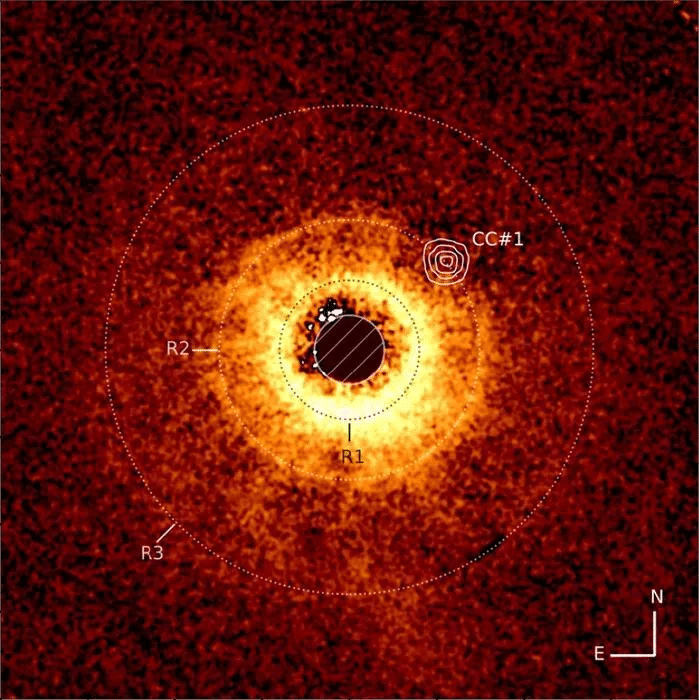
The CE Antilae system offers astronomers a remarkable viewpoint—its orientation from Earth is nearly “pole-on,” giving a direct look at its surrounding protoplanetary disk, which is a disk of gas and dust where future planets take shape. This vantage, similar to looking at the top of a spinning plate, reveals the disk’s structure in full detail.
The protoplanetary disk is segmented into three distinct rings, one of which is notably narrow. It was within this thin ring that astronomers detected TWA 7b. The JWST picked up a faint infrared glow emanating from this narrow region, indicating the presence of a nascent planet. Subsequent modeling linked this narrow ring and the adjacent gap in the debris disk precisely to TWA 7b’s location. This strongly supports the idea that the planet is shaping the disk’s features.
This kind of direct imaging of a planet-forming disk is extremely valuable, as it sheds light on the earliest phases of planetary birth. Gravity from planets and smaller bodies in the disk causes gaps and structures, and TWA 7b’s discovery adds a vital clue to understanding these complex processes.
The Technology Behind JWST’s Success
Observing faint planets near their much brighter host stars is a major obstacle in astronomy. Often, a star’s brilliant light masks the dim glow of orbiting planets. However, the JWST utilizes a coronagraph, a device that blocks out the star’s light, enabling the detection of nearby, less luminous planets.
Employing both the coronagraph and the MIRI instrument, JWST successfully detected the infrared emissions from TWA 7b despite the overwhelming light of its parent star. This sophisticated technique allows astronomers to study planets that are either too faint or too close to their stars for standard telescopes. Directly imaging young exoplanets like TWA 7b opens up novel opportunities to analyze planetary development in real-time.
The JWST is the culmination of decades of technological innovation, and its recent achievements demonstrate the precision engineering behind the mission. Its infrared sensitivity makes it particularly suited for spotting young, low-mass exoplanets that were previously beyond reach.
- Categories:
- News







0 comments
Sign in to Comment