
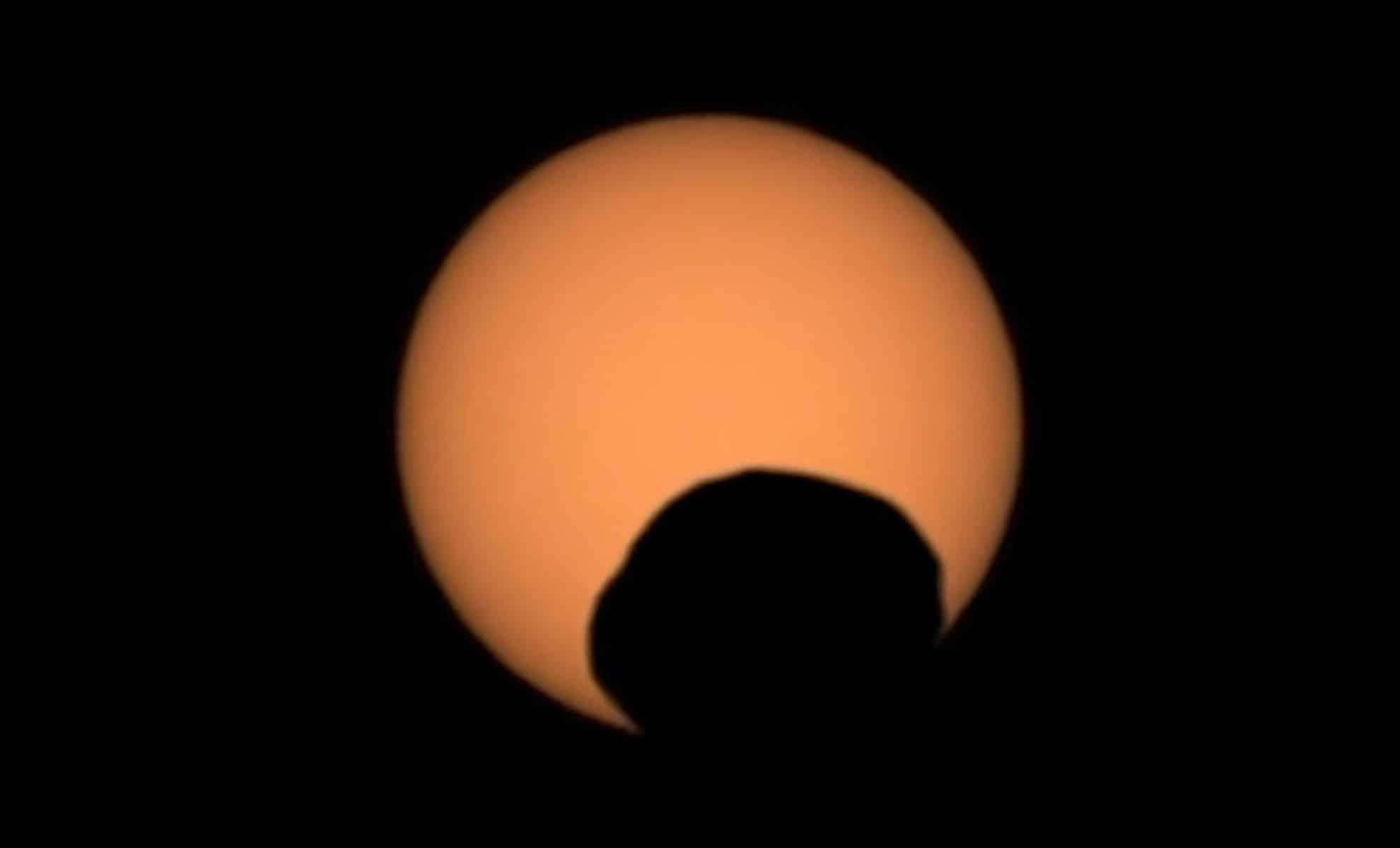
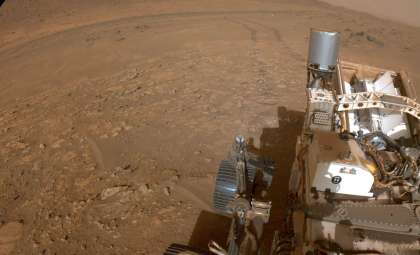
The Perseverance rover on Mars has captured a remarkable event: a solar eclipse created by the Martian moon Phobos passing in front of the Sun.
This captivating moment took place on September 30, 2024, and was documented by the rover’s Mastcam-Z imaging system. Such transits are relatively rare and provide key scientific insights, enhancing knowledge about Phobos’ orbit and its gradual inward spiral towards Mars.
Phobos: Mars’ Irregularly Shaped Inner Moon
The eclipse lasted roughly 30 seconds as Phobos, Mars’ larger and closest moon, swiftly crossed the solar disk. Orbiting only about 6,000 kilometers (3,700 miles) above the Martian surface, Phobos completes three orbits per Martian day, moving from west to east. Its uneven shape, peppered with craters, cast a distinctive shadow, producing a striking "googly eye" appearance when observed from the Jezero Crater.

First identified by astronomer Asaph Hall in 1877 and named after the Greek deity representing fear, Phobos provides valuable clues about Mars’ gravitational forces. By tracking these eclipses over time, scientists can detect subtle changes in Phobos’ orbit. Reports highlight that “Phobos is gradually moving closer to Mars and is expected to impact the planet in approximately 50 million years,” evidencing its slow orbital decay.
The Importance of Monitoring Phobos’ Solar Passages
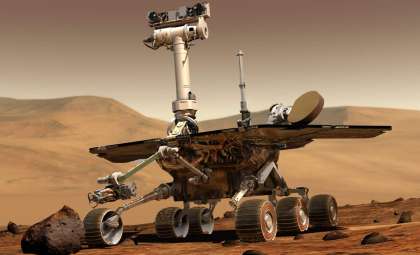
Watching Phobos transit the Sun delivers crucial data to unravel the behavior of Mars’ moons. Both the Perseverance and Curiosity rovers have recorded similar events, with earlier observations made by the Opportunity rover in 2004. Comparing these images helps researchers refine models predicting Phobos’ orbital evolution and Mars’ gravitational effects. NASA experts state, “By analyzing the series of images, we improve our understanding of how the moon’s orbit shifts over time.”
These eclipses also contribute to broader Martian studies. Insights into Phobos’ orbital decay can shed light on the planet’s geological history and atmospheric conditions, informing mission planning. This eclipse event aligns closely with Perseverance’s objectives, including investigating Mars’ geological past, searching for biosignatures, and collecting samples to eventually send back to Earth.
Continuing Discoveries and Future Aims of Perseverance
Since touching down on Mars in February 2021, Perseverance has contributed enormously to our understanding of the Red Planet, with Phobos eclipse observations highlighting one fascinating element of its research. Situated within the Jezero Crater, an ancient lakebed, the rover is collecting crucial data about Mars’ surface to support future human missions. These efforts form part of NASA’s broader Moon to Mars exploration program, which also connects to upcoming Artemis missions.
Operators at Arizona State University, along with Caltech and international collaborators, continue to manage Perseverance’s sophisticated instruments and analyze its findings. This eclipse footage underscores the dynamic relationships between planetary bodies and showcases the power of robotic explorers in expanding our solar system knowledge.
- Categories:
- Astronomy ,
- News ,
- Nasa








0 comments
Sign in to Comment