

At the Massachusetts Institute of Technology, scientists have engineered a soft artificial muscle that replicates the form and function of the human iris. This biologically integrated system uses light as an energy source and consists of live cells embedded within a 3D-printed scaffold, marking a major advancement in robotic mobility aimed at imitating the nuanced agility of human movement.
An Iris-Inspired Design Activated by Light
Contemporary humanoid robots lack the supple, reflexive motions often imagined in sci-fi media. Iconic figures like Data from Star Trek, replicants from Blade Runner, or hosts in Westworld demonstrate a fluidity that remains elusive in current robotic systems.
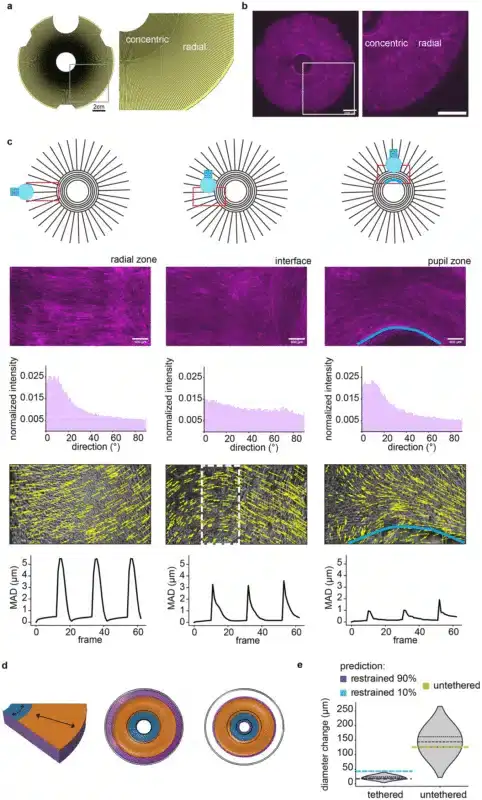
To bridge this divide, MIT researchers have introduced a synthetic muscle that emulates human iris behavior. Approximately two centimeters wide, this biological actuator can contract and expand both radially and concentrically, closely mimicking the aperture adjustment of a natural iris.

Remarkably, this system operates without motors or wiring, relying solely on light stimulation. By harnessing optogenetics, a method that genetically modifies cells to contract or relax in response to light, the team created a lightweight, flexible muscle capable of dynamic movement without mechanical parts.
Combining 3D Printing with Living Cells
The muscle rests on a 3D-printed circular framework with microscopic grooves that guide the orientation of genetically engineered muscle cells from human and mouse sources.
Suspended in a hydrogel medium, these cells were deposited into the scaffold where they aligned along the grooves and developed into muscle fiber structures within 24 hours.
Exposure to targeted light pulses triggered contraction in the muscle fibers, replicating the multi-directional movements of a real iris as it adapts to light intensity. The muscle contracts both radially and circularly, demonstrating intricate biological mimicry.
Reusable Matrices and Prospects for Scaling
This technique shines for its reusability: the 3D-printed scaffolds are not single-use. Once the muscle cells complete a growth cycle and the system’s performance is analyzed, the framework can be cleaned and seeded with fresh cells to repeat the process.
The researchers describe this cyclical method as “stamping,” allowing repeated fabrication of living muscles on the same scaffolds.
They foresee this approach becoming accessible on commercial 3D printers, making it feasible not only for research institutions but also for innovators and startups to explore biological actuators in robotics and related fields.
Beyond the Scale of an Iris
While the current muscle measures approximately the size of a human iris, the implications extend far larger. MIT’s team is investigating alternative cell varieties and structural designs to build more substantial and complex muscular systems.
Their ultimate vision involves creating light-responsive, flexible robotic actuators manufactured from organic materials—capabilities far beyond what is achievable with rigid mechanical devices today.
Potential applications include enhanced robotic movement that more closely mimics living organisms, advanced prosthetics offering improved adaptability and comfort, and novel medical devices and wearables integrating soft, light-controlled components.
The Emergence of Living Soft Robotics
The future of robotics may shift away from emphasis on heavier motors and complex gears toward incorporating living tissue engineered for movement and responsiveness.
This pioneering work from MIT illustrates the potential to culture muscle fibers in laboratories, integrate them into precision-engineered structures, and activate them purely through light without conventional mechanical inputs.
Although still nascent, this innovation signals a transformative shift: replacing stiff, mechanical constructs with biologically inspired, light-triggered muscle systems that bring machines closer to human-like motion.
- Categories:
- Science













0 comments
Sign in to Comment