

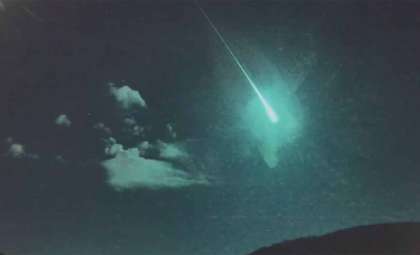
On Sunday evening, residents across Texas witnessed a brilliant streak of light soaring through the night sky, prompting many to capture the phenomenon on their phones and fuel online discussions. Referred to as a fireball for its intense brightness and swift, silent movement, the event spurred reactions ranging from amazement to speculation. While official confirmation is still awaited, preliminary expert assessments covered by The Dallas Morning News point to a Starlink satellite burning up upon reentry.
Fiery Spectacle Raises Curiosity Across Texas
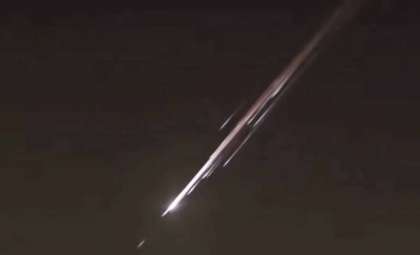
Shortly after 8:30 p.m., under clear skies, observers from the Concho Valley to Northeast Texas spotted a glowing object streaking overhead. Witnesses described its radiant trail shifting through hues of red, orange, and green as fragments occasionally separated from the main body.
The event was strikingly silent, with no accompanying sonic booms. Many likened it to a meteor, while some suggested it seemed manmade. The American Meteorological Society recorded over 40 reports, and groups like Texas Storm Chasers encouraged the public to share their sighting data. The fireball sparked not only daylight curiosity but an online buzz as well.

Debunking Theories: Meteor, Missile, Or Space Debris?
Speculations quickly arose, ranging from natural meteors to missile tests, and even humorous takes linked to recent sports scores. On social media platform X, some users joked about divine intervention linked to a football game outcome, while others entertained extraterrestrial possibilities.
Though NASA has yet to issue a statement and declined immediate comments, one explanation gained considerable attention: orbital debris. Specifically, the Starlink-30373 satellite, launched by SpaceX in September 2023, was anticipated to reenter Earth’s atmosphere during this timeframe.
Some sort of space debris or meteor coming in hot across Texas this evening around 8:30PM. https://t.co/6UY73DorY2
— Texas Storm Chasers ⚡ (@TxStormChasers) September 22, 2025
Tracing Patterns: The Familiar Descent of Starlink Satellites
This isn’t the first instance of such a display in Texas. In November 2024, another Starlink satellite, Starlink-4682, produced a comparable light show visible across Texas, Oklahoma, Kansas, and Colorado. The pattern is consistent: a quiet, luminous descent accompanied by fragmenting debris, confusion, then explanation.
Astronomer Jonathan McDowell, known for tracking orbital debris, has noted that Starlink satellites frequently create this type of reentry spectacle. Although he hasn’t commented specifically on Sunday’s event, the evidence strongly aligns with this scenario.
Starlink satellites come equipped with mechanisms to self-deorbit at the end of their operational life. This controlled reentry ensures they burn up in the atmosphere, reducing the build-up of space debris. Sunday’s fireball may well have been a satellite performing its final atmospheric farewell.
The Increasing Frequency of Visible Satellite Reentries
As the constellation of Starlink satellites expands into the thousands, such atmospheric reentries are becoming more frequent. While many occur unnoticed over oceans or remote regions, some will light up populated skies.
This recent fireball over Texas epitomizes a new era where the human presence in low Earth orbit is unmistakably visible. Scenes once reserved for science fiction — silent, glowing objects descending from space — are now part of our real skywatching experiences, prompting us to ponder what other celestial events await above.
Woah…. This fireball cluster was insane!! South side of San Angelo TX @ 831pm CT 9/21/25. @xai @grok what is happening here? @SanAngeloLIVE @klstnews @elonmusk pic.twitter.com/jvbWRNWONr
— Justin Jenkins (@senor_justin) September 22, 2025
- Categories:
- News










0 comments
Sign in to Comment