
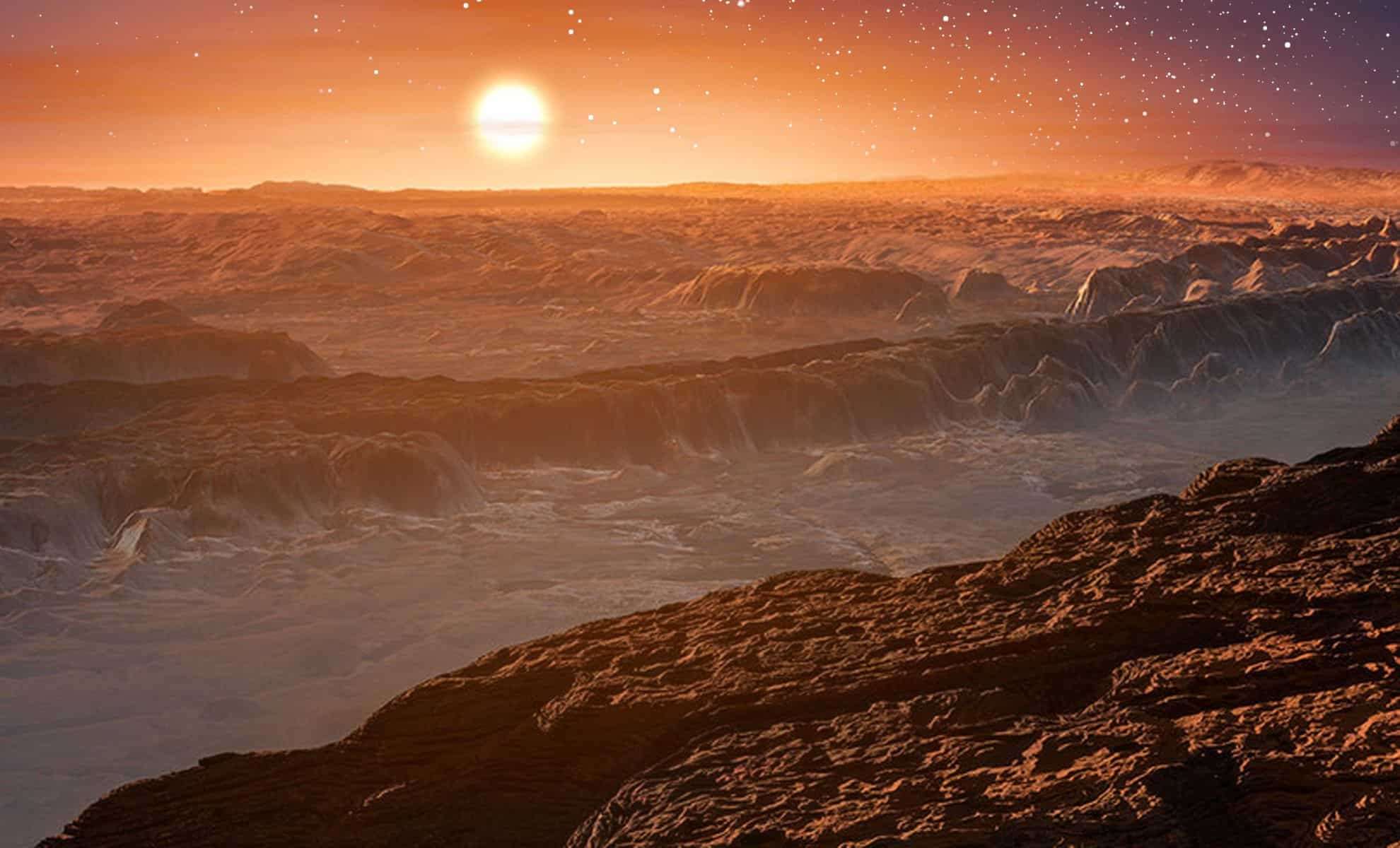
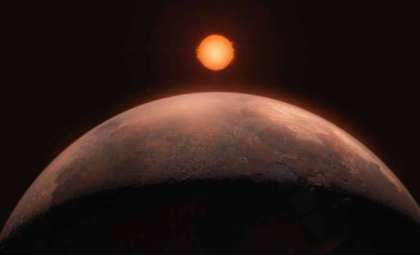
Astronomers might have identified the first rocky exoplanet within a habitable zone exhibiting potential evidence of an atmosphere. Published in The Astrophysical Journal Letters, this discovery emerged from the latest observations by NASA’s James Webb Space Telescope, centering on a small planet orbiting the red dwarf star, TRAPPIST-1e, located just 40 light-years from Earth.
Prior to this, no such exoplanet had offered compelling signs of an atmosphere — TRAPPIST-1e may break new ground.
Indications of an Atmosphere Beyond Hydrogen
Between June and October 2023, JWST conducted four observations of TRAPPIST-1e through a method called transit spectroscopy. This approach measures subtle brightness changes as the planet transits its star, enabling scientists to identify atmospheric components if present.

Initial findings eliminated the possibility of a hydrogen-heavy atmosphere, typical of gas giants but unlikely to support life. This outcome hints at the existence of a secondary atmosphere, potentially consisting of denser molecules like nitrogen, methane, or carbon dioxide.
MIT postdoctoral researcher Ana Glidden, part of the investigative team, explained their objective: “Assuming the planet isn’t airless, can we narrow down various atmospheric scenarios?” The answer so far is yes, but the evidence is still inconclusive.
The Star’s Activity Adds Complexity
The challenge isn't just the faintness of the signals, but also the nature of the host star. TRAPPIST-1 is a small, active red dwarf whose surface variability through flares, star spots, and temperature fluctuations can complicate data and mimic atmospheric signatures.
Researchers utilized a statistical modeling method known as Gaussian processes to differentiate stellar variability from planetary signals. Despite this, isolating the planetary influence required over a year of careful data analysis.
Ultimately, two scenarios remain plausible: either TRAPPIST-1e possesses an atmosphere made up of heavy molecules, or it is a bare, rocky world. Current data resolution is insufficient to conclusively favor one.
Could TRAPPIST-1 e be a watery world or a bare rock?
— NASA 360 (@NASA360) September 9, 2025
With @NASAWebb’s powerful infrared eyes, scientists are narrowing down the possibilities for this Earth-sized exoplanet 40 light-years away. Each new observation brings us closer to answering one big question: are we alone in… pic.twitter.com/dtYyVZJtxI
Insights Into Climate, Not Just Chemistry
Being slightly smaller than Earth, TRAPPIST-1e receives a comparable stellar irradiance that might allow liquid water to persist. As with many close-in planets, it is probably tidally locked, meaning one hemisphere constantly faces its star.
An atmosphere in such a case would be essential for redistributing heat, preventing drastic temperature extremes between the planet’s perpetually lit side and its dark side. Without an atmosphere, one part could freeze while the other is scorched.
Ryan MacDonald, a planetary science lecturer at the University of St. Andrews and lead author of a related study, emphasized: “The most exciting prospect is that TRAPPIST-1e harbors a secondary atmosphere composed of heavy gases like nitrogen.” Yet, the notion that the planet might lack an atmosphere altogether still stands.
A Refined Approach for Upcoming Observations
While the initial quartet of transits hasn’t delivered firm conclusions, astronomers are undertaking an expanded observational campaign. By the close of 2025, JWST is scheduled to observe 15 more transits of TRAPPIST-1e, promising enhanced data quality.
This upcoming phase will compare TRAPPIST-1e's transits with those of TRAPPIST-1b, a neighboring planet confirmed to lack an atmosphere. Using TRAPPIST-1b as a baseline, scientists aim to more clearly isolate any atmospheric signals unique to TRAPPIST-1e.
MacDonald explained the strategy: “Any additional gas absorption detected solely during TRAPPIST-1e’s transits can confidently be attributed to its atmosphere.” This method may resolve current ambiguities and advance our understanding of whether this nearby rocky world can sustain life.
- Categories:
- News




0 comments
Sign in to Comment