
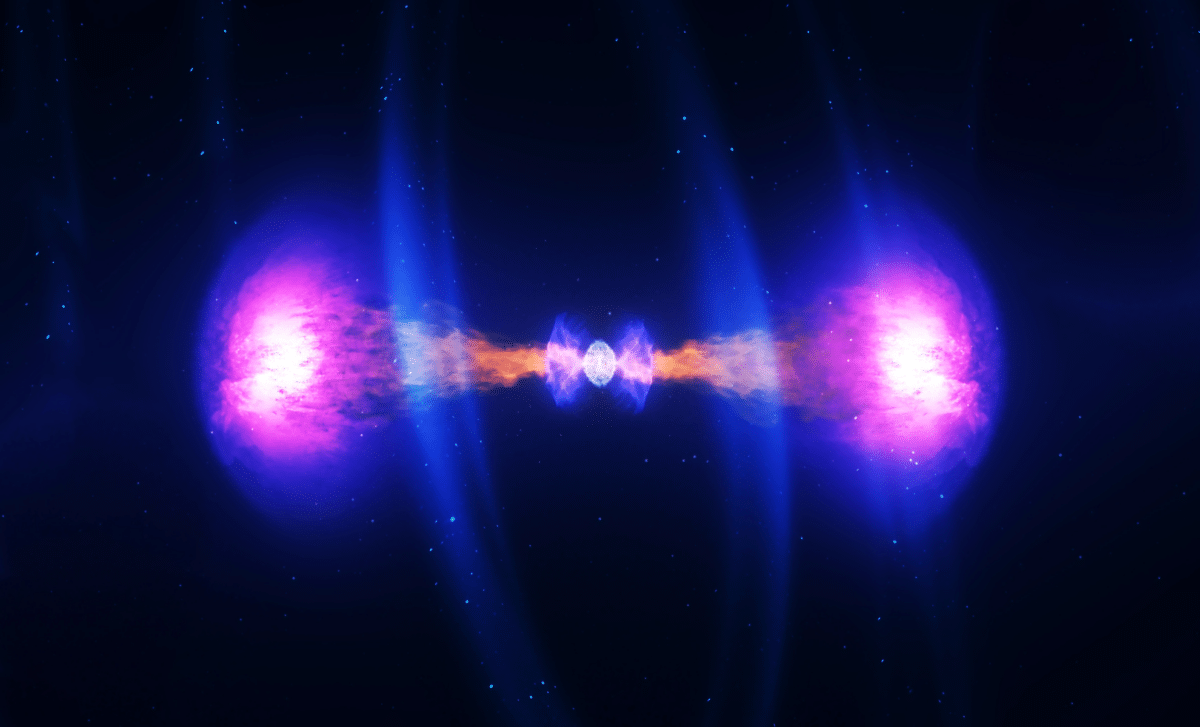
Researchers have achieved a groundbreaking feat by simulating the universe’s conditions just moments after the Big Bang. At the Large Hadron Collider (LHC), a team examined the characteristics of quark-gluon plasma, revealing surprising liquid-like properties rather than a gas, as detailed in a recent Physics Letters B publication. This research illuminates how the universe’s earliest material transitioned into the atoms forming the matter we observe today.
Quark-Gluon Plasma: A Primordial Liquid
Quark-gluon plasma represents a unique phase of matter that existed shortly following the Big Bang. In this state, quarks and gluons—the building blocks of protons and neutrons—roamed freely within an intense, high-temperature environment where ordinary atomic structures could not persist.
“The density and temperature is so high that the regular atom structure is no longer maintained,” says Yi Chen, assistant professor of physics at Vanderbilt University and a member of the CMS team. Instead, “all the nuclei are overlapping together and forming the so-called quark-gluon plasma, where quarks and gluons can move beyond the confines of the nuclei. They behave more like a liquid.”
Add Cosmo Herald as a Preferred Source

This discovery challenges prior assumptions by demonstrating that quark-gluon plasma flows collectively, resembling the movement of a liquid rather than isolated particles behaving like a gas. Such findings are critical to refining our understanding of the universe’s infancy and the behavior of matter under extreme conditions.
Simulating Cosmic Origins Within the Laboratory
Physicists recreated primordial cosmic states by smashing heavy atomic nuclei at velocities approaching the speed of light within the LHC. This process produces fleeting droplets of quark-gluon plasma, which, despite their brief existence, offer profound insights into the universe’s formative moments.
“In our studies, we want to study how different things interact with the small droplet of liquid that is created in the collisions,” Chen explains.
The experiments track how energetic particles, especially high-energy quarks, propagate through this intense medium. Using Z bosons—particles that minimally interact with the plasma—scientists can differentiate the quark’s influence on its surroundings, revealing conditions similar to those just after the Big Bang. Observations showed quarks generating a distinctive “wake,” comparable to ripples created by a boat moving through water.
Unveiling a Delicate Yet Vital Phenomenon
Published in Physics Letters B, the research uncovered a slight reduction in particle counts trailing the quark’s path through the plasma. This subtle "wake" provides evidence that quarks transfer energy to the surrounding quark-gluon medium. Chen comments:
“For now, the observed dip is just the start. The exciting implication of this work is that it opens up a new venue to gain more insight on the property of the plasma. With more data accumulated, we will be able to study this effect more precisely and learn more about the plasma in the near future.”
Although the detected dip is under 1%, it marks the first definitive identification of such a wake in Z-boson-tagged events. This breakthrough enriches our knowledge on quark-plasma interactions and promises deeper discoveries as further data is collected.
- Categories:
- Astronomy







0 comments
Sign in to Comment