

Scientists have produced the most comprehensive low-frequency radio image of the Milky Way to date, showcasing an expansive mosaic of electromagnetic emissions revealing thousands of features throughout the galaxy’s southern sky. Originating from an observatory parked in the remote red soils of Western Australia, this image presents an unprecedentedly detailed panorama of our galaxy.
The project was led by experts at the International Centre for Radio Astronomy Research (ICRAR), who diligently gathered and processed data from the Murchison Widefield Array telescope (MWA). This culminating image surpasses earlier efforts in clarity, scale, and sensitivity, marking a significant technological achievement demanding over a million CPU hours to assemble.
Revealing Intricate Features of the Galactic Midplane
The core ambition of this new image was straightforward yet challenging: enhancing visibility and resolution. Earlier observations of the Southern Galactic Plane at low radio frequencies provided useful but limited views. ICRAR reports that the latest GLEAM-X survey yields double the resolution and tenfold the sensitivity of past maps, alongside covering twice the sky area.

Positioned on Wajarri Yamaji land in Western Australia, the MWA benefits from one of Earth’s quietest radio environments. Over 141 nights spanning 2013 to 2020, astronomers collected extensive data to construct this masterpiece.
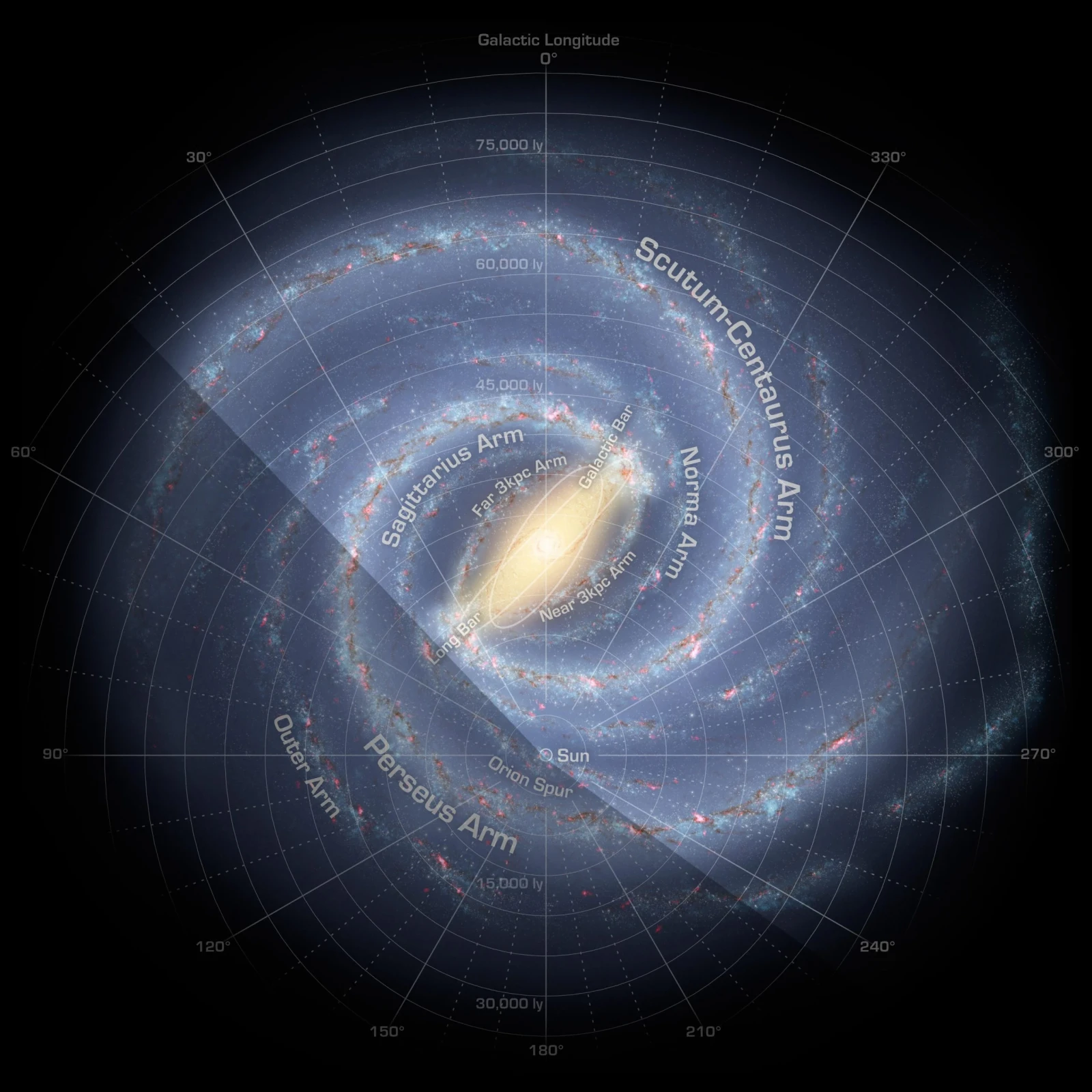
Observations across various low-frequency bands were combined using color coding to form a unified image. These radio waves are invisible to optical telescopes but unveil the properties of cosmic gas and dust in new ways. PhD student Silvia Mantovanini of Curtin University led the challenging assembly of the final composite.
“You can clearly identify remnants of exploded stars, represented by large red circles. The smaller blue regions indicate stellar nurseries where new stars are actively forming,” she told SciTechDaily.
Tracking the Lifecycle of Stars
A highlight of the survey is its ability to chart stellar evolution — not only the birthplaces but the dying embers of stars. Mantovanini concentrates particularly on supernova remnants, which are difficult to distinguish amid the galaxy’s complex background. Hundreds are known, but it’s believed many more remain undiscovered.

With the enhanced sharpness, these stellar explosion leftovers, appearing as expansive clouds of gas threaded with magnetic fields, become easier to detect. These features serve as cosmic relics, offering clues to past cataclysmic events and helping astronomers identify previously overlooked remnants.
The survey also sheds light on pulsars—rapidly spinning neutron stars emitting radio waves. According to the ICRAR team, analyzing pulsar brightness across multiple low-frequency bands could enhance understanding of their physics and galactic distribution.
Foundations for Future Radio Astronomy
This newly released map represents a landmark moment for low-frequency radio surveys. It’s the first to chart the entire southern stretch of the Milky Way’s Galactic Plane at these wavelengths. As Associate Professor Natasha Hurley-Walker, head of the GLEAM-X initiative, highlights:
“No low-frequency radio image of the entire Southern Galactic Plane has been published before, making this an exciting milestone in astronomy.”
While the MWA remains a key tool today, it will eventually be supplanted by the forthcoming SKA-Low telescope array under development at the same site. When operational, the SKA Observatory will deliver even more detailed and sensitive views of the cosmos, though this advancement is several years away.
Ultimately, the GLEAM-X team’s achievement lays a critical foundation for future work. Their detailed map catalogs over 98,000 radio sources—from dense HII regions and pulsars to distant extragalactic objects—creating a luminous atlas of our cosmic surroundings poised to guide coming generations of astronomers.
- Categories:
- Space








0 comments
Sign in to Comment