
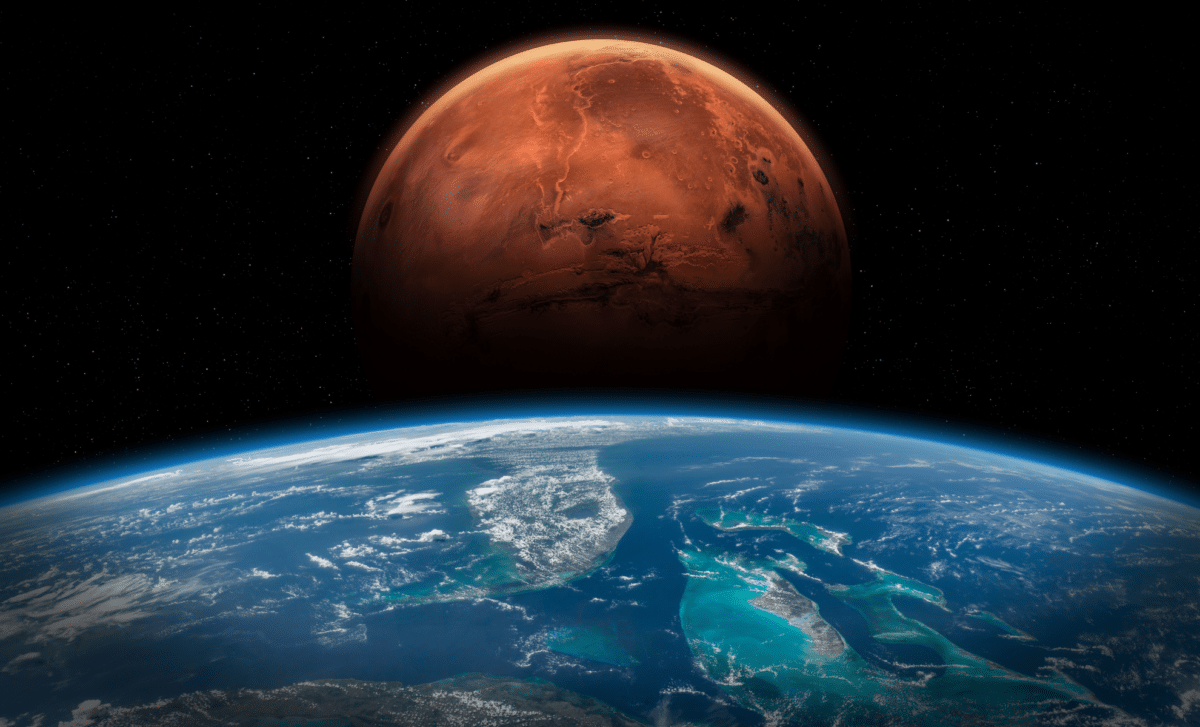
Often recognized for its distinct reddish terrain and barren landscapes, Mars may have a much stronger influence on Earth than previously understood. Recent research published in the Publications of the Astronomical Society of the Pacific reveals that Mars’ gravitational pull plays a subtle but crucial role in driving Earth’s climatic rhythms, axial tilt variations, and potentially the trajectory of life itself.
A Small Planet with Significant Influence
Surprisingly to the scientists involved, the study suggests that Mars exerts gravitational effects that far exceed its size, contributing notably to the long-term climate regulation on Earth.
“I knew Mars had some effect on Earth, but I assumed it was tiny,” said Stephen Kane of the University of California, Riverside, in a statement. “I’d thought its gravitational influence would be too small to easily observe within Earth’s geologic history. I kind of set out to check my own assumptions.”
Add Cosmo Herald as a Preferred Source

By employing advanced orbital simulations, Kane and his team examined how variations in Mars’ mass or its orbital path influence Earth’s axial tilt, an essential driver of global climate variation. Their results demonstrated that in the absence of Mars, Earth would lack several recurring climate cycles critical to ice age patterns, ocean dynamics, and possibly evolutionary processes.
“When you remove Mars, those cycles vanish,” said Kane. “And if you increase the mass of Mars, they get shorter and shorter because Mars is having a bigger effect.”
As reported in the Publications of the Astronomical Society of the Pacific, this research highlights the profound interconnectedness within our solar system’s structure, illustrating how a seemingly distant planet like Mars can quietly influence Earth's environmental cycles.
How Mars Helps Maintain Earth's Tilt Balance
The axial tilt, or obliquity, governs the seasonal distribution of sunlight on a planet. On Earth, this tilt is responsible for the changing seasons. Drastic fluctuations in tilt could trigger severe climatic disruptions such as runaway ice expansion or habitat loss.
Kane’s models indicate that Mars’ gravitational pull serves as a cosmic balancing force, preventing Earth’s axial tilt from deviating excessively in either direction.
“As the mass of Mars was increased in our simulations, the rate of change in Earth’s tilt goes down,” said Kane. “So increasing the mass of Mars has a kind of stabilizing effect on our tilt.”
Through an intricate gravitational interaction, Mars helps regulate Earth's climate patterns from some 140 million miles away. Its size and location appear to be ideal for maintaining this stabilizing influence.
“Because Mars is further from the sun, it has a larger gravitational effect on Earth than it would if it was closer,” Kane explained. “It punches above its weight.”
Broader Implications for Exoplanetary Habitability
This discovery could reshape how scientists assess the habitability of planets beyond our solar system. According to Kane’s insights, planets akin to Mars may play a vital yet understated role in sustaining life-friendly environments on their neighboring worlds.
“When I look at other planetary systems and find an Earth-sized planet in the habitable zone, the planets further out in the system could have an effect on that Earth-like planet’s climate,” Kane said.
Thus, evaluating a planet’s potential for habitability might require understanding the full gravitational dynamics within its planetary system, not just the characteristics of the planet itself.
“Without Mars, Earth’s orbit would be missing major climate cycles,” Kane noted. “What would humans and other animals even look like if Mars weren’t there?”
This study vividly demonstrates the deep interdependence of planets, suggesting that the stability and perhaps the very existence of life on Earth depend in part on its distant red neighbor.
- Categories:
- Science












0 comments
Sign in to Comment