

Europa, one of Jupiter’s most captivating moons, has been a key focus for scientists searching for extraterrestrial life. It harbors a vast subsurface ocean beneath its thick ice crust, which many researchers believed could support microbial organisms. However, a recent paper in Nature Communications presents a different perspective. Led by Paul Byrne from Washington University, the team reveals that Europa’s ocean might be surprisingly inactive, lacking the geological energy critical to sustain life.
Europa’s Ocean Floor: The Missing Piece in the Puzzle
This study, featured in Nature Communications, highlights that the potential for life on Europa depends significantly on the dynamic processes at its ocean floor, not just the presence of the water itself. Previously, research mostly focused on Europa’s ocean volume and composition, neglecting the seafloor’s characteristics. Byrne points out this critical oversight in life-detection efforts.
“I’m really interested to know what that seafloor looks like,” he said. “For all of the talk about the ocean itself, there has been little discussion about the seafloor.”
Add Cosmo Herald as a Preferred Source

The energy required to sustain life typically comes from geological activity such as hydrothermal vents and chemical reactions, which depend heavily on an active ocean floor. Without such processes, Europa’s underwater environment might be inhospitable.
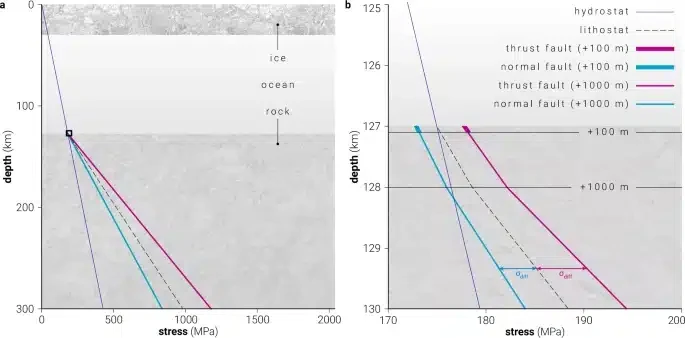
Byrne’s analysis indicates that the seafloor beneath Europa’s thick ice shell is largely geologically dormant. Unlike Earth’s oceanic crust, characterized by volcanism and tectonic shifts, Europa’s seafloor shows little evidence for such activity. This geological calmness could hinder the chemical and thermal energy flows that are essential for sustaining life.
“If we could explore that ocean with a remote-control submarine, we predict we wouldn’t see any new fractures, active volcanoes, or plumes of hot water on the seafloor,” Byrne stated. “Geologically, there’s not a lot happening down there. Everything would be quiet.”
This suggests a scarcity of environmental factors commonly associated with habitable zones, such as heat supply and mineral exchanges.
The Impact of Tidal Forces and Europa’s Structure
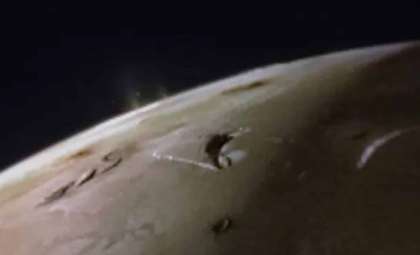
Europa’s ocean lies beneath an ice shell estimated to be 15 to 25 kilometers thick. Although massive in size, this ocean might have limited interaction with the moon’s rocky interior. Earlier assumptions credited Europa’s tidal heating—generated by Jupiter’s gravitational pull—with producing sufficient energy for geological activity. Nevertheless, Byrne’s findings challenge this notion. Europa’s nearly circular orbit subjects it to weaker tidal influences compared to moons like Io, which experiences intense volcanic activity due to its eccentric orbit. Calculations show that Europa’s tidal heating today likely fails to fuel the geological processes necessary for life, such as the formation of hydrothermal vents and tectonic disruptions.
Even if tidal heating was stronger in Europa’s ancient past, the study posits that any residual heat would have faded over billions of years. For the present, this inactivity leads to the grim conclusion that Europa’s ocean may be devoid of life. Byrne summarizes, “The energy just doesn’t seem to be there to support life, at least today.” This shadows the earlier optimism about Europa as a prime candidate for alien life.
Future Missions and the Quest for Clarity
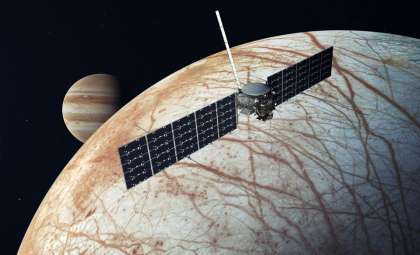
Despite these sobering insights, Byrne and his team remain hopeful. NASA’s upcoming Europa Clipper mission, scheduled for launch in 2031, aims to investigate the moon’s ice thickness and gather high-resolution data about its ocean. These measurements could shed new light on Europa’s habitability potential and provide crucial answers. Byrne states, “Those measurements should answer a lot of questions and give us more certainty.” Regardless of whether life is discovered, these findings will enrich our understanding of icy moons and the conditions for life elsewhere.
As Byrne reflects, exploring Europa is about expanding humanity’s knowledge frontier, not just the search for life itself. “I’m not upset if we don’t find life on this particular moon,” he adds. “I’m confident that there is life out there somewhere, even if it’s 100 light-years away. That’s why we explore—to see what’s out there.”
- Categories:
- Astronomy









0 comments
Sign in to Comment